 NL·0071
Herbarium of the Nature Library
- Name
- Castanea sativa
- Family
- Fagaceae
- Native to
- South-eastern Europe and Asia Minor; spread by the Greeks and Romans across Mediterranean and western Europe
- Habitat
- Temperate deciduous forest, Mountain coppice woodland, Orchards
Sweet chestnut
Castanea sativa
Also calledKestane (Turkish) · Shāh-balūṭ (Persian) · Castaña (Spanish) · Châtaigne / Marron (French) · Kastanéa (Greek) · Kasztan jadalny (Polish) · Kastanya (Tagalog, from Spanish)
A huge, long-lived tree of southern Europe and Asia Minor whose starchy nuts were the 'bread tree' staple of mountain villages from Corsica to Galicia. Individual trees live for over 2,000 years, their trunks twisting into spirals.
The sweet chestnut, also known as the Spanish chestnut or European chestnut, is a species of tree in the flowering plant family Fagaceae. Wikipedia
What it can do
- iThe 'Hundred Horse Chestnut' on Mount Etna is estimated at 2,000–4,000 years old
- iiResprouts vigorously when coppiced, providing durable poles for centuries
- iiiSpiny burrs protect the nuts from most animals
- ivTimber is rich in tannins, making it naturally rot-resistant
At the table
Eatennuts (roasted, boiled, dried and milled into flour, candied as marrons glacés)
Nuts are eaten cooked; the bitter inner skin (pellicle) is removed. Do not confuse with horse chestnut (Aesculus hippocastanum), whose shiny conkers are toxic — sweet chestnut burrs are densely needle-spined and contain 2–3 flat-sided nuts with a tufted tip.
In the medicine cabinet
| Tradition | Use |
|---|---|
| European folk medicine | Leaf infusion for whooping cough and other coughs |
| Bach flower remedies | Sweet chestnut flower essence for despair (no pharmacological evidence) |
Weight of evidence
Traditional. Long historical use; little or no modern clinical evidence.
Active compounds
starch, tannins (castalagin, vescalagin), vitamin C, ellagic acid
Fruit & seed


Fruit
Nut, in a spiny cupule (burr)
Ripens: Autumn (October–November)
A green, densely spiny burr 5–10 cm that splits into four, holding usually three glossy brown nuts.
Seed
2–4 cm
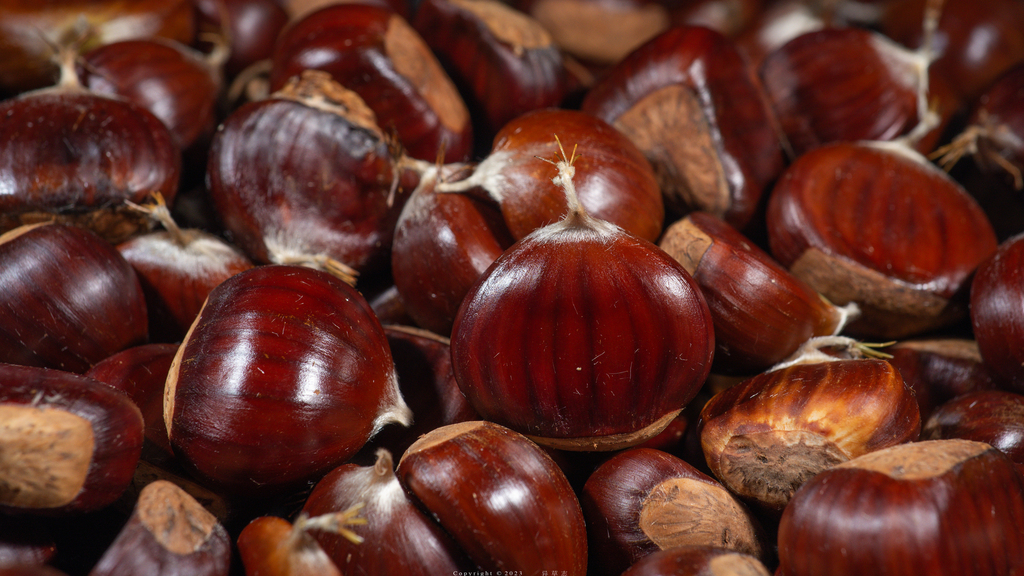
Glossy, reddish-brown nuts 2–4 cm, rounded on one side and flat on the other, with a pale scar at the base and a tuft of hairs at the pointed tip; creamy-white starchy kernel under a bitter brown skin
- Dispersal
- Jays, squirrels, wild boar and mice cache the nuts
- Germination
- Sow fresh nuts in autumn, or stratify cold and moist for 60–90 days; plant 3–5 cm deep. Never let them dry out
Photographs from Wikimedia Commons under open licences; hover for the photographer, click for the file.
How to grow it
Hardiness (USDA zones)
USDA 5–9. Survives winters down to about -29 °C.
- Light
- Full sun
- Water
- Moderate
- Soil
- Acidic, light, well-drained sandy loam (pH 4.5–6.5); does poorly on chalk or heavy clay
- Propagation
- Seed; grafting of named cultivars and hybrids (e.g. 'Marron de Lyon', 'Bouche de Bétizac')
- To harvest
- 3–5 years from a grafted tree; 8–12 from seed
- Climates
- Temperate, Oceanic, Cool Mediterranean
- 1Plant two or more varieties for cross-pollination, as most chestnuts are self-sterile, on acidic, free-draining ground.
- 2Water young trees well in their first two summers and guard them against deer and rabbits.
- 3Prune to a strong central leader in early years; older trees need little pruning (or coppice on a 12–20 year cycle for poles).
- 4Watch for chestnut blight and gall wasp in affected regions, and buy resistant stock.
- 5Gather nuts from the ground daily as burrs drop; score each nut before roasting so it doesn't explode, or dry and mill for flour.
Can it grow where you are?
Where it lives
Recorded sightings
—
geo-referenced records in GBIF, from museums, herbaria and field observers.
Native range
South-eastern Europe and Asia Minor; spread by the Greeks and Romans across Mediterranean and western Europe
Drag the globe to turn it. Dots are where records exist, not a range map; darker means more records.
In the old herbals & bestiaries
Woodcuts and engravings matched from the Source Library’s scanned books by name. Plates marked “relative” show a close kin rather than this exact species. Click a plate to read the page it came from, with translation.

Six Groups of the History of Plants
Rembert Dodoens · 1583 · p.823

Commentaries on the Six Books of Dioscorides
Pietro Andrea Mattioli · 1560 · p.241

Rariorum Plantarum Historia (with Fungorum Historia)
Carolus Clusius · 1601 · p.26

Ortus sanitatis
1491 · p.101

Notable Commentaries on the History of Plants
Leonhart Fuchs · 1542 · p.411

Book of Herbs
Hieronymus Bock (Tragus) · 1546 · p.868

Notable Commentaries on the History of Plants
Leonhart Fuchs · 1549 · p.409

On Medical Materials in Six Books
Dioscorides · 1550 · p.150

On the Names of Plants
Hieronymus Bock (Tragus) · 1552 · p.1172

History of Rare Plants of Pannonia
Carolus Clusius · 1576 · p.14
In the stacks
Searching the stacks…
Every page naming Castanea sativa in the Biodiversity Heritage Library →
Marginalia
Xenophon described Greek soldiers eating chestnuts in Asia Minor around 400 BCE, and in Corsica and the Cévennes chestnut flour ('farina di castagne') sustained villages so fully that the tree was called 'l'arbre à pain', the bread tree.
Curiosity
The 'Hundred Horse Chestnut' on Mount Etna got its name from a legend that it sheltered a queen and her hundred knights from a storm.
Kinship


Photographs: iNaturalist contributors under the licences shown. Records: GBIF.org. Historical plates: Source Library (CC BY-SA 4.0; originals public domain). Summary text: Nature Library editors and Wikipedia (CC BY-SA). Medicinal and edibility notes are historical and educational, not advice. iNaturalist taxon 121763.