 NL·0273
Herbarium of the Nature Library
- Name
- Ardea cinerea
- Family
- Ardeidae
- Native to
- Europe, North Africa, the Middle East, Central, South and East Asia, and sub-Saharan Africa and Madagascar
- Habitat
- Wetland, Rivers, Lakes, Estuaries
On eBird ↗
Gray Heron
Live sightings near you, the range map, bar charts of when it is seen, and Macaulay Library photos and recordings.
Grey heron
Ardea cinerea
Also calledBalshoun (Arabic) · Gri balıkçıl (Turkish) · Graureiher (German) · Héron cendré (French) · Garza real (Spanish) · Blauwe reiger (Dutch)
A tall, grey, dagger-billed hunter that stands motionless at the water's edge for long periods before striking. It nests in noisy treetop colonies called heronries, some occupied for centuries.
The grey heron is a long-legged wading bird of the heron family, Ardeidae, native throughout Europe, Asia, and most of Africa. It is resident in much of its range, but some populations from the more northern parts migrate southwards in autumn. A bird of wetland areas, it can be seen around lakes, rivers, ponds, marshes and on the sea coast. It feeds mostly on aquatic creatures which it catches after standing stationary beside or in the water, or stalking its prey through the shallows. Wikipedia
What it can do
- iSpecialised neck vertebrae let it shoot its bill forward in a lightning strike
- iiSwallows prey as large as eels, rats and ducklings whole
- iiiHunts by day and night, standing still for long periods
- ivGrows powder-down feathers that crumble into a dust used to clean slime from its plumage
In the field
Field marks
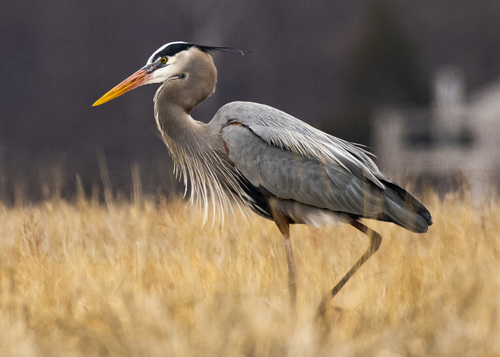
- aGrey back, whitish neck and underparts with black streaks down the front
- bWhite head with a black stripe ending in a wispy plume
- cDagger-like yellow bill; bright orange in breeding adults
- dFlies with neck pulled in, on slow, bowed wings with black flight feathers
- Voice
- A loud, harsh 'fraank' in flight; heronries are full of clattering, croaking and bill-snapping.
- Not to be confused with
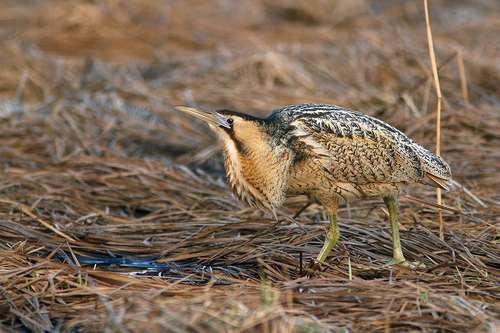
- Purple heron is darker and rufous with a thin snake-like neck. Common crane flies with neck outstretched. White stork is white with a red bill.
- Where to see it
- Almost any European wetland; large heronries in the Netherlands, the Danube Delta and English parks such as Regent's Park, London.
- When
- Resident in western Europe; northern and eastern birds winter south to Africa
Listen
Looking for field recordings…
Life & habits
- Diet
- Fish, eels, frogs, small mammals, ducklings, large insects
- Habitat
- Rivers, lakes, marshes, estuaries, ditches and garden ponds
- Size
- 84–102 cm long; wingspan 155–175 cm; 1–2 kg
- Lifespan
- Typically about 5 years; ringed birds have exceeded 20
Begins nesting in late winter, when heronries fill with bill-clattering and harsh croaks long before the leaves appear.
Where it lives
Recorded sightings
—
geo-referenced records in GBIF, from museums, herbaria and field observers.
Native range
Europe, North Africa, the Middle East, Central, South and East Asia, and sub-Saharan Africa and Madagascar
Drag the globe to turn it. Dots are where records exist, not a range map; darker means more records.
In the old herbals & bestiaries
Woodcuts and engravings matched from the Source Library’s scanned books by name. Plates marked “relative” show a close kin rather than this exact species. Click a plate to read the page it came from, with translation.

Garden of Health (Hortus Sanitatis)
Jacob Meydenbach · 1491 · p.580

Ortus sanitatis
1491 · p.642

History of Animals, Book I: On Viviparous Quadrupeds
Conrad Gessner · 1554 · p.393

History of Animals, Book I: On Viviparous Quadrupeds
Conrad Gessner · 1554 · p.387

Ulyssis Aldrovandi ... Ornithologiae
Aldrovandi, Ulisse · 1610 · p.1023

Noah's Ark
Athanasius Kircher · 1675 · p.127

The Natural History of Carolina, Florida and the Bahama Islands, Vol. 1
Mark Catesby · 1777 · p.245

The Natural History of Carolina, Florida and the Bahama Islands, Vol. 1
Mark Catesby · 1777 · p.251

A voyage to the islands Madera Barbados Jamaica Vol. 1
Hans Sloane · 1707 · p.630
In the stacks
Searching the stacks…
Every page naming Ardea cinerea in the Biodiversity Heritage Library →
Marginalia
The Egyptian Bennu bird, linked to the sun god and later to the Greek phoenix, is usually depicted as a grey heron, and herons were prized quarry of medieval falconers and served roast at royal feasts.
Curiosity
Hamlet's line 'I know a hawk from a handsaw' is often read as a corruption of 'hernshaw', an old word for heron.
Kinship

Fact-checked: 1 correction made to this sheet. Photographs: iNaturalist contributors under the licences shown. Records: GBIF.org. Historical plates: Source Library (CC BY-SA 4.0; originals public domain). Summary text: Nature Library editors and Wikipedia (CC BY-SA). Medicinal and edibility notes are historical and educational, not advice. iNaturalist taxon 4954.