 NL·0275
Herbarium of the Nature Library
- Name
- Botaurus stellaris
- Family
- Ardeidae
- Native to
- Europe, North Africa, Turkey, the Middle East, Central Asia to Japan; southern African population; northern birds winter south to Africa and South Asia
- Habitat
- Reedbed, Wetland
On eBird ↗
Eurasian Bittern
Live sightings near you, the range map, bar charts of when it is seen, and Macaulay Library photos and recordings.
Eurasian bittern
Botaurus stellaris
Also calledAl-wāq al-kabīr الواق الكبير (Arabic) · Balaban (Turkish) · Rohrdommel (German) · Butor étoilé (French) · Avetoro común (Spanish) · Roerdomp (Dutch)
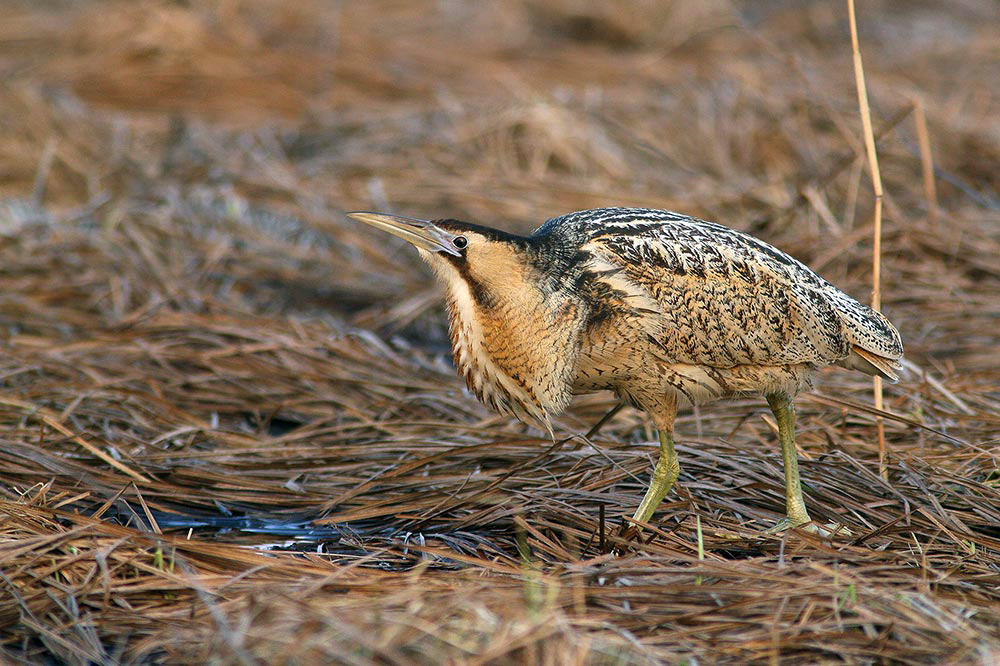
A secretive, streaky-brown heron of dense reedbeds, almost invisible when it freezes with its bill pointed skyward. In spring the male's booming call carries across the marshes like a distant foghorn.
The Eurasian bittern or great bittern is a wading bird in the bittern subfamily (Botaurinae) of the heron family Ardeidae. There are two subspecies, the northern race breeding in parts of Europe and across the Palearctic, as well as on the northern coast of Africa, while the southern race is endemic to parts of southern Africa. It is a secretive bird, seldom seen in the open as it prefers to skulk in reed beds and thick vegetation near water bodies. Its presence is apparent in the spring, when the booming call of the male during the breeding season can be heard. It feeds on fish, small mammals, fledgling birds, amphibians, crustaceans and insects. Wikipedia
What it can do
- iBooming call can be heard up to several kilometres away
- iiFreezes with neck stretched and bill up, swaying with the reeds as camouflage
- iiiIts eyes are positioned to see forward even when the bill points straight up
- ivBooming is produced by inflating the oesophagus
In the field
Field marks
- aGolden-brown plumage boldly streaked and barred with black
- bBlack crown and moustache stripe
- cStocky heron with thick neck and greenish-yellow legs
- dBroad, rounded, owl-like wings in flight
- Voice
- Male's booming 'oo-pumb', given in series at dusk and dawn in spring; flight call a harsh 'kau'.
- Not to be confused with
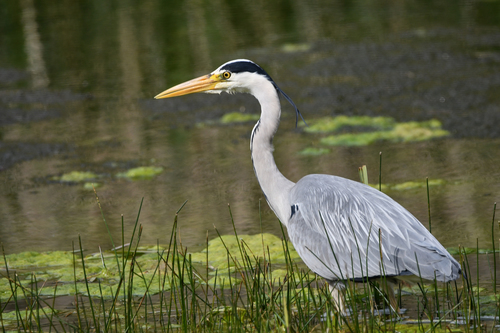
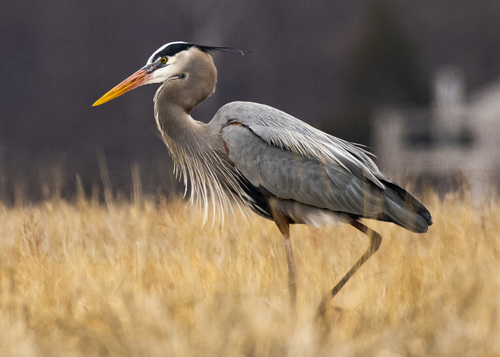
- Juvenile night heron is smaller and spotted white. Purple heron is slimmer with a long thin neck. Little bittern is much smaller with pale wing panels.
- Where to see it
- Minsmere, Ham Wall and Lakenheath Fen (England), Biebrza Marshes (Poland), the Danube Delta, Lake Neusiedl.
- When
- Resident in western Europe; summer visitor further east; booms Mar–Jun
Listen
Looking for field recordings…
Life & habits
- Diet
- Fish (especially eels), frogs, insects and small mammals
- Habitat
- Extensive wet reedbeds with open water
- Size
- 69–81 cm; wingspan 100–130 cm; 0.9–1.9 kg
Stalks slowly through the reeds, hunting in channels and pools.
Where it lives
Recorded sightings
—
geo-referenced records in GBIF, from museums, herbaria and field observers.
Native range
Europe, North Africa, Turkey, the Middle East, Central Asia to Japan; southern African population; northern birds winter south to Africa and South Asia
Drag the globe to turn it. Dots are where records exist, not a range map; darker means more records.
In the old herbals & bestiaries
Woodcuts and engravings matched from the Source Library’s scanned books by name. Plates marked “relative” show a close kin rather than this exact species. Click a plate to read the page it came from, with translation.


In the stacks
Searching the stacks…
Every page naming Botaurus stellaris in the Biodiversity Heritage Library →
Marginalia
Chaucer's Wife of Bath compares a sound to the bittern ('as a bitore bombleth in the myre'), and its booming gave rise to folk names such as 'butterbump' and 'bog bumper'.
Curiosity
Britain's booming males fell to just 11 in 1997; reedbed restoration raised them to more than 200 by the early 2020s and 283 in 2024.
Kinship

Fact-checked: 2 corrections made to this sheet. Photographs: iNaturalist contributors under the licences shown. Records: GBIF.org. Historical plates: Source Library (CC BY-SA 4.0; originals public domain). Summary text: Nature Library editors and Wikipedia (CC BY-SA). Medicinal and edibility notes are historical and educational, not advice. iNaturalist taxon 5033.