On eBird ↗
Red Crossbill
Live sightings near you, the range map, bar charts of when it is seen, and Macaulay Library photos and recordings.
Red Crossbill
Loxia curvirostra
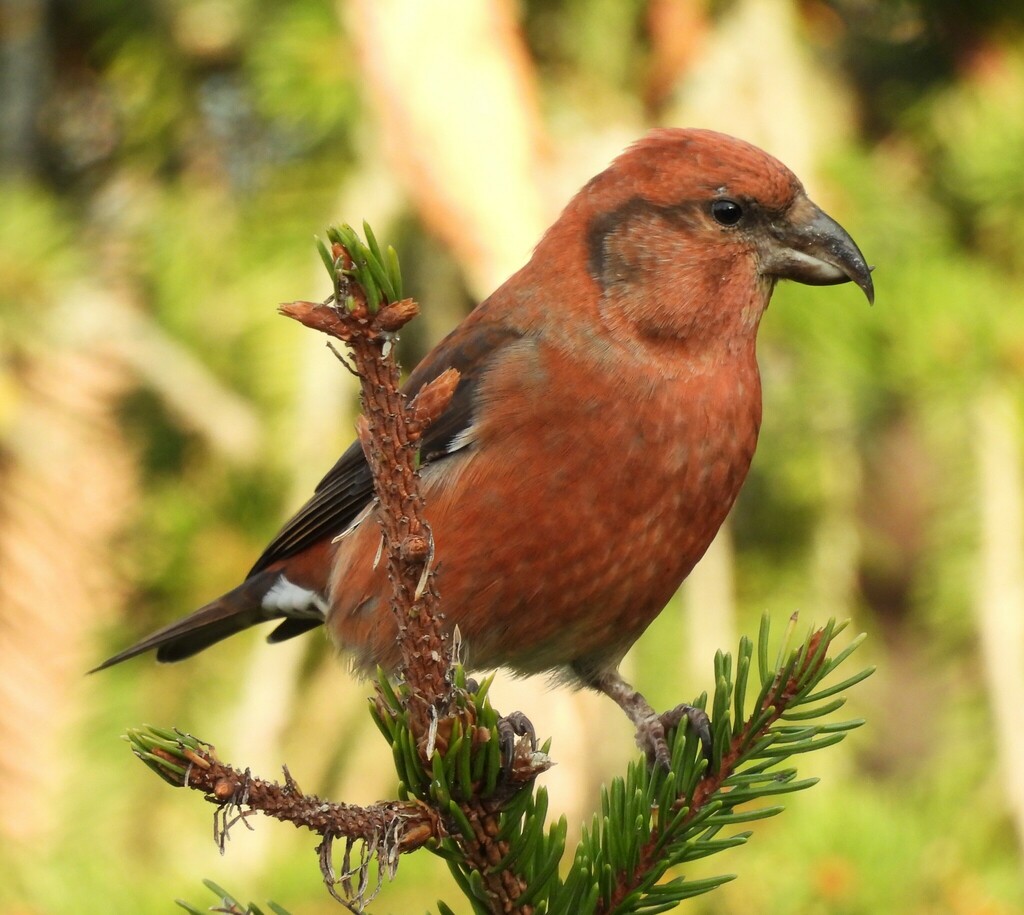
The red crossbill or common crossbill (Loxia curvirostra) is a small passerine bird in the finch family Fringillidae. Crossbills have distinctive mandibles, crossed at the tips, which enable them to extract seeds from conifer cones and other fruits.
Adults are often brightly coloured, with red or orange males and green or yellow females, but there is wide variation in beak size and shape, and call types, leading to different classifications of variants, some of which have been named as subspecies. The species is known as "red crossbill" in North America and "common crossbill" in Europe.
From the article Red crossbill on Wikipedia (CC BY-SA), quoted section by section
Description
Crossbills are distinguished by the mandibles crossing at their tips, which gives the group its English name. Using their crossed mandibles for leverage, crossbills are able to efficiently separate the scales of conifer cones and extract the seeds on which they feed. Adult males tend to be red or orange in colour, and females green or yellow, but there is much variation; juveniles are greyish-green and streaked.
Identification. The distinctive crossed mandibles eliminate most other species, but this feature is shared by the similar two-barred crossbill, with which it overlaps considerably in range. The two-barred crossbill has two bright white wing bars, while the wings of the red crossbill are entirely brownish-black. The red crossbill is the only dark-winged crossbill throughout most of its range, but it overlaps at least seasonally with the small ranges of the very similar parrot, Scottish, and Cassia crossbills. These species were formerly considered subspecies of the red crossbill, and though they show very slight differences in bill size and shape, they are very difficult to visually distinguish from the red crossbill and are generally best identified by call. The plumage differences between these four crossbills are negligible, there being more variation between individual birds than between species. Measurements:
Length: 20 cm Weight: 40–53 g Wingspan: 27–29 cm
Listen
Looking for field recordings…
Where it lives
Recorded sightings
—
geo-referenced records in GBIF, from museums, herbaria and field observers.
Drag the globe to turn it. Dots are where records exist, not a range map; darker means more records.
In the stacks
Searching the stacks…
Every page naming Loxia curvirostra in the Biodiversity Heritage Library →
This page is assembled live from iNaturalist, GBIF, Wikipedia, the Source Library and the Internet Archive. It is not yet part of the hand-edited codex. iNaturalist taxon 10411.