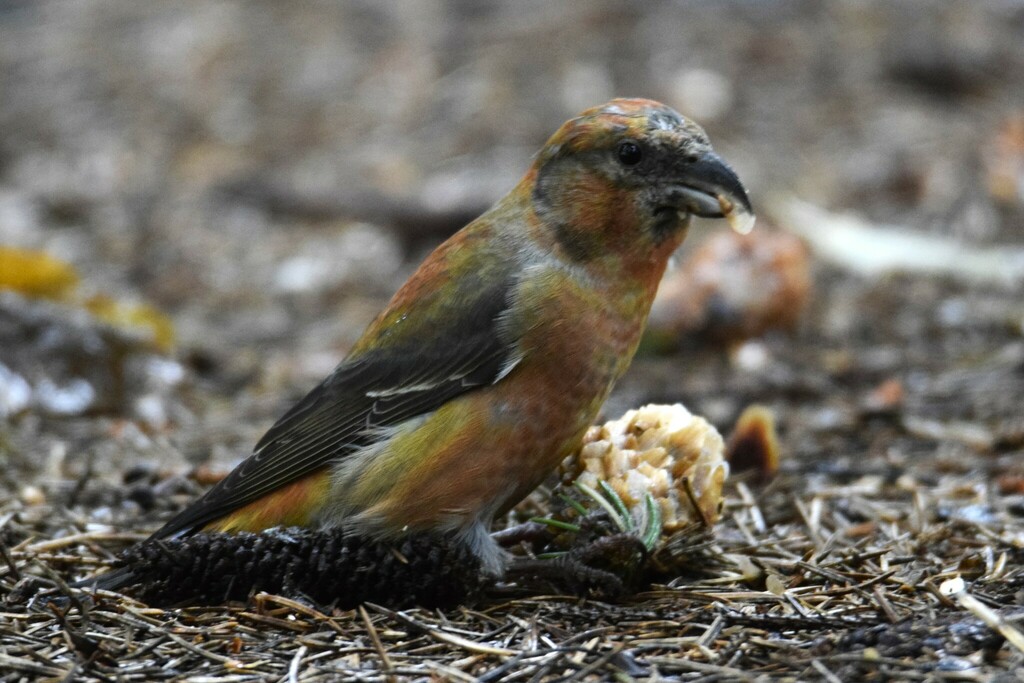
Crossbills
Loxia
Crossbills are birds of the genus Loxia within the finch family (Fringillidae), with five or six extant and one extinct species. These birds are distinguished by their mandibles with crossed tips, which gives the group its English name. Adult males tend to be red or orange, and females green or yellow, but there is much variation; some females, and juveniles, are greyish-green; juveniles are also streaked dark-on-pale.
Crossbills are specialist feeders on conifer cones, and the unusual bill shape is an adaptation which enables them to extract seeds from cones. These birds are typically found in higher northern hemisphere latitudes, where their food sources grow, but extending into the tropics in Central America, Hispaniola, Vietnam, and the Philippines. They irrupt out of the breeding range when the cone crop fails. Crossbills breed very early in the year, often in winter months, to take advantage of maximum cone supplies.
6 branches of this genus, most-observed first · about 6 known species
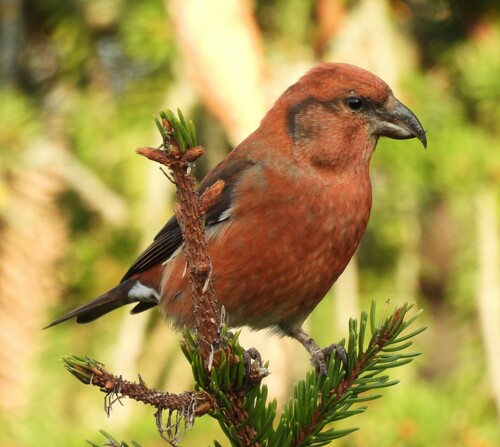
Red Crossbill
speciesLoxia curvirostra
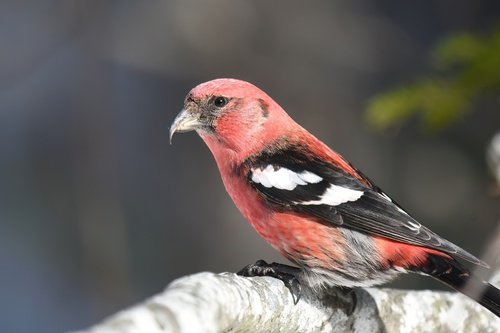
White-winged Crossbill
speciesLoxia leucoptera

Parrot Crossbill
speciesLoxia pytyopsittacus
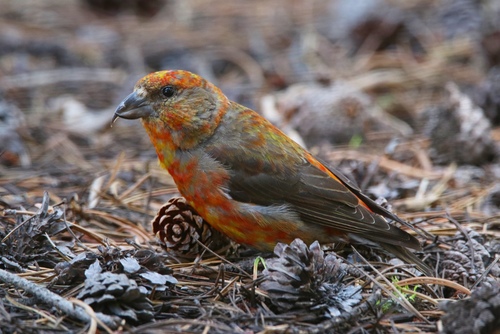
Cassia Crossbill
speciesLoxia sinesciuris
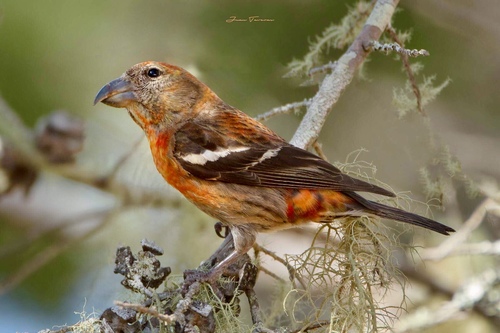
Hispaniolan Crossbill
speciesLoxia megaplaga

Scottish Crossbill
speciesLoxia scotica
Where it lives
Recorded sightings
—
geo-referenced records in GBIF, from museums, herbaria and field observers.
Drag the globe to turn it. Dots are where records exist, not a range map; darker means more records.
In the old herbals & bestiaries

History of Animals, Book I: On Viviparous Quadrupeds
Conrad Gessner · 1554 · p.754

Historiae Animalium Liber III: De Avium Natura
Conrad Gesner · 1555 · p.609

Ornithology
Ulisse Aldrovandi · 1599 · p.913

Ornithology
Ulisse Aldrovandi · 1599 · p.914

Ornithologiae: de avibus historiae libri XII
Ulisse Aldrovandi · 1599 · p.896
In the stacks
Searching the stacks…
Every page naming Loxia in the Biodiversity Heritage Library →
This page is assembled live from iNaturalist, GBIF, Wikipedia, the Source Library and the Internet Archive. It is not yet part of the hand-edited codex. iNaturalist taxon 10410.