- Animals
- ›Chordates
- ›Vertebrates
- ›Birds
- ›Pelicans, Herons, Ibises, and Allies
- ›Herons, Egrets, and Bitterns
- ›Typical Herons and Egrets
- ›Butorides
On eBird ↗
Green Heron
Live sightings near you, the range map, bar charts of when it is seen, and Macaulay Library photos and recordings.
Green Heron
Butorides virescens
The green heron (Butorides virescens) is a small heron of North and Central America. Butorides is from Middle English butor "bittern" and Ancient Greek -oides, "resembling", and virescens is Latin for "greenish".
It was long considered conspecific with its sister species the striated heron (Butorides striata); when treated together, they were called "green-backed heron".
From the article Green heron on Wikipedia (CC BY-SA), quoted section by section
Description
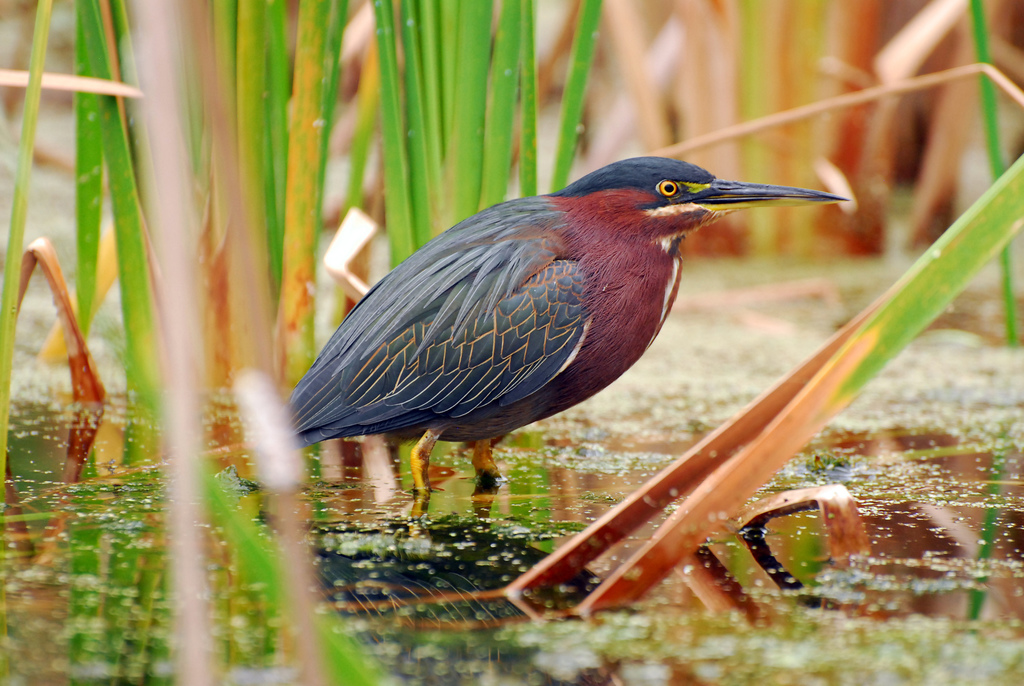
The green heron is a relatively small heron; adult body length is about 44 cm (17 in). The neck is often pulled in tight against the body. Adults have a glossy, greenish-black cap, an iridescent greenish back and wings that are gray-black grading into green or blue, a chestnut neck with a pair or more of white lines down the front, gray underparts and short yellow legs. The bill is dark with a long, sharp point. Female adults tend to be smaller than males, and have duller and lighter plumage, particularly in the breeding season. Juveniles are duller, with the head sides, neck and underparts streaked brown and white, tan-splotched back and wing coverts, and greenish-yellow legs and bill. Hatchlings are covered in down feathers, light gray above, and white on the belly. The green heron's call is a loud and sudden kyow; it also makes a series of more subdued kuk calls. During courtship, the male gives a raah-rahh call with wide-open bill, makes noisy wingbeats and whoom-whoom-whoom calls in flight, and sometimes calls roo-roo to the female before landing again. While sitting, an aaroo-aaroo courtship call is also given. Measurements:
Length: 41–46 cm (16–18 in) Weight: 240 g (8.5 oz) Wingspan: 64–68 cm (25–27 in)
What it does
The habitat and foraging area of the green heron includes riparian zones, wetlands, ponds, and lakes, as well as human-made canals and ditches. Green herons do not exhibit a particular preference for diurnal or nocturnal foraging, often engaging in both. Shore-living individuals adapt to the rhythm of the tides. They mainly eat small fish, frogs and aquatic arthropods, but may take any invertebrate or vertebrate prey they can catch, including such animals like leeches, earthworms, dragonflies, damselflies, waterbugs, grasshoppers, spiders, crayfish, prawns, mice, other rodents, lizards, tadpoles and snakes. Some of the many fish eaten are minnows, sunfish, catfish, perch, eels and, in urban areas, goldfish. Green herons are intolerant of other birds (including conspecifics) when feeding, and are not seen to forage in groups. They typically stand still on shore or in shallow water or perch upon branches and await prey. They are able to hover briefly to catch prey. Green herons have been observed using captured prey (e.g. mayflies) or other objects (bread, feathers) to "bait-fish", using a lure on the water's surface to attract fish. This bait-fishing behavior is common among herons. The northern population moves to its breeding ranges during March and April; near the northernmost limit of the green heron's range, breeding is well underway by the end of May. …
Wikipedia: “Ecology”
Listen
Looking for field recordings…
Where it lives
Recorded sightings
—
geo-referenced records in GBIF, from museums, herbaria and field observers.
Drag the globe to turn it. Dots are where records exist, not a range map; darker means more records.
In the old herbals & bestiaries

In the stacks
Searching the stacks…
Every page naming Butorides virescens in the Biodiversity Heritage Library →
This page is assembled live from iNaturalist, GBIF, Wikipedia, the Source Library and the Internet Archive. It is not yet part of the hand-edited codex. iNaturalist taxon 5020.