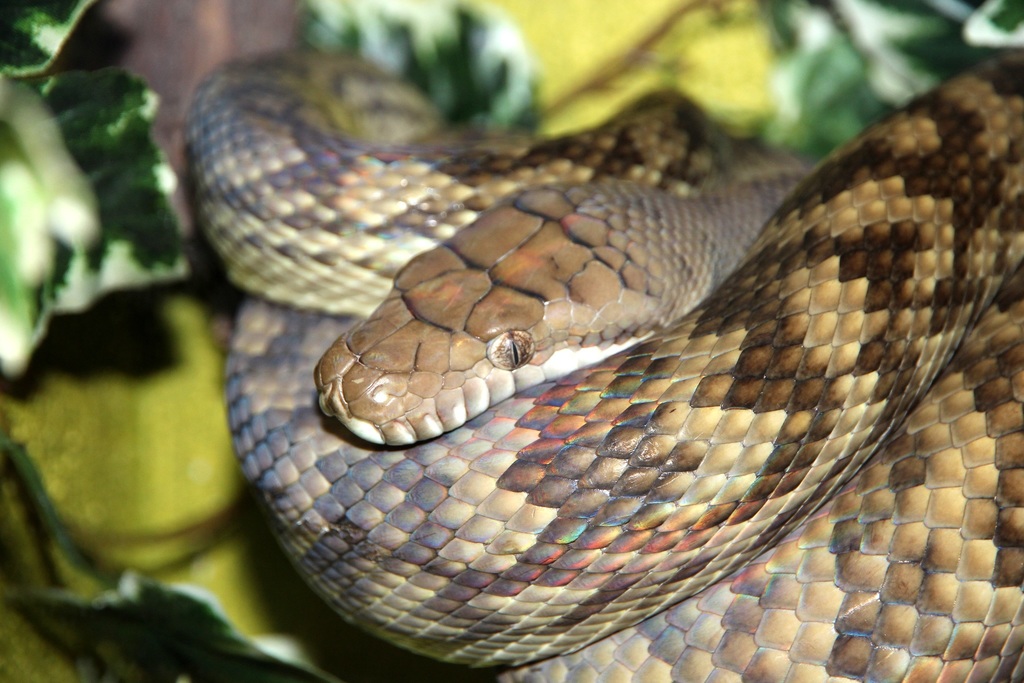
Amethyst Python
Simalia amethistina
The amethystine python (Simalia amethistina, formerly known as Morelia amethistina), also known as the scrub python or sanca permata in Indonesian, is a species of non-venomous snake in the family Pythonidae. The species is found in Indonesia and Papua New Guinea. Popular among reptile enthusiasts, and noted for its coloration and size, it is one of the largest snakes in the world, as measured either by length or weight, and is the largest native snake in Papua New Guinea. Until 2000, the larger Australian species S. kinghorni was generally considered a subspecies of S. amethistina, and this change of classification has still not been universally reflected in literature. Because of this issue, S. amethistina has often been described as the largest snake in Australia, but this is not accurate since under the current classification, this species does not occur in Australia.
From the article Amethystine python on Wikipedia (CC BY-SA), quoted section by section
Description
Specimens of S. amethistina have reportedly been measured at more than 5.5 m (18.0 ft) in total length (including tail), but this is likely due to confusion with Australian S. kinghorni specimens, as even 4 m (13 ft) specimens of S. amethistina are already considered extremely large. Although the amethystine python is smaller than the Australian scrub python, some sources claim that S. amethistina is able to reach lengths of 6 m (20 ft), with a weight up to 27 kg (60 lb). The smooth dorsal scales are arranged in 39–53 rows at midbody. There are deep, heat-sensing pits on six or seven of the posterior lower labials.
Range & habitat
The Amethystine python is found in Indonesia (Maluku Islands, Timur Laut Islands, Banda, Kai Islands, Aru Islands, Misool, Salawati, most of Western New Guinea, many islands in Geelvink Bay, such as Biak, Numfor, Yapen, and Supiori), and Papua New Guinea (including Umboi Island, Bismarck Archipelago, Trobriand Islands, the d'Entrecasteaux Islands to Rossel Island, Louisiade Archipelago). The type locality is unknown. S. amethistina occurs in both bushland and suburbia. In Indonesia, it is found mostly in rainforests. Warm, humid habitats with good water sources are preferred. In New Guinea, it mostly lives in scrublands.
Wikipedia: “Distribution and habitat”
What it does
The diet of the amethystine python generally consists of birds, bats, rats, possums, and other small mammals. Larger Papuan specimens catch and eat wallabies and cuscus, waiting by creek and river banks for prey seeking drinking water.
Wikipedia: “Diet”
Where it lives
Recorded sightings
—
geo-referenced records in GBIF, from museums, herbaria and field observers.
Drag the globe to turn it. Dots are where records exist, not a range map; darker means more records.
In the stacks
Searching the stacks…
Every page naming Simalia amethistina in the Biodiversity Heritage Library →
This page is assembled live from iNaturalist, GBIF, Wikipedia, the Source Library and the Internet Archive. It is not yet part of the hand-edited codex. iNaturalist taxon 540199.