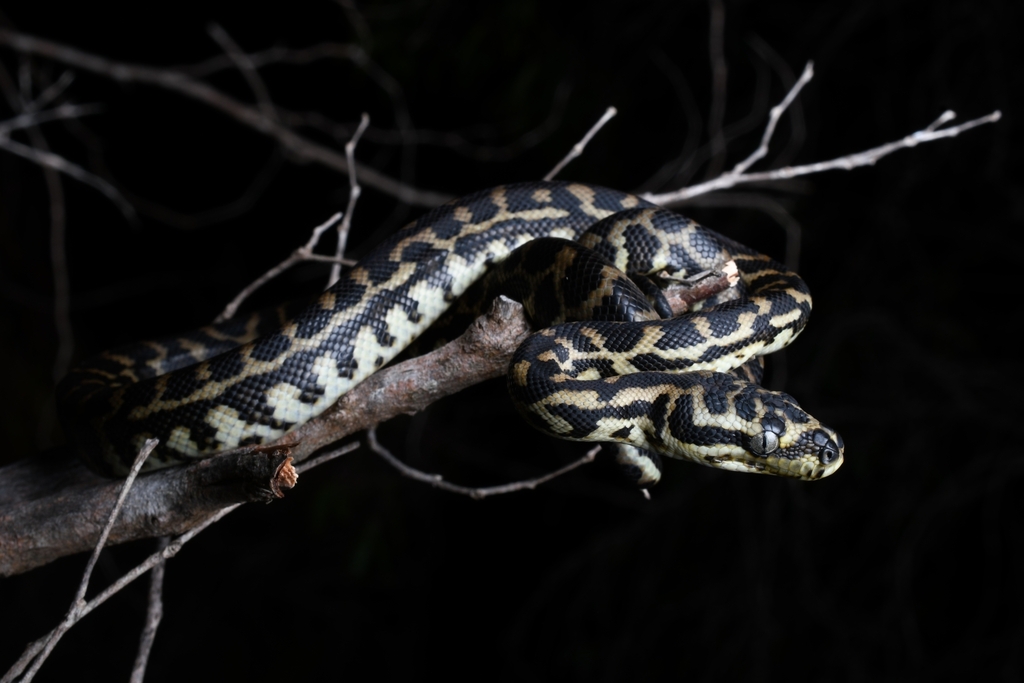
Southwestern Carpet Python
Morelia imbricata
Morelia imbricata, also known commonly as the southwestern carpet python, is a large species of snake in the family Pythonidae. It is a constrictor and is not venomous. The species is native to southern regions of Western Australia and western regions of South Australia.
From the article Morelia imbricata on Wikipedia (CC BY-SA), quoted section by section
Description
Morelia imbricata may attain a total length (tail included) of up to 2.3 m (7.5 ft), with a snout-to-vent length (SVL) of 2.0 m (6.6 ft). This species has a well defined neck and small scales across the head. Males may be up to 1.1 kg (2.4 lb) in weight, but females may be four times heavier when fully grown. Larger individuals have been reported as being 4 m (13 ft) in total length. Several other similar pythons occur in its range. The woma, Aspidites ramsayi, lacks the obvious neck of M. imbricata, and the western Stimson's python, Antaresia stimsoni stimsoni, has a higher number of ventral scales.
Range & habitat
The preferred natural habitat of Morelia imbricata is coastal areas, woodland, heathland, and semiarid areas. It is often found in woodlands of Eucalypt and Banksia, or amongst grasses or low growing shrubs.
Wikipedia: “Habitat”
What it does
Morelia imbricata is discreet and slow moving, spending most of its time hidden, though occasionally it is seen attempting to cross roads. Typically this python is sedentary, but females in a survey at Garden Island were noted to be active most of the year. M. imbricata takes up residence in deep crevices or holes in limestone, on granite, in dense heath, and animal burrows.
Wikipedia: “Behavior”
Where it lives
Recorded sightings
—
geo-referenced records in GBIF, from museums, herbaria and field observers.
Drag the globe to turn it. Dots are where records exist, not a range map; darker means more records.
In the stacks
Searching the stacks…
Every page naming Morelia imbricata in the Biodiversity Heritage Library →
This page is assembled live from iNaturalist, GBIF, Wikipedia, the Source Library and the Internet Archive. It is not yet part of the hand-edited codex. iNaturalist taxon 1224418.