 NL·0556
Herbarium of the Nature Library
- Name
- Homarus americanus
- Family
- Nephropidae
- Native to
- North-west Atlantic, from Labrador to North Carolina
- Habitat
- Rocky sea floor, Continental shelf, Kelp beds
American lobster
Homarus americanus
Also calledHomard américain (French) · Langosta americana (Spanish) · Maine lobster (American English)
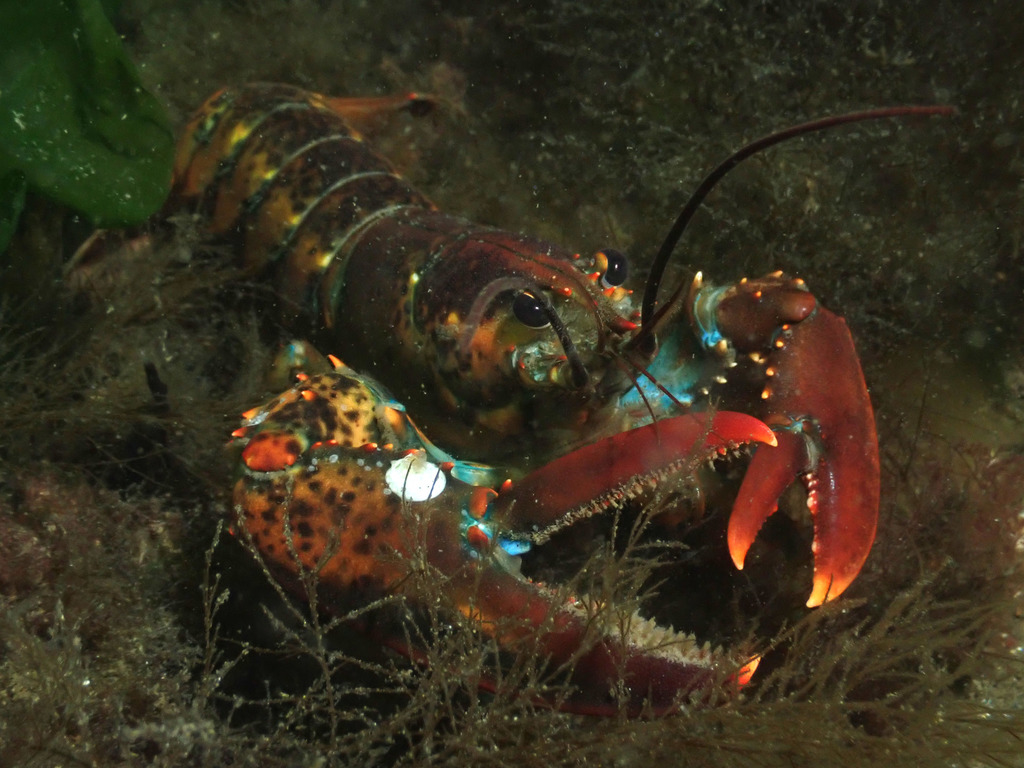
The heaviest crustacean in the world, with the record animal weighing about 20 kg. It carries two different claws, a heavy crusher and a sharp cutter, and may live for a century.
The American lobster is a species of lobster found on the Atlantic coast of North America, chiefly from Labrador to New Jersey. It is also known as Atlantic lobster, Canadian lobster, northern lobster, Canadian Reds, or Maine lobster. It is sometimes called the true lobster or common lobster, but those names are ambiguous. It can reach a body length of 64 cm (25 in), and a mass of over 20 kilograms (44 lb), making it not only the heaviest crustacean in the world, but also the heaviest of all living arthropod species. Its closest relative is the European lobster Homarus gammarus, which can be distinguished by its coloration and the lack of spines on the underside of the rostrum. American lobsters are usually bluish green to brown with red spines, but several color variations have been observed. Wikipedia
What it can do
- iHeaviest crustacean on record (about 20 kg)
- iiTwo specialised claws: a blunt crusher and a sharp pincer
- iiiRegenerates lost legs and claws
- ivLocates food by smell with its antennules and leg hairs
In the field
Field marks
- aDark greenish-brown to bluish shell, turning red only when cooked
- bTwo large, unequal claws
- cLong, reddish antennae
- dFan-shaped tail
- Not to be confused with
- European lobster (Homarus gammarus) is bluer and lacks the spine on the underside of the rostrum. Caribbean spiny lobster (Panulirus argus) has no big claws and a spiny shell.
- Where to see it
- Rocky coasts of the Gulf of Maine and Maritime Canada; lobster boats and pounds in Maine and Nova Scotia.
- When
- Year-round; moves inshore and moults in summer
Life & habits
- Diet
- Crabs, molluscs, sea urchins, worms, fish and some plants
- Habitat
- Rocky and sandy bottoms from the shallows to about 480 m, mostly at 4–50 m
- Size
- Commonly 25–50 cm long; record about 20 kg
- Lifespan
- Estimated to exceed 100 years in large individuals
Females carry thousands of eggs under the tail for about a year before they hatch.
Where it lives
Recorded sightings
—
geo-referenced records in GBIF, from museums, herbaria and field observers.
Native range
North-west Atlantic, from Labrador to North Carolina
Drag the globe to turn it. Dots are where records exist, not a range map; darker means more records.
In the old herbals & bestiaries
No plate in the Source Library names this exact species, so these show its closest relatives as the old naturalists drew them: same genus, or the same kind of animal. Click a plate to read the page it came from, with translation.

Cosmographey: das ist Beschreibung aller Laender
Relative · Münster, Sebastian · 1598 · p.1351

The Hieroglyphics
Relative · Horapollo · 1551 · p.247

History of Animals, Book II: On Oviparous Quadrupeds
Relative · Conrad Gessner · 1586 · p.580

Garden of Health (Hortus Sanitatis)
Relative · Jacob Meydenbach · 1491 · p.612

Garden of Health
Relative · Jacob Meydenbach · 1491 · p.702

History of Animals, Book II: On Oviparous Quadrupeds
Relative · Conrad Gessner · 1586 · p.584

Ten Books of Exotic Things
Relative · Carolus Clusius · 1605 · p.798

Theater of Earthly Creatures
Relative · Anonymous · 1672 · p.288

Ortus sanitatis
Relative · 1491 · p.682

Garden of Health
Relative · 1507 · p.434
In the stacks
Searching the stacks…
Every page naming Homarus americanus in the Biodiversity Heritage Library →
Marginalia
Early colonial accounts describe lobsters so abundant in New England that they were used as fish bait and fertiliser; only from the 19th century did canning and railways turn them into a luxury food.
Curiosity
About one lobster in a couple of million is bright blue because of a genetic mutation that alters its shell pigment protein.
Kinship



Fact-checked: 1 correction made to this sheet. Photographs: iNaturalist contributors under the licences shown. Records: GBIF.org. Historical plates: Source Library (CC BY-SA 4.0; originals public domain). Summary text: Nature Library editors and Wikipedia (CC BY-SA). Medicinal and edibility notes are historical and educational, not advice. iNaturalist taxon 61383.