- Animals
- ›Chordates
- ›Vertebrates
- ›Ray-finned Fishes
- ›Spiny-rayed fishes
- ›Wrasses and allies
- ›False scorpionfishes, wrasses, and parrotfishes
- ›Wrasses and Parrotfishes
- ›Parrotfishes
- ›Chlorurus
- ›Chlorurus sordidus
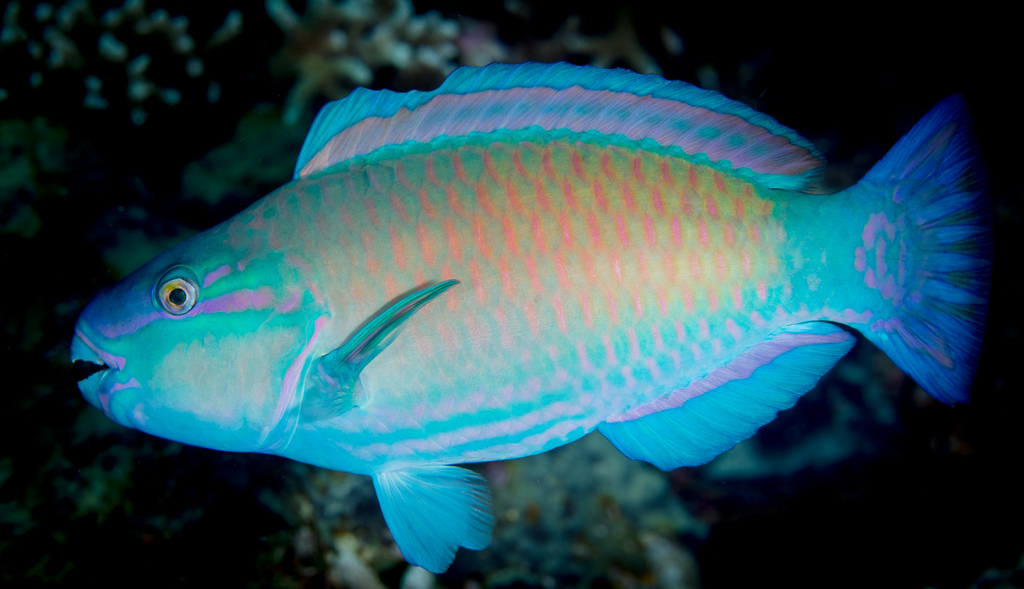
Pacific Bullethead Parrotfish
Chlorurus spilurus
Chlorurus spilurus, commonly known as the Pacific daisy parrotfish or Pacific bullethead parrotfish and in Hawaiian called uhu, is a species of marine fish in the family Scaridae. The Pacific daisy parrotfish is widespread throughout the tropical waters of the Pacific.
From the article Chlorurus spilurus on Wikipedia (CC BY-SA), quoted section by section
Description
The initial phase fish, which can be female or male, have a white beak, an overall dark reddish coloration with a white caudal peduncle and fin with a black patch. There is great variation in the coloration among the terminal males of this species. Their body is greenish with big scales outlined with purple-blue lines, three purple-blue stripes around the mouth, and an orange and a white patch on the cheek.
Range & habitat
Chlorurus spilurus can be found in the Western and Central Pacific, from Indonesia to Hawaii and Pitcairn Island.
Wikipedia: “Distribution”
What it does
These parrotfish have strong beaks that are designed to easily break off chunks of coral to feed on coral polyps and algae growing on the coral.
Wikipedia: “Diet”
In human culture
The pacific bullethead parrotfish was, and still is a favorite amongst fishermen for meals. They were usually eaten raw, but also were boiled on occasion. The Uhu also has a prominent space in Hawaiian culture and folklore, particularly in the story of Puniakaia, where a supernatural parrotfish is said to be the parent of all fish species. In the end, two heroes named Kawelo and Makuakeke killed the fish named Uhumaka'ika'i.
Wikipedia: “Cultural significance”
Where it lives
Recorded sightings
—
geo-referenced records in GBIF, from museums, herbaria and field observers.
Drag the globe to turn it. Dots are where records exist, not a range map; darker means more records.
In the stacks
Searching the stacks…
Every page naming Chlorurus spilurus in the Biodiversity Heritage Library →
This page is assembled live from iNaturalist, GBIF, Wikipedia, the Source Library and the Internet Archive. It is not yet part of the hand-edited codex. iNaturalist taxon 187233.