 NL·0035
Herbarium of the Nature Library
- Name
- Taraxacum officinale
- Family
- Asteraceae
- Native to
- Eurasia; now naturalised on every continent except Antarctica
- Habitat
- Temperate grassland, Lawns, Disturbed ground, Alpine meadow
Dandelion
Taraxacum officinale
Also calledLöwenzahn (German) · Diente de león (Spanish) · Pissenlit (French, 'wet the bed') · Púgōngyīng 蒲公英 (Chinese, Taraxacum spp.)
The world's most familiar weed. Each flower head is a cluster of up to 200 florets, and most of its seeds are clones made without pollination. Every part is edible and its bitter roots and leaves have long been used as a liver and kidney remedy.
Taraxacum officinale, the dandelion or common dandelion, is a herbaceous perennial flowering plant in the daisy family, Asteraceae. The common dandelion is well-known for its yellow flower heads that turn into round balls of many silver-tufted fruit, which disperse in the wind. These balls are sometimes called "clocks" or "blowballs". Wikipedia
What it can do
- iSets seed asexually (apomixis): most seeds are genetic copies of the parent
- iiIts pappus parachute creates a stable 'separated vortex ring' of air, a kind of flight unknown before 2018
- iiiDeep taproot regrows from fragments and draws up minerals
- ivFlowers from early spring, an important early nectar and pollen source
At the table
Eatenleaves · flowers · roots (roasted as coffee substitute)
All parts are edible; young leaves are less bitter. Avoid plants from sprayed lawns or roadsides. People allergic to Asteraceae or latex may react.
In the medicine cabinet
| Tradition | Use |
|---|---|
| European folk medicine | Leaf as a diuretic ('pissenlit'); root as a bitter tonic for liver, gallbladder and digestion |
| Traditional Chinese Medicine | Pugongying clears heat and toxins, for breast abscess, boils, sore throat and urinary infections |
| Indigenous American | Adopted after European introduction by several nations, such as the Ojibwe and Iroquois, as a spring green and for heartburn and kidney complaints |
Weight of evidence
Traditional. Long historical use; little or no modern clinical evidence.
Active compounds
taraxasterol, taraxinic acid glucoside, inulin, chicoric acid, luteolin, potassium
Fruit & seed


Fruit
Cypsela with beaked pappus
Ripens: Spring–autumn
Ribbed achenes on a slender beak topped with a parachute, forming the 'clock'.


Seed
~3–4 mm (plus beak)
Olive-brown spiny achene with white pappus
- Dispersal
- Wind, sometimes over kilometres
- Germination
- Needs light; 7–21 days at 15–25 °C
Photographs from Wikimedia Commons under open licences; hover for the photographer, click for the file.
How to grow it
Hardiness (USDA zones)
USDA 3–10. Survives winters down to about -40 °C.
- Light
- Full sun to part shade
- Water
- Moderate
- Soil
- Any; deeper soil gives larger roots
- Propagation
- Seed
- To harvest
- Leaves 6–8 weeks; roots in autumn of year 1–2
- Climates
- Temperate, Continental, Mediterranean, Alpine
- 1Scatter seed on the surface in spring
- 2Blanch leaves under a pot for a week for milder salad greens
- 3Pick flowers for wine or fritters at midday when fully open
- 4Dig roots in autumn, roast and grind for 'coffee'
Can it grow where you are?
Where it lives
Recorded sightings
—
geo-referenced records in GBIF, from museums, herbaria and field observers.
Native range
Eurasia; now naturalised on every continent except Antarctica
Drag the globe to turn it. Dots are where records exist, not a range map; darker means more records.
In Gerard's Herball, 1597

Second Booke · Chap. 30 · p. 228 · read the page →
Of Dandelion.
John Gerard, The Herball, or Generall Historie of Plantes, London, 1597. What England's best-known herbal said of dandelion, in its own spelling.
- The vertues
- Dandelion is like in temperature to Succorie, that is to saie to wilde Endiue. It is colde, but it drieth more, and doth withall clense and open by reason of the bitternes which it hath ioined with it: and therefore it is good for those things for which Succorie is.
- The place
- They are found often in medows neere vnto water ditches, as also in gardens and in high waies much troden.
- The time
- They flower most times in the yeere, especially if the winter be not extreame colde.
- The names
- These plants belong to the Succories, among which Theophrastus in his 7. booke nameth ἀφάκη, Leonardus Fuchsius thinketh that Dandelion is Hedypnois Plinij, of which he writeth in his 20. booke 8. chapter, affirming it to be a wilde kinde of broade leafed Succorie, and that Dandelion is Taraxacon: but Taraxacon as Auicen teacheth in his 692. Chapter is Garden Endiue, as Serapio, Serapio mentioneth in his 143.
Gerard wrote within Galenic humoral medicine, and his opinions, including about the peoples of the Americas and their crops, are those of 1590s London. His “vertues” are history, not advice. Transcription: Source Library (CC BY-SA 4.0). The whole chapter in the Herball Room.
In the old herbals & bestiaries
Woodcuts and engravings matched from the Source Library’s scanned books by name. Plates marked “relative” show a close kin rather than this exact species. Click a plate to read the page it came from, with translation.

Maria Sibylla Merian — Der rupsen begin, voedzel en wonderbaare verandering (1712)
Maria Sibylla Merian · 1717 · p.59

The Anatomy of Plants (Vol. 2)
Nehemiah Grew · 1682 · p.412

Elements of Botany
Joseph Pitton de Tournefort · 1719 · p.17

The Great Herbary with all the figures of the herbs
1532 · p.137

Notable Commentaries on the History of Plants
Leonhart Fuchs · 1542 · p.714

Notable Commentaries on the History of Plants
Leonhart Fuchs · 1549 · p.712

Commentaries on the Six Books of Dioscorides
Pietro Andrea Mattioli · 1560 · p.408

Commentaries on the Six Books of Dioscorides on Medical Matter
Pietro Andrea Mattioli · 1563 · p.393

Commentaries on the Six Books of Pedanius Dioscorides on Medical Matter
Pietro Andrea Mattioli · 1565 · p.676

A New Herbal, or History of Plants
Rembert Dodoens (trans. Henry Lyte) · 1578 · p.588
In the stacks
Searching the stacks…
Every page naming Taraxacum officinale in the Biodiversity Heritage Library →
Marginalia
The genus name came into medieval Latin from the Arabic and Persian tarakhshaqūq, a plant discussed by Arabic physicians around the 10th–11th centuries. The English name comes from the French dent de lion, 'lion's tooth', after the jagged leaves.
Curiosity
In 2018 Edinburgh researchers showed that a dandelion seed's bristly parachute is about 90% empty space, yet it traps a stable bubble of swirling air that keeps it aloft.
Kinship

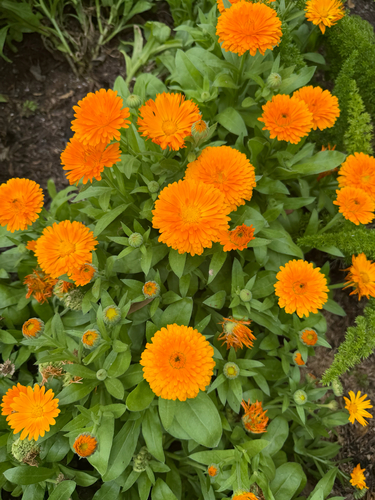
Photographs: iNaturalist contributors under the licences shown. Records: GBIF.org. Historical plates: Source Library (CC BY-SA 4.0; originals public domain). Summary text: Nature Library editors and Wikipedia (CC BY-SA). Medicinal and edibility notes are historical and educational, not advice. iNaturalist taxon 47602.