 NL·0537
Herbarium of the Nature Library
- Name
- Mimus polyglottos
- Family
- Mimidae
- Native to
- Southern Canada and the US south to southern Mexico, the Bahamas and the Greater Antilles; introduced to Hawaii and Bermuda
- Habitat
- Shrubland, Gardens, Farmland, Desert scrub
On eBird ↗
Northern Mockingbird
Live sightings near you, the range map, bar charts of when it is seen, and Macaulay Library photos and recordings.
Northern mockingbird
Mimus polyglottos
Also calledCenzontle (Spanish, from Nahuatl) · Sinsonte (Spanish, Cuba) · Centzontlatole (Nahuatl, 'four hundred voices') · Moqueur polyglotte (French)
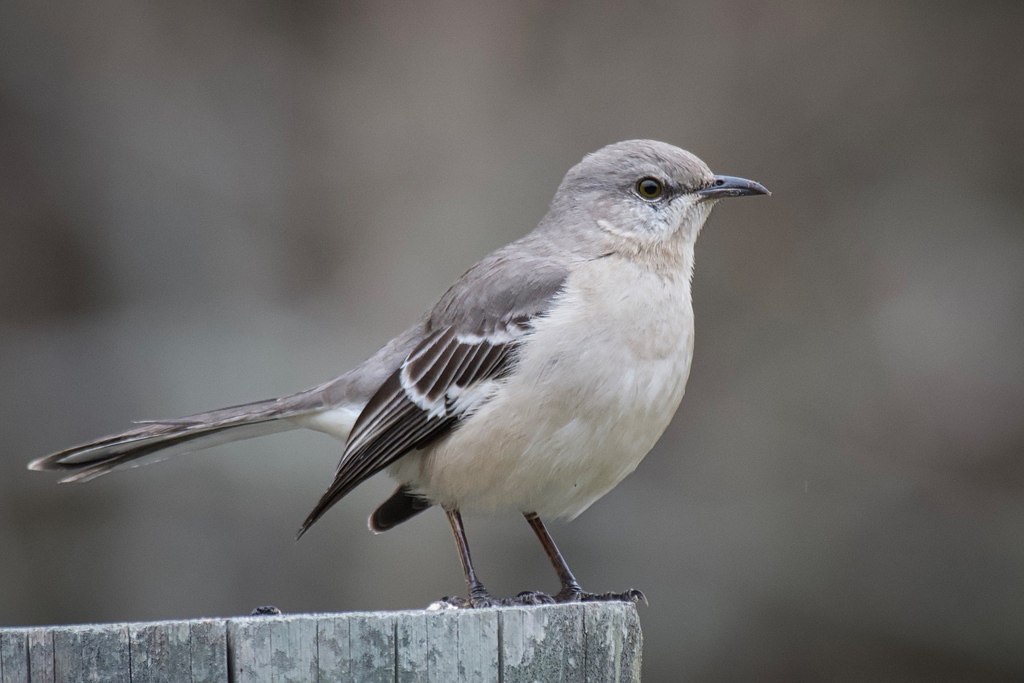
A slim grey bird with a big voice, famous for copying the songs of other birds, frogs and even car alarms. Males may learn around 200 different songs, repeating each phrase several times before switching.
The northern mockingbird is a mockingbird commonly found in North America, of the family Mimidae. The species is also found in some parts of the Caribbean, as well as on the Hawaiian Islands. It is typically a permanent resident across much of its range, but northern mockingbirds may move farther south during inclement weather or prior to the onset of winter. The northern mockingbird has gray to brown upper feathers and a paler belly. Its tail and wings have white patches which are visible in flight. Wikipedia
What it can do
- iLearns new song types throughout life, adding mimicry of birds, frogs, insects and mechanical sounds
- iiUnmated males sing through the night, especially under bright moonlight or streetlights
- iiiRecognises individual humans who have approached its nest and scolds them on sight
- ivFlashes white wing patches while foraging, possibly to startle insects
In the field
Field marks
- aGrey above, paler grey-white below
- bLarge white patches on dark wings, obvious in flight
- cLong dark tail with white outer feathers
- dThin, slightly decurved dark bill; yellow eye in adults
- Voice
- Long, varied runs of phrases, each repeated three or more times in a row, mixing its own song with mimicry; call a harsh 'chack'.
- Not to be confused with
- Loggerhead Shrike has a black mask and a hooked bill and flies with fast, low wingbeats. Gray Catbird is dark slate with a black cap and rusty undertail. Townsend's Solitaire (west) has an eye-ring and buffy wing patches.
- Where to see it
- Lawns, parking-lot shrubs and fence posts throughout the southern US; abundant in Texas and Florida.
- When
- Resident; northernmost birds partly withdraw in winter
Listen
Looking for field recordings…
Life & habits
- Diet
- Insects in summer; fruit and berries in autumn and winter
- Habitat
- Open ground with shrubs and trees — suburbs, hedgerows, parks, desert edges
- Size
- 21–26 cm; 45–58 g
- Lifespan
- Banding record about 14 years
It aggressively defends nests and winter fruit trees, diving at cats, hawks and people.
Where it lives
Recorded sightings
—
geo-referenced records in GBIF, from museums, herbaria and field observers.
Native range
Southern Canada and the US south to southern Mexico, the Bahamas and the Greater Antilles; introduced to Hawaii and Bermuda
Drag the globe to turn it. Dots are where records exist, not a range map; darker means more records.
In the old herbals & bestiaries
Woodcuts and engravings matched from the Source Library’s scanned books by name. Plates marked “relative” show a close kin rather than this exact species. Click a plate to read the page it came from, with translation.

In the stacks
Searching the stacks…
Every page naming Mimus polyglottos in the Biodiversity Heritage Library →
Marginalia
Thomas Jefferson kept a pet mockingbird named Dick at the President's House, and the species gave Harper Lee the title of To Kill a Mockingbird (1960); it is the state bird of Arkansas, Florida, Mississippi, Tennessee and Texas.
Curiosity
Its scientific name means 'many-tongued mimic', and its Nahuatl-derived Spanish name cenzontle means 'four hundred voices'.
Kinship
Fact-checked: 1 correction made to this sheet. Photographs: iNaturalist contributors under the licences shown. Records: GBIF.org. Historical plates: Source Library (CC BY-SA 4.0; originals public domain). Summary text: Nature Library editors and Wikipedia (CC BY-SA). Medicinal and edibility notes are historical and educational, not advice. iNaturalist taxon 14886.