- Animals
- ›Chordates
- ›Vertebrates
- ›Birds
- ›Pelicans, Herons, Ibises, and Allies
- ›Ibises and Spoonbills
- ›Eudocimus
On eBird ↗
White Ibis
Live sightings near you, the range map, bar charts of when it is seen, and Macaulay Library photos and recordings.
White Ibis
Eudocimus albus
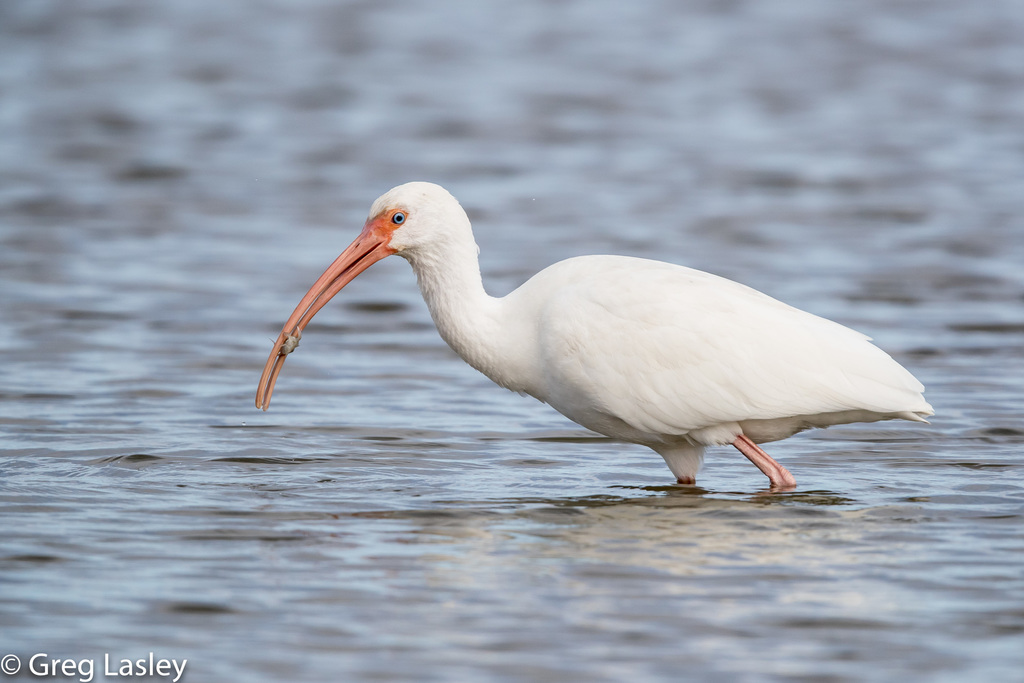
The American white ibis (Eudocimus albus) is a species of bird in the ibis family, Threskiornithidae. It is found from the southern half of the US East Coast (from southern New Jersey to Georgia), along the Gulf Coast states (Florida, Alabama, Mississippi, Louisiana and Texas) and south through most of the Caribbean coastal regions of Central America. This particular ibis species is a medium-sized wading bird, possessing an overall white plumage with black wing-tips (usually only visible in flight), and having the typical downward-curving bill of the ibises, though of a bright red-orange color, the same hue as its long legs. Males are larger and have longer bills than females. The breeding range runs along the Gulf and Atlantic Coast, and the coasts of Mexico and Central America. Outside the breeding period, the range extends further inland in North America and also includes the Caribbean. It is also found along the northwestern South American coastline in Colombia and Venezuela. Populations in central Venezuela overlap and interbreed with the scarlet ibis. The two have been classified by some authorities as a single species.
Their diet consists primarily of small aquatic prey, such as insects and small fishes. Crayfish are its preferred food in most regions, but it can adjust its diet according to the habitat and prey abundance. Its main foraging behavior is probing with its beak at the bottom of shallow water to feel for and capture its prey. It does not see the prey.
From the article American white ibis on Wikipedia (CC BY-SA), quoted section by section
Description
The white plumage and pink facial skin of adult American white ibises are distinctive. Adults have black wingtips that are usually only visible in flight. In non-breeding condition the long downcurved bill and long legs are bright red-orange. During the first ten days of the breeding season, the skin darkens to a deep pink on the bill and an almost purple-tinted red on the legs. It then fades to a paler pink, and the tip of the bill becomes blackish. It is difficult to determine the sex of an adult American white ibis from its external appearance, since the sexes have similar plumage. However, there is sexual dimorphism in size and proportion as males are significantly larger and heavier than females and have longer and stouter bills. This species is moderately large for an ibis but is relatively short legged, compact and bulky for a large wading bird. A study of the American white ibis in southern Florida yielded weight ranges of 872.9 to 1,261 g (1.924 to 2.780 lb) for males and 592.7 to 861.3 g (1.307 to 1.899 lb) for females, with average weights of 1,036.4 g (2.285 lb) for males and 764.5 g (1.685 lb) for females. The length of adult female and male birds ranges from 53 to 70 cm (21 to 28 in) with a 90 to 105 cm (35 to 41 in) wingspan. …
Range & habitat
The American white ibis is most common in Florida, where over 30,000 have been counted in a single breeding colony. It also occurs throughout the Caribbean, on both coasts of Mexico (from Baja California southwards) and Central America, and as far south as Colombia and Venezuela. The non-breeding range extends further inland, reaching north to Virginia, and west to eastern Texas. The species is known to wander, and has been sighted, sometimes in small flocks, in states far out of its usual range. In North America, breeding takes place along the Atlantic coast, from southern New Jersey south to Florida and thence west along the Gulf Coast. (It nested in New Jersey for the first time in 2020, having appeared there rarely before then.) Laguna Cuyutlán is an isolated and regionally important wetland in the state of Colima on México's west coast where a breeding colony has been recorded. American white ibises are not faithful to the sites where they breed, and large breeding colonies composed of ten thousand birds or more can congregate and disband in one or two breeding seasons. Breeding populations across its range have fluctuated greatly with wholesale movement between states. Until the 1940s, the species bred only in large numbers in Florida, mostly within the Everglades. …
Wikipedia: “Distribution and habitat”
What it does
A field study late in the Florida nesting season revealed that on an average day, adult American white ibis spent 10.25 hours looking for food, 0.75 hours flying, 13 hours resting, roosting, and attending to their nests. Much of the time roosting is spent preening, biting and working their feathers with their long bills, as well as rubbing the oil glands on the sides of their heads on back plumage. American white ibis generally only preen themselves, not engaging in allopreening unless part of courtship behavior. Bathing often takes place before preening; ibis squat in water 5–20 cm (2.0–7.9 in) deep and flick water over themselves with each wing in succession. Hundreds of birds may bathe together around the time of courtship. The American white ibis is territorial, defending the nesting and display sites against intruders. Agonistic or threat displays include lunging forward with the bill in a horizontal posture, and standing upright and snapping the bill opposite another bird engaging in the same display. Birds also lunge and bite, often holding onto an opponent's head or wings.
Breeding and lifespan. The American white ibis pairs up in spring and breeds in huge colonies, often with other waterbird species. Nesting begins as soon as suitable foraging and nesting habitat is available. …
Wikipedia: “Behavior”
In human culture
Native American folklore held that the bird was the last to seek shelter before a hurricane, and the first to emerge afterwards. The bird was thus a symbol for danger and optimism. For this reason, the University of Miami adopted the American white ibis as its official athletics mascot in 1926, and the yearbook was known as The Ibis from that year. The mascot was initially known as Ibis before adopting the name Sebastian in 1957. It was named after San Sebastian Hall, a residence hall on campus, which sponsored an Ibis entry in the college's homecoming celebration. Similar to the University of Miami, South Georgia Tormenta FC uses the ibis as its mascot and nickname, incorporating the bird into the team's crest.
Wikipedia: “In culture”
Listen
Looking for field recordings…
Where it lives
Recorded sightings
—
geo-referenced records in GBIF, from museums, herbaria and field observers.
Drag the globe to turn it. Dots are where records exist, not a range map; darker means more records.
In the old herbals & bestiaries

In the stacks
Searching the stacks…
Every page naming Eudocimus albus in the Biodiversity Heritage Library →
This page is assembled live from iNaturalist, GBIF, Wikipedia, the Source Library and the Internet Archive. It is not yet part of the hand-edited codex. iNaturalist taxon 3751.