 NL·0599
Herbarium of the Nature Library
- Name
- Pelecanus occidentalis
- Family
- Pelecanidae
- Native to
- Atlantic, Gulf and Pacific coasts of the Americas, from the USA to northern South America, and the Caribbean
- Habitat
- Coastal, Estuary, Mangrove
On eBird ↗
Brown Pelican
Live sightings near you, the range map, bar charts of when it is seen, and Macaulay Library photos and recordings.
Brown pelican
Pelecanus occidentalis
Also calledAlcatraz (Spanish) · Pélican brun (French) · Pelícano pardo (Spanish)
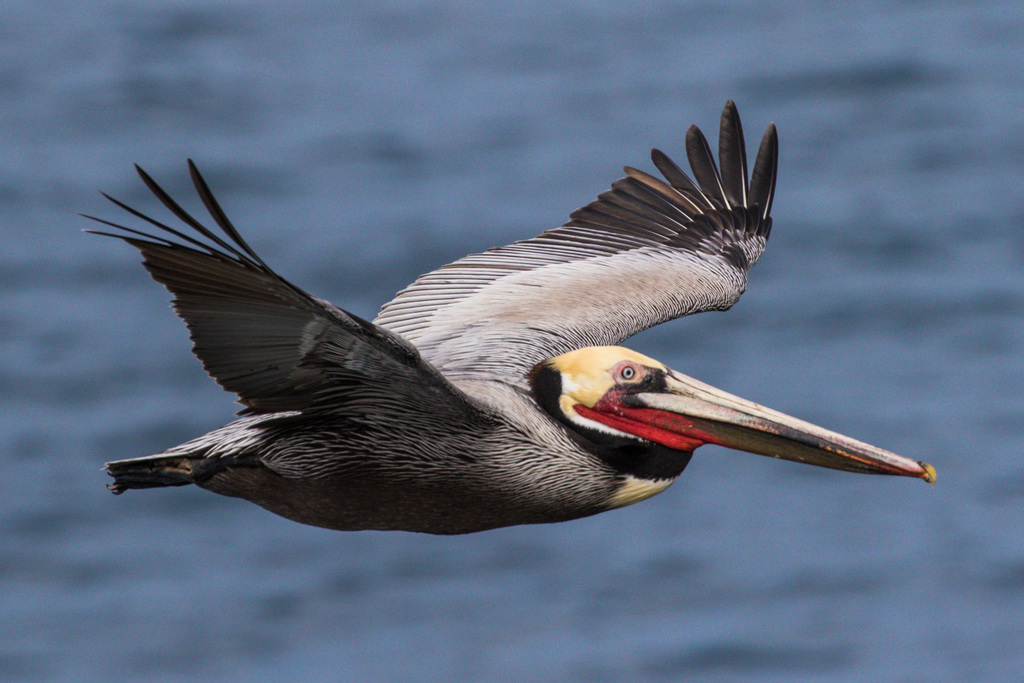
A big, grey-brown coastal pelican that hunts by spectacular plunge-dives, unlike most other pelicans. It recovered from near disappearance in North America after DDT was banned.
The brown pelican is a bird of the pelican family, Pelecanidae, one of three species found in the Americas and one of two that feed by diving into water. It is found on the Atlantic Coast from New Jersey to the mouth of the Amazon River, and along the Pacific Coast from British Columbia to Peru, including the Galapagos Islands. The nominate subspecies in its breeding plumage has a white head with a yellowish wash on the crown. The nape and neck are dark maroon–brown. The upper sides of the neck have white lines along the base of the gular pouch, and the lower fore neck has a pale yellowish patch. The male and female are similar, but the female is slightly smaller. The nonbreeding adult has a white head and neck. The pink skin around the eyes becomes dull and gray in the nonbreeding season. It lacks any red hue, and the pouch is strongly olivaceous ochre-tinged and the legs are olivaceous gray to blackish-gray. Wikipedia
What it can do
- iPlunge-dives from up to about 20 m, folding back its wings before impact
- iiAir sacs under the skin cushion the impact and help it bob back to the surface
- iiiThroat pouch holds up to about 10 litres of water and fish
- ivGlides in lines just above wave crests, riding the air cushion
In the field
Field marks
- aGrey-brown body; the smallest and darkest pelican
- bWhite head and neck in non-breeders; chestnut hindneck in breeding adults
- cYellowish crown in breeding plumage
- dLong bill with grey pouch (reddish in Pacific breeding birds)
- eJuveniles all brown with paler belly
- Voice
- Adults are almost silent; nestlings squeal and grunt.
- Not to be confused with
- American white pelican is white with black flight feathers and feeds by swimming, not diving. Peruvian pelican (Peru and Chile) is larger, with a white stripe running down the neck.
- Where to see it
- Florida Gulf Coast, Louisiana marshes, Monterey Bay and San Diego (California), Gulf of California, Caribbean islands
- When
- Resident; Pacific birds disperse north after breeding
Listen
Looking for field recordings…
Life & habits
- Diet
- Small schooling fish such as menhaden, anchovies and sardines
- Habitat
- Coastal waters, bays, estuaries and mangrove islands
- Size
- 100–137 cm; wingspan 2–2.3 m; 2–5 kg
- Lifespan
- Up to about 30 years
Laughing gulls often perch on a pelican's head to snatch fish spilling from its pouch.
Where it lives
Recorded sightings
—
geo-referenced records in GBIF, from museums, herbaria and field observers.
Native range
Atlantic, Gulf and Pacific coasts of the Americas, from the USA to northern South America, and the Caribbean
Drag the globe to turn it. Dots are where records exist, not a range map; darker means more records.
In the old herbals & bestiaries
No plate in the Source Library names this exact species, so these show its closest relatives as the old naturalists drew them: same genus, or the same kind of animal. Click a plate to read the page it came from, with translation.


In the stacks
Searching the stacks…
Every page naming Pelecanus occidentalis in the Biodiversity Heritage Library →
Marginalia
San Francisco's Alcatraz Island takes its name from the Spanish 'alcatraces', for the pelicans that lived there. The brown pelican is the state bird of Louisiana and appears on its flag.
Curiosity
Removed from the US endangered species list in 2009, it is one of the clearest success stories of the DDT ban.
Kinship

Photographs: iNaturalist contributors under the licences shown. Records: GBIF.org. Historical plates: Source Library (CC BY-SA 4.0; originals public domain). Summary text: Nature Library editors and Wikipedia (CC BY-SA). Medicinal and edibility notes are historical and educational, not advice. iNaturalist taxon 4328.