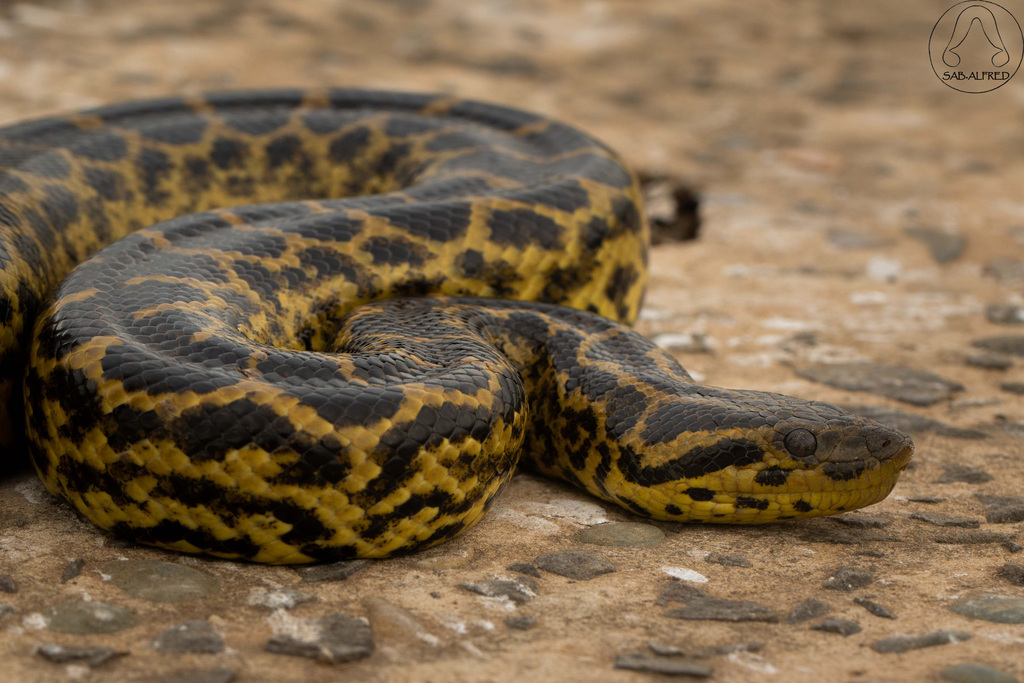
Yellow Anaconda
Eunectes notaeus
The yellow anaconda (Eunectes notaeus), also known as the Paraguayan anaconda, is a boa species endemic to southern South America. It is one of the largest snakes in the world but smaller than its close relative, the green anaconda. No subspecies are currently recognized. Like all boas and pythons, it is non-venomous and kills its prey by constriction.
From the article Yellow anaconda on Wikipedia (CC BY-SA), quoted section by section
Description
Adults grow to an average of 3.7 m (12 ft 1+1⁄2 in) in total length. Females are generally larger than males and have been reported up to 4.6 m (15 ft 1 in) in length. They commonly weigh 25 to 35 kg (55 to 77 lb), but specimens weighing more than 55 kg (121 lb) have been observed. The color pattern consists of a yellow, golden-tan or greenish-yellow ground color overlaid with a series of black or dark brown saddles, blotches, spots and streaks.
Range & habitat
The range of the yellow anaconda encompasses the drainage of the Paraguay River and its tributaries, from the Pantanal region in Bolivia, Paraguay, and western Brazil to northeastern Argentina and northern Uruguay. The anaconda's most suitable habitat occurs mostly in northern Argentina and southern Paraguay. It prefers mostly aquatic habitats, including swamps, marshes, and brush-covered banks of slow-moving rivers and streams. The species appears to have been introduced in Florida, although it is unknown whether the small population (thought to derive from escaped pets) is reproductive. The taxonomic sinking of Eunectes beniensis and Eunectes deschauenseei into Eunectes notaeus proposed by Rivas et al. (2023) results in this species also being found in western Bolivia (and possibly nearby Brazil), northern Brazil, coastal French Guiana and possibly Suriname.
Wikipedia: “Distribution and habitat”
What it does
Yellow anacondas are mostly sequentially monogamous. Males will follow the scent of a female's pheromones in the air to begin courtship which usually happens in the water. Yellow anacondas can form breeding balls which consist of one female and several males at a time. In the breeding ball, the males will fight for access to the female and the largest male typically succeeds. The breeding period for yellow anacondas occurs every year between April and May. The gestation period for female yellow anacondas is 6 months. Females are ovoviviparous, so they will incubate the eggs inside of their body and give birth to live young. The female can give birth anywhere from 4 to 82 young which can be around 60 cm in length. The female leaves the young directly after they are born to fend for themselves. Sexual maturity for yellow anacondas is 3 to 4 years old.
Wikipedia: “Reproduction”
In human culture
The Neo-Latin specific name notaeus derives from Ancient Greek: νωταίος, romanized: nōtaios, lit. 'dorsal' (νωταίος is a poetic form of νωτιαίος/nōtiaios). In distinguishing his new species Eunectes notaeus from Eunectes murinus, Edward Drinker Cope stated, "Dorsal scales are larger and in fewer rows."
Wikipedia: “Etymology”
Where it lives
Recorded sightings
—
geo-referenced records in GBIF, from museums, herbaria and field observers.
Drag the globe to turn it. Dots are where records exist, not a range map; darker means more records.
In the stacks
Searching the stacks…
Every page naming Eunectes notaeus in the Biodiversity Heritage Library →
This page is assembled live from iNaturalist, GBIF, Wikipedia, the Source Library and the Internet Archive. It is not yet part of the hand-edited codex. iNaturalist taxon 100714.