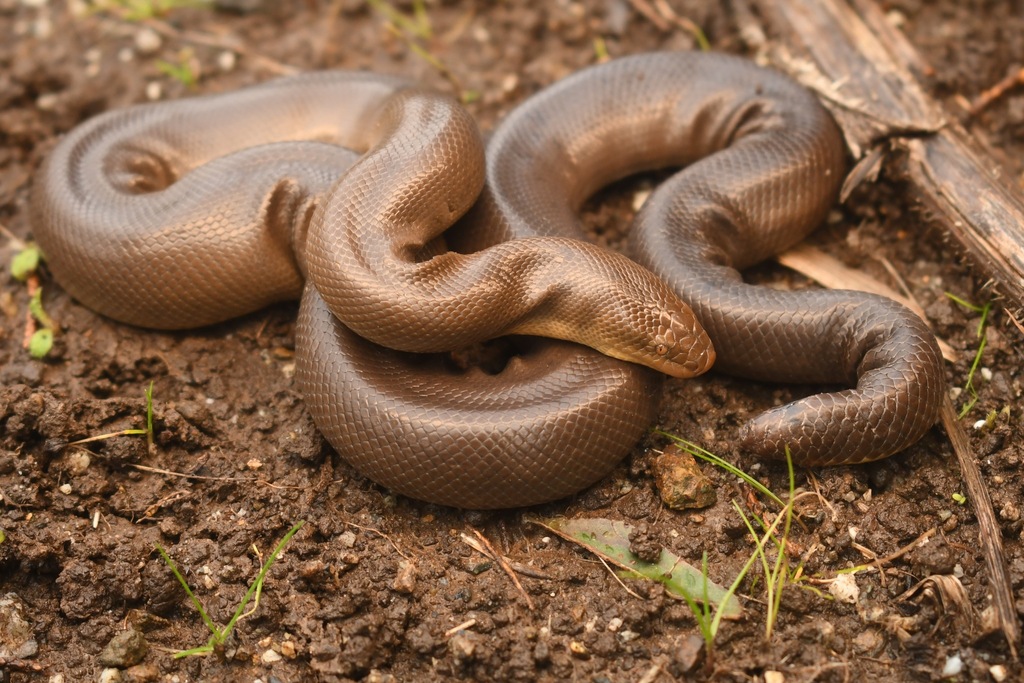
Northern Rubber Boa
Charina bottae
The rubber boa (Charina bottae) is a species of snake in the family Boidae and is native to western North America. It is sometimes known as the coastal rubber boa or the northern rubber boa and is not to be confused with the southern rubber boa (Charina umbratica).
From the article Rubber boa on Wikipedia (CC BY-SA), quoted section by section
Description
Rubber boas are one of the smaller boa species, adults can be anywhere from 38 to 84 cm (1.25 to 2.76 ft) long; newborns are typically 19 to 23 cm (7.5 to 9.1 in) long. The common name is derived from their skin which is often loose and wrinkled and consists of small scales that are smooth and shiny. These characteristics give the snakes a rubber-like look and texture. Colors are typically tan to dark brown with a lighter ventral surface but sometimes olive-green, yellow, or orange. Newborns often appear pink and slightly transparent but darken with age. Rubber boas have small eyes with vertically elliptical pupils and short blunt heads that are no wider than the body. One of the most identifiable characteristics of rubber boas is their short blunt tails that closely resemble the shape of their head. Rubber boas appear quite different visually than any other species that share the same range (except maybe for the southern rubber boa) and thus are usually easy to identify.
Range & habitat
Rubber boas are the most northerly of all boa species. The distribution of rubber boas covers a large portion of the western United States, stretching from the Pacific Coast east to western Utah and Montana, as far south as central California, and as far north as southern British Columbia in Canada. There have also been rare sightings in Colorado and Alberta in addition to the states/provinces that they are known to thrive in: California, Oregon, Washington, Nevada, Utah, Wyoming, Montana, Idaho, and extending to its northernmost range in British Columbia, around Pemberton, Williams Lake, and Radium Hot Springs.
Wikipedia: “Distribution”
What it does
Characteristics of rubber boas' behavior also set them apart from other snakes. Rubber boas are considered one of the most docile of the boa species and are often used to help people overcome their fear of snakes. Rubber boas are known to never strike at or bite a human under any circumstances but will release a potent musk from their vent if they feel threatened. They are primarily nocturnal and likely crepuscular (active during dawn and dusk) which partially contributes to how rarely they are encountered. Because of the temperate regions they inhabit, rubber boas hibernate during the winter months in underground dens.
Hunting. Rubber boas feed primarily on young mammals such as shrews, voles (such as long-tailed voles), mice (such as deer mice), etc. When they encounter nestling mammals, they try to consume the entire litter and fend off the mother with their tail. This is why they often have extensive scarring on their tails. Rubber boas have also been known to prey on salamanders, possibly frogs, snake eggs, lizard eggs, lizards, young birds, small birds, young bats, and there have even been instances of them eating other snakes.
Predation. Rubber boas can be preyed upon by almost any reasonably sized predator in their habitat. When threatened, rubber boas curl into a ball around their head, and expose their tail to mimic their head. …
Wikipedia: “Behavior”
Where it lives
Recorded sightings
—
geo-referenced records in GBIF, from museums, herbaria and field observers.
Drag the globe to turn it. Dots are where records exist, not a range map; darker means more records.
In the stacks
Searching the stacks…
Every page naming Charina bottae in the Biodiversity Heritage Library →
This page is assembled live from iNaturalist, GBIF, Wikipedia, the Source Library and the Internet Archive. It is not yet part of the hand-edited codex. iNaturalist taxon 243962.