 NL·0284
Herbarium of the Nature Library
- Name
- Megaptera novaeangliae
- Family
- Balaenopteridae
- Native to
- All oceans, from polar feeding grounds to tropical breeding grounds; a non-migratory population lives in the Arabian Sea
- Habitat
- Open ocean, Coastal waters, Coral reef lagoons
Humpback whale
Megaptera novaeangliae
Also calledBallena jorobada (Spanish) · Baleia-jubarte (Portuguese) · Koholā (Hawaiian) · Zatōkujira (Japanese) · Keporkak (Greenlandic)
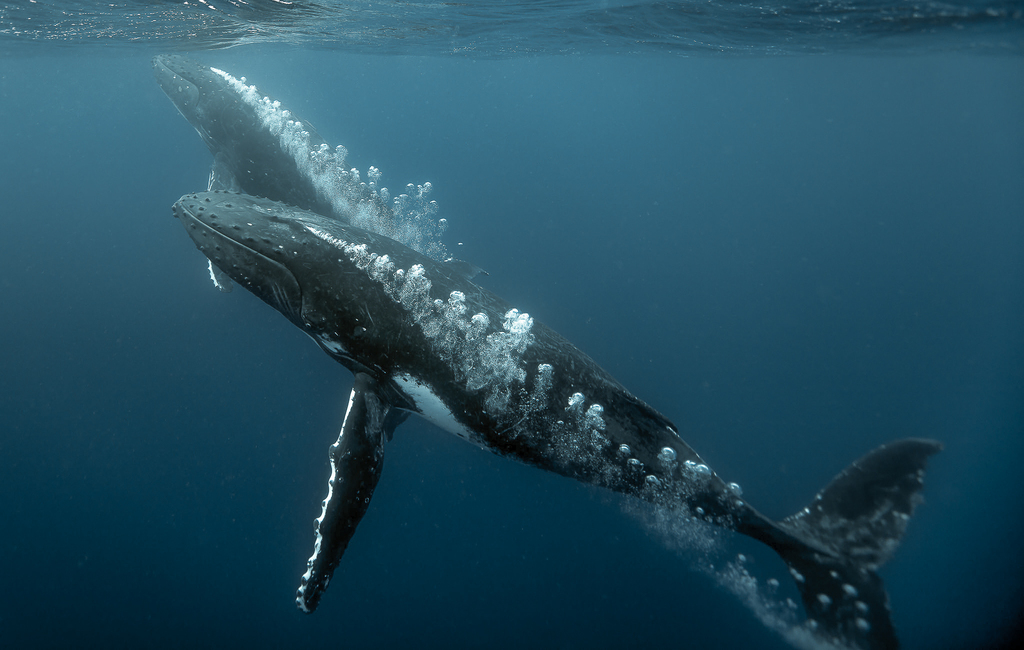
An acrobatic baleen whale with enormous wing-like flippers, known for breaching, bubble-net feeding and some of the most complex songs in the animal kingdom. After commercial whaling ended, most populations have recovered strongly. It migrates thousands of kilometres between cold feeding grounds and tropical breeding grounds every year.
The humpback whale is a species of baleen whale. It is a rorqual and is the only species in the genus Megaptera. Adults range in length from 14–17 m (46–56 ft) and weigh up to 40 metric tons. The humpback has a distinctive body shape, with long pectoral fins and tubercles on its head. It is known for breaching and other distinctive surface behaviors, making it popular with whale watchers. Males produce a complex song that typically lasts from 4 to 33 minutes. Wikipedia
What it can do
- iGroups blow spiralling 'bubble nets' to herd fish into a tight ball, then lunge through it
- iiMales sing complex, structured songs that change over seasons and spread between populations across ocean basins
- iiiMigrations of up to about 8,000 km one way, among the longest of any mammal
- ivFlippers up to a third of body length, with knobbly leading edges that improve lift
In the field
Field marks
- aVery long white or partly white flippers
- bSmall, stubby dorsal fin on a hump, two-thirds of the way back
- cKnobbly tubercles on the head and jaw
- dRaises the tail flukes high before a deep dive; black-and-white underside pattern of each fluke is unique
- eBushy blow, 3–4 m tall
- Voice
- Males' songs are long sequences of moans, groans, whoops and squeals arranged in repeated themes, lasting up to half an hour and repeated for hours.
- Not to be confused with
- Gray whale lacks a dorsal fin and long flippers and is mottled grey. Fin and minke whales have tall, sickle-shaped dorsal fins and seldom raise their flukes. Right whales lack a dorsal fin and have white callosities.
- Where to see it
- Hervey Bay (Queensland); Maui (Hawaii); Vava'u (Tonga); Silver Bank (Dominican Republic); Stellwagen Bank (Massachusetts); Monterey Bay (California); Juneau (Alaska); Húsavík (Iceland); Gulf of Masirah and the Dhofar coast (Oman) for Arabian Sea whales
- When
- Northern breeding grounds January–April; northern feeding grounds May–October; Australia and Tonga July–October
Listen
Looking for field recordings…
Life & habits
- Diet
- Krill and small schooling fish such as herring, capelin, anchovies and sand lance
- Habitat
- Coastal and continental-shelf waters; tropical shallows for breeding
- Size
- 12–16 m; 25–30 tonnes (females larger)
- Lifespan
- About 45–50 years, possibly longer
Breaches, slaps flippers and tails, and travels in loose groups. Mothers and calves stay together for about a year.
Where it lives
Recorded sightings
—
geo-referenced records in GBIF, from museums, herbaria and field observers.
Native range
All oceans, from polar feeding grounds to tropical breeding grounds; a non-migratory population lives in the Arabian Sea
Drag the globe to turn it. Dots are where records exist, not a range map; darker means more records.
In the stacks
Searching the stacks…
Every page naming Megaptera novaeangliae in the Biodiversity Heritage Library →
Marginalia
Roger Payne and Scott McVay's 1971 paper and the album 'Songs of the Humpback Whale' (1970) helped spark the 'Save the Whales' movement; a recording flew on the Voyager Golden Records in 1977.
Curiosity
Its genus name Megaptera means 'big-winged', for flippers that can reach 5 m long.
Kinship





Fact-checked: 2 corrections made to this sheet. Photographs: iNaturalist contributors under the licences shown. Records: GBIF.org. Historical plates: Source Library (CC BY-SA 4.0; originals public domain). Summary text: Nature Library editors and Wikipedia (CC BY-SA). Medicinal and edibility notes are historical and educational, not advice. iNaturalist taxon 41566.