 NL·0283
Herbarium of the Nature Library
- Name
- Balaenoptera musculus
- Family
- Balaenopteridae
- Native to
- All oceans except the high Arctic; distinct populations in the North Atlantic, North Pacific, Indian Ocean and Southern Ocean
- Habitat
- Open ocean, Continental shelf edge, Upwelling zones
Blue whale
Balaenoptera musculus
Also calledBallena azul (Spanish) · Baleine bleue (French) · Lánjīng 蓝鲸 (Chinese) · Shironagasu-kujira (Japanese) · Steypireyður (Icelandic) · Blåhval (Norwegian)
The largest animal known to have ever lived, larger than any dinosaur, reaching about 30 m and well over 150 tonnes. It grows that large almost entirely on krill, shrimp-like animals a few centimetres long.
The blue whale is a species of baleen whale and the largest marine mammal in the rorqual family Balaenopteridae. Reaching a maximum confirmed length of 29.9–30.5 m (98–100 ft) and weighing up to 190–200 t, it is the largest animal known to have ever existed. The blue whale's long and slender body can be of various shades of greyish-blue on its upper surface and somewhat lighter underneath. Four subspecies are recognized: B. m. musculus in the North Atlantic and North Pacific, B. m. intermedia in the Southern Ocean, B. m. brevicauda in the Indian Ocean and South Pacific Ocean, and B. m. indica in the Northern Indian Ocean. There is a population in the waters off Chile that may constitute a fifth subspecies. Wikipedia
What it can do
- iLunge-feeds by engulfing a mouthful of water larger than its own body, then strains it through baleen
- iiCan eat up to around 16 tonnes of krill in a day during the feeding season
- iiiProduces low-frequency calls of up to ~188 dB that can travel hundreds of kilometres underwater
- ivMigrates thousands of kilometres between feeding and breeding grounds
In the field
Field marks
- aEnormous, mottled blue-grey whale
- bTall, straight blow up to about 9 m
- cTiny dorsal fin set far back
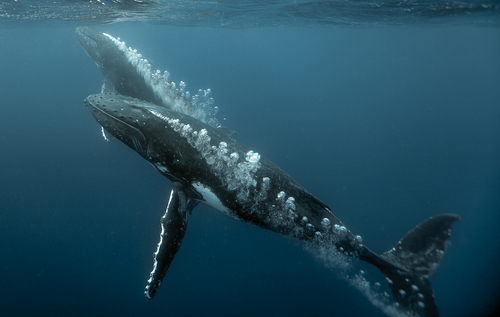
- dBroad, U-shaped head; often raises the tail flukes when diving deep
- Voice
- Very loud, low-frequency moans and pulses, mostly below human hearing
- Not to be confused with
- Fin whale is darker grey with a taller dorsal fin and an asymmetric jaw (white on the right side). Sei whale is smaller with a more prominent fin.
- Where to see it
- Mirissa (Sri Lanka), Monterey Bay and the Santa Barbara Channel (California), Loreto in the Gulf of California
- When
- Sri Lanka Dec–Apr; California Jun–Oct; Gulf of California Feb–Apr
Listen
Looking for field recordings…
Life & habits
- Diet
- Filter feeder: almost entirely krill
- Habitat
- Open ocean and productive upwelling zones along shelf edges
- Size
- Typically 24–27 m; record ~30 m; up to ~150–190 t
- Lifespan
- 80–90 years or more
A lunge takes about ten seconds, the throat pleats ballooning to hold tens of tonnes of water. Calves drink a fat-rich milk and gain around 90 kg a day.
Where it lives
Recorded sightings
—
geo-referenced records in GBIF, from museums, herbaria and field observers.
Native range
All oceans except the high Arctic; distinct populations in the North Atlantic, North Pacific, Indian Ocean and Southern Ocean
Drag the globe to turn it. Dots are where records exist, not a range map; darker means more records.
In the old herbals & bestiaries
No plate in the Source Library names this exact species, so these show its closest relatives as the old naturalists drew them: same genus, or the same kind of animal. Click a plate to read the page it came from, with translation.

In the stacks
Searching the stacks…
Every page naming Balaenoptera musculus in the Biodiversity Heritage Library →
Marginalia
Robert Sibbald described a blue whale stranded on the Firth of Forth in 1692 in his Phalainologia Nova (1694), and the species was long called 'Sibbald's rorqual'. Twentieth-century whaling killed about 360,000 in the Southern Hemisphere before a 1966 ban.
Curiosity
Its heart weighs about 180 kg, and its tongue alone can weigh as much as an elephant.
Kinship




Photographs: iNaturalist contributors under the licences shown. Records: GBIF.org. Historical plates: Source Library (CC BY-SA 4.0; originals public domain). Summary text: Nature Library editors and Wikipedia (CC BY-SA). Medicinal and edibility notes are historical and educational, not advice. iNaturalist taxon 41553.