- Animals
- ›Chordates
- ›Vertebrates
- ›Ray-finned Fishes
- ›Spiny-rayed fishes
- ›Butterflyfishes, Angelfishes, and Allies
- ›Surgeonfishes, Tangs, and Unicornfishes
- ›Acanthurus
- ›Acanthurus triostegus
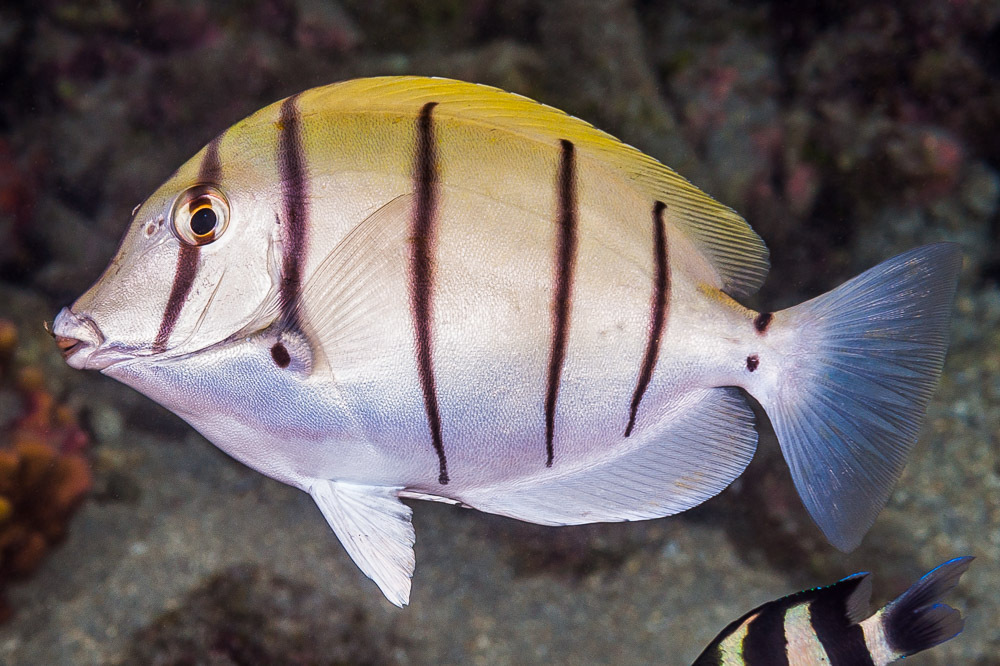
Convict Surgeonfish
Acanthurus triostegus
Acanthurus triostegus, commonly known as convict tang, manini, convict surgeonfish, convict surgeon, or fiveband surgeonfish,
is a species of marine ray-finned fish belonging to the family Acanthuridae which includes the surgeonfishes, unicornfishes and tangs. This species has a wide Indo-Pacific distribution.
From the article Acanthurus triostegus on Wikipedia (CC BY-SA), quoted section by section
Description
The convict tang is so called because of its bold black stripes on a yellowish background. It is a laterally-compressed oval-shaped fish with a maximum length of about 26–27 cm (10–11 in). The head is small with a pointed snout and a terminal mouth with thick lips. It has six black stripes which distinguishes it from the zebra tang (Acanthurus polyzona) which has nine, and has a more restricted range in the Indian Ocean. The first black stripe is oblique and passes through the eye. There are two black spots on the caudal peduncle, and on each side there is a sharp, retractable spine, which is used in offence or defence.
Range & habitat
Acanthurus triostegus occurs in the tropical Indo-Pacific region. Its range extends from the East African coast and Madagascar to southwestern Japan, Australia and Central America, including many Pacific island groups. It is found over hard bottoms in lagoons, reef slopes, bays and estuaries. Juveniles are common in tide pools, and larger fish are found at depths down to about 90 m (300 ft).
Wikipedia: “Distribution and habitat”
In human culture
Acanthurus triostegus was given the specific name triostegus which means "three covers", this may refer to the three branchiostegal membranes.
Wikipedia: “Etymology”
Where it lives
Recorded sightings
—
geo-referenced records in GBIF, from museums, herbaria and field observers.
Drag the globe to turn it. Dots are where records exist, not a range map; darker means more records.
In the stacks
Searching the stacks…
Every page naming Acanthurus triostegus in the Biodiversity Heritage Library →
This page is assembled live from iNaturalist, GBIF, Wikipedia, the Source Library and the Internet Archive. It is not yet part of the hand-edited codex. iNaturalist taxon 59931.