 NL·0767
Herbarium of the Nature Library
- Name
- Turdus merula
- Family
- Turdidae
- Native to
- Europe, North Africa, Turkey, the Caucasus, Iran and Central Asia; introduced to Australia and New Zealand
- Habitat
- Temperate forest, Woodland, Gardens and parks
On eBird ↗
Eurasian Blackbird
Live sightings near you, the range map, bar charts of when it is seen, and Macaulay Library photos and recordings.
Eurasian blackbird
Turdus merula
Also calledShahrur (Arabic) · Karatavuk (Turkish) · Toka-ye siyah (Persian) · Amsel (German) · Merle noir (French) · Mirlo (Spanish)
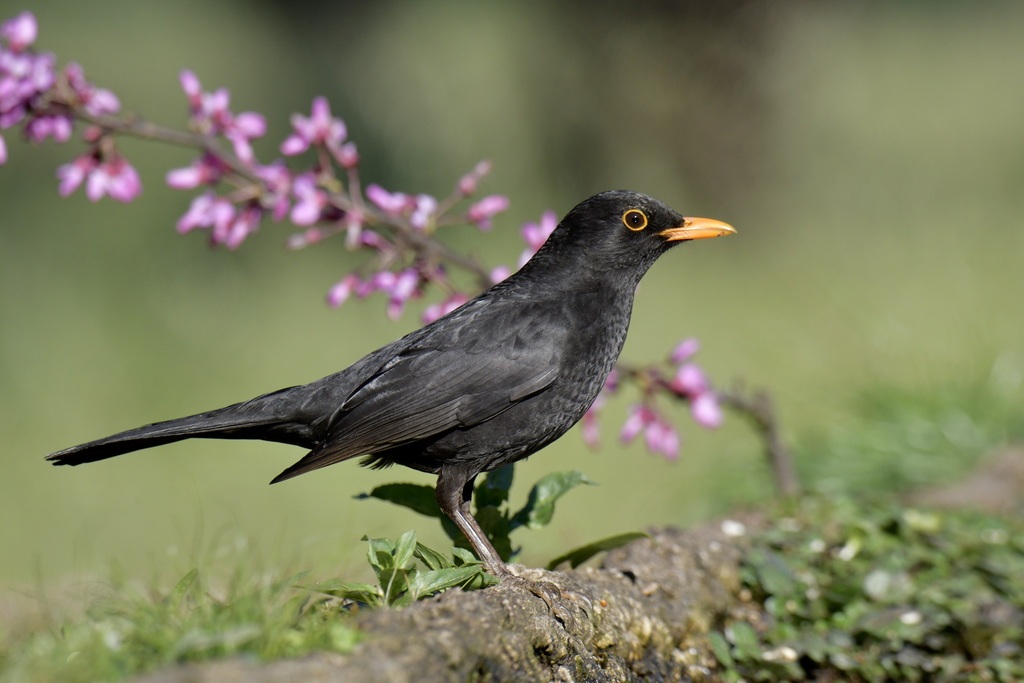
A thrush whose males are jet black with a golden-orange bill and eye-ring. Its unhurried, fluty song is one of the defining sounds of European towns at dusk. It moved from forest into cities in the 19th century, and was later introduced to Australia and New Zealand.
The common blackbird is a species of true thrush. It is also known as the Eurasian blackbird, or simply the blackbird. It breeds in Europe, western Asia, and North Africa, and has been introduced to Australia and New Zealand. It has a number of subspecies across its large range; a few former Asian subspecies are now widely treated as separate species. Depending on latitude, the common blackbird may be resident, partially migratory, or fully migratory. Wikipedia
What it can do
- iUrban populations sing at higher pitch, start earlier in the day and are more sedentary than forest birds
- iiLocates earthworms by sight, cocking its head before stabbing into lawns
- iiiSpreads seeds of hawthorn, ivy, yew and other berry-bearing plants
- ivGives distinct alarm calls for ground predators and for hawks
In the field
Field marks
- aAdult male all-black with a bright orange-yellow bill and eye-ring
- bFemale dark brown with a faintly mottled throat and breast
- cLong tail, often raised on landing
- dFirst-year males have a dark bill and brownish wings
- Voice
- Song a slow, mellow, fluting warble in relaxed phrases that often trail off into squeaky twitters; alarm a frantic, rattling 'chink-chink-chink' and a thin 'tsee' for aerial predators.
- Not to be confused with
- Ring ouzel males have a white crescent on the breast and pale wing panels. Common starling is smaller, short-tailed, glossy and spotted, and walks rather than hops. Females can suggest song thrushes but are much darker and not boldly spotted.
- Where to see it
- Any European park, garden or woodland; common in Moroccan and Turkish towns and Central Asian orchards.
- When
- Resident in most of Europe; northern and eastern birds move south and west in winter
Listen
Looking for field recordings…
Life & habits
- Diet
- Earthworms, insects, snails; fruit and berries in autumn and winter
- Habitat
- Woodland, hedges, parks, gardens and towns
- Size
- 23.5–29 cm; 80–125 g
- Lifespan
- Typically 2–4 years
Turns over leaf litter by flicking it aside with its bill, and at dusk 'chinks' loudly while going to roost.
Where it lives
Recorded sightings
—
geo-referenced records in GBIF, from museums, herbaria and field observers.
Native range
Europe, North Africa, Turkey, the Caucasus, Iran and Central Asia; introduced to Australia and New Zealand
Drag the globe to turn it. Dots are where records exist, not a range map; darker means more records.
In the old herbals & bestiaries
Woodcuts and engravings matched from the Source Library’s scanned books by name. Plates marked “relative” show a close kin rather than this exact species. Click a plate to read the page it came from, with translation.

Garden of Health (Hortus Sanitatis)
Jacob Meydenbach · 1491 · p.584

History of Animals, Book I: On Viviparous Quadrupeds
Conrad Gessner · 1554 · p.769

History of Animals, Book I: On Viviparous Quadrupeds
Conrad Gessner · 1554 · p.765

Historiae Animalium Liber III: De Avium Natura
Conrad Gesner · 1555 · p.624

Historiae Animalium Liber III: De Avium Natura
Conrad Gesner · 1555 · p.620

History of Animals, Book II: On Oviparous Quadrupeds
Conrad Gessner · 1586 · p.381

Noah's Ark
Athanasius Kircher · 1675 · p.138

Garden of Health
1507 · p.526
In the stacks
Searching the stacks…
Every page naming Turdus merula in the Biodiversity Heritage Library →
Marginalia
The Irish quatrain 'The Blackbird of Belfast Lough', probably composed in the ninth century and preserved in later metrical tracts, is among the best-loved early Irish nature verse; the 'four and twenty blackbirds baked in a pie' of the nursery rhyme echo real Renaissance banquet tricks.
Curiosity
Blackbirds introduced to Australia in the 1850s–60s became an agricultural pest and help spread invasive blackberry by eating its fruit.
Kinship

Fact-checked: 1 correction made to this sheet. Photographs: iNaturalist contributors under the licences shown. Records: GBIF.org. Historical plates: Source Library (CC BY-SA 4.0; originals public domain). Summary text: Nature Library editors and Wikipedia (CC BY-SA). Medicinal and edibility notes are historical and educational, not advice. iNaturalist taxon 12716.