On eBird ↗
Helmeted Friarbird
Live sightings near you, the range map, bar charts of when it is seen, and Macaulay Library photos and recordings.
Helmeted Friarbird
Philemon buceroides
The helmeted friarbird (Philemon buceroides) is part of the Meliphagidae family. The helmeted friarbird, along with all their subspecies, is commonly referred to as "leatherhead" by the birding community.
From the article Helmeted friarbird on Wikipedia (CC BY-SA), quoted section by section
Description
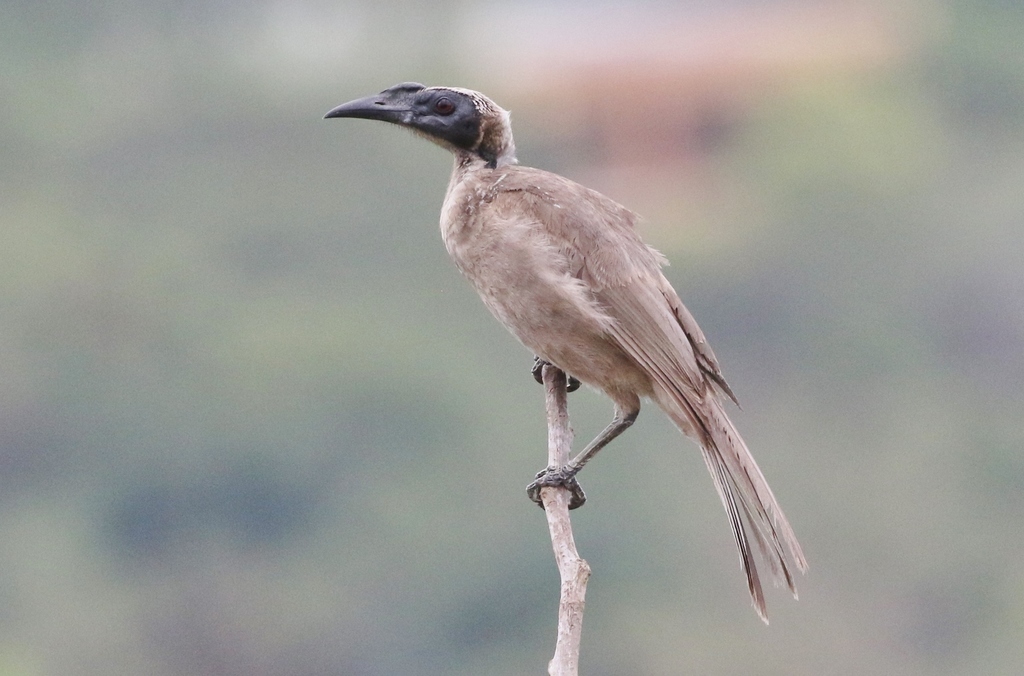
The helmeted friarbird has a dark gray face with red eyes. This bird is a gray-brown bird with a fading white as it comes toward the chest. As the spotted chest approaches the feet, it starts to tint darker until it gets to the feet. The bird ranges from 32 to 36 centimeters weighing in at 127-179g for males and 92-112g for females. The average male measures about 38 cm, and is the largest subspecies of the 4 helmeted friarbirds found in Australia.
Range & habitat
The helmeted friarbird is most prominently abundant in the Northern Territory coasts of Australia and Indonesia. The specific habitat of the friarbird varies based on the subspecies; however, they are mainly found in subtropical or tropical dry forests, lowland forests, and mangrove forests. While building nests, the friarbirds typically use bark, leaves and stems to create a sturdy structure. They will also use sticks for extra support and grass for comfort. They tend to build their nests close to a body of water and high in trees to avoid harm.
Wikipedia: “Distribution and habitat”
What it does
The helmeted friarbird is very vocal with loud "squawks" that can be heard from afar. They are known for sounding like keeyo-keoway or kowee ko keeyo which can be repeated up to a dozen times. In addition, they also vocalize kurr-rk frequently which they slowly repeat from eight to ten times. The friarbird typically is more vocal in the morning and during storms and is quiet throughout the rest of the time. There are only slim differences between the male and female as well.
Breeding. Breeding for the helmeted friarbird most commonly happens throughout the months of September to February, occasionally throughout the months of February to May and October to December, but never in the months of May and July. While breeding the helmeted friarbird typically lays 2-4 eggs at a time; however, they can lay up to 5 at a time. The incubation period only takes 15-18 days. The lifespan of a helmeted friarbird is roughly 5-7 years. The helmeted friarbird's population has currently been evaluated as stable; however, it is suspected that within the next 10 years the population will decrease by 10%, therefore ultimately classifying the species as vulnerable. The friarbird is quickly becoming closer to extinction with a decrease of ten percent after every generation. With the average lifespan only being five to seven years, this species is in danger. …
Wikipedia: “Behaviour”
Listen
Looking for field recordings…
Where it lives
Recorded sightings
—
geo-referenced records in GBIF, from museums, herbaria and field observers.
Drag the globe to turn it. Dots are where records exist, not a range map; darker means more records.
In the stacks
Searching the stacks…
Every page naming Philemon buceroides in the Biodiversity Heritage Library →
This page is assembled live from iNaturalist, GBIF, Wikipedia, the Source Library and the Internet Archive. It is not yet part of the hand-edited codex. iNaturalist taxon 12345.