On eBird ↗
Pied-billed Grebe
Live sightings near you, the range map, bar charts of when it is seen, and Macaulay Library photos and recordings.
Pied-billed Grebe
Podilymbus podiceps
The pied-billed grebe (Podilymbus podiceps) is a species of the grebe family of water birds. Since the Atitlán grebe (Podilymbus gigas) has become extinct, it is the sole extant member of the genus Podilymbus. The pied-billed grebe is primarily found in ponds throughout the Americas. Other names of this grebe include American dabchick, dabchick, Carolina grebe, devil-diver, dive-dapper, dipper, hell-diver, pied-billed dabchick, pied-bill, thick-billed grebe, and water witch.
From the article Pied-billed grebe on Wikipedia (CC BY-SA), quoted section by section
Description
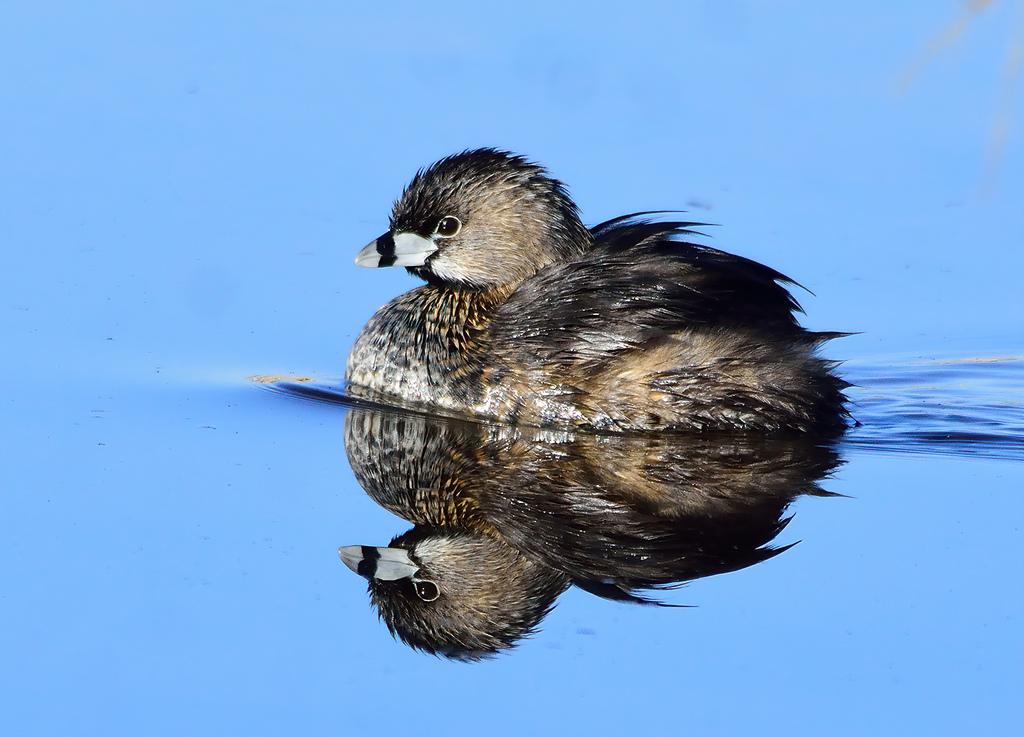
Pied-billed grebes are small, stocky, and short-necked. They are 31–38 cm (12–15 in) in length, with a wingspan of 45–62 cm (18–24 in) and weigh 253–568 g (8.9–20.0 oz). They are mainly brown, with a darker crown and back. Their brown color serves as camouflage in the marshes they live in. They do not have white visible under their wings when flying, like other grebes. Their undertail is white and they have a short, blunt chicken-like bill that is a light grey color, which in summer is encircled by a broad black band (hence the name). In the summer, its throat is black. There is no sexual dimorphism. Juveniles have black and white stripes and look more like winter adults. This grebe does not have webbed feet. Its toes have lobes that come out of the side of each toe. These lobes allow for easy paddling. When flying, the feet appear behind the body due to the feet's placement in the far back of the body. Because of the feet placement, they are not able to walk on land. These grebes may be confused with the least grebe, although that species is much smaller and has a thinner bill. Other similarly sized grebes are very distinct in plumage, i.e. the eared grebe and horned grebe. …
Range & habitat
They are most commonly found throughout North and Central America, the Caribbean, and South America year round. During the summer breeding season, they are most prevalent in central, northern and northeastern Canada. If they live in an area where the water freezes in the winter they will migrate. Migrating birds generally meet with year-round birds in September and October. They migrate at night. Most migratory birds leave in March or April. They make occasional appearances in Europe and Hawaii. In the United Kingdom, pied-billed grebe visits have numbered 45 sightings as of 2019, appearing generally in October to January. One bird in England bred with a little grebe, producing hybrid young. It is the only grebe on record to have visited the Galapagos Islands. Pied-billed grebes are found in freshwater wetlands with emergent vegetation, such as cattails. They are occasionally found in salt water. When breeding they are found in emergent vegetation near open water, and in the winter they are primarily found in open water due to the lack of nests to maintain. They may live near rivers, but prefer still water. They may be found in higher elevations when migrating. They will breed in restored and man-made wetlands. Pied-billed grebes live approximately 10–12 years.
Wikipedia: “Distribution and habitat”
What it does
Pied-billed grebes rarely fly. They make a slow dive frequently, especially when in danger, diving to about 20 ft (6.1 m) or less. They dive for about 30 seconds and may move to a more secluded area of the water, allowing only the head to be visible to watch the danger dissipate. This frequency in diving has earned them the description of being reclusive or shy, and the nickname "hell-diver". Pied-billed grebes can trap air in their feathers, which controls their buoyancy. They rarely spend time in flocks. Their courtship include calling and sometimes duets. Males will show territorial behaviour if another male is at the edge of his territory. They face each other and then turn their heads and bills up. Then they turn away and start calling. Then they turn back around to look at one another.
Breeding. The pied-billed grebe breeds in south-central Canada, throughout the United States, Central America, the Caribbean, and temperate South America. These grebes may lay up to two sets of eggs a year. Their nests sit on top of the water, their eggs sitting in vegetation that resides in the water. Grebes lay between three and ten bluish white smooth elliptical eggs with the female starting the incubation process. They are incubated for around 23 days by both parents, with the female taking over incubation duties towards the end of that time period. …
Wikipedia: “Behaviour”
In human culture
Pied-billed grebe feathers are thick and soft. Their feathers were formerly used as decorations on hats and earmuffs and they were hunted in the eastern United States, in the 19th century.
Wikipedia: “In culture”
Listen
Looking for field recordings…
Where it lives
Recorded sightings
—
geo-referenced records in GBIF, from museums, herbaria and field observers.
Drag the globe to turn it. Dots are where records exist, not a range map; darker means more records.
In the old herbals & bestiaries

In the stacks
Searching the stacks…
Every page naming Podilymbus podiceps in the Biodiversity Heritage Library →
This page is assembled live from iNaturalist, GBIF, Wikipedia, the Source Library and the Internet Archive. It is not yet part of the hand-edited codex. iNaturalist taxon 4246.