On eBird ↗
Little Grebe
Live sightings near you, the range map, bar charts of when it is seen, and Macaulay Library photos and recordings.
Little Grebe
Tachybaptus ruficollis
The little grebe (Tachybaptus ruficollis), also known as the dabchick, is a member of the grebe family of water birds. The genus name is from Ancient Greek takhus "fast" and bapto "to sink under". The specific ruficollis is from Latin rufus "red" and Modern Latin -collis, "-necked", itself derived from Latin collum "neck".
At 23 to 29 centimetres (9 to 11+1⁄2 inches) in length it is the smallest European, Asian, and African member of its family. It is commonly found in open bodies of water across most of its range.
From the article Little grebe on Wikipedia (CC BY-SA), quoted section by section
Description
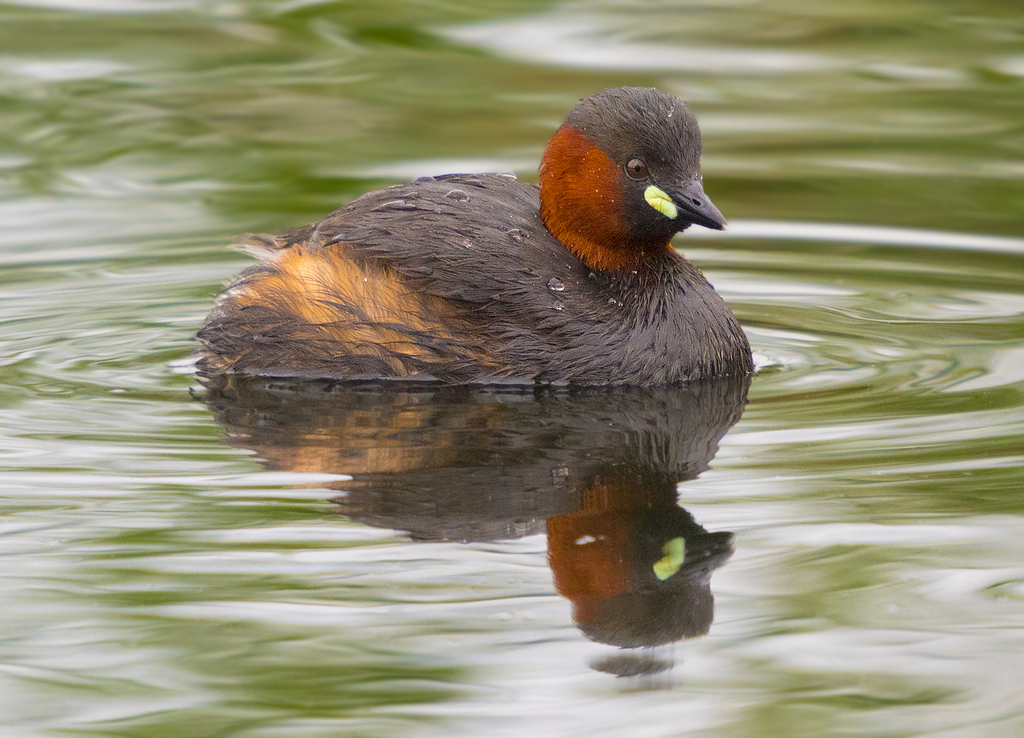
The little grebe is a small water bird with a pointed bill. The adult is unmistakable in summer, predominantly dark above with its rich, rufous colour neck, cheeks and flanks, and bright yellow gape. The rufous is replaced by a dirty brownish grey in non-breeding and juvenile birds. Juvenile birds have a yellow bill with a small black tip, and black and white streaks on the cheeks and sides of the neck as seen below. This yellow bill darkens as the juveniles age, eventually turning black in adulthood. In winter, its size, buff plumage, with a darker back and cap, and "powder puff" rear end enable easy identification of this species. The little grebe's breeding call, given singly or in duet, is a trilled repeated weet-weet-weet or wee-wee-wee which sounds like a horse whinnying.
Range & habitat
This bird breeds in small colonies in heavily vegetated areas of freshwater lakes across Europe, much of Asia down to New Guinea, and most of Africa. Most birds move to more open or coastal waters in winter, but it is only migratory in those parts of its range where the waters freeze. Outside of breeding season, it moves into more open water, occasionally even appearing on the coast in small bays.
Wikipedia: “Distribution”
What it does
The little grebe is an excellent swimmer and diver and pursues its fish and aquatic invertebrate prey underwater. It uses the vegetation skilfully as a hiding place. Like all grebes, it nests at the water's edge, since its legs are set very far back and it cannot walk well. Usually four to seven eggs are laid. When the adult bird leaves the nest it usually takes care to cover the eggs with weeds. This makes it less likely to be detected by predators. The young leave the nest and can swim soon after hatching, and chicks are often carried on the backs of the swimming adults. In India, the species breeds during the rainy season.
Wikipedia: “Behaviour”
Listen
Looking for field recordings…
Where it lives
Recorded sightings
—
geo-referenced records in GBIF, from museums, herbaria and field observers.
Drag the globe to turn it. Dots are where records exist, not a range map; darker means more records.
In the old herbals & bestiaries

In the stacks
Searching the stacks…
Every page naming Tachybaptus ruficollis in the Biodiversity Heritage Library →
This page is assembled live from iNaturalist, GBIF, Wikipedia, the Source Library and the Internet Archive. It is not yet part of the hand-edited codex. iNaturalist taxon 4237.