On eBird ↗
Sanderling
Live sightings near you, the range map, bar charts of when it is seen, and Macaulay Library photos and recordings.
Sanderling
Calidris alba
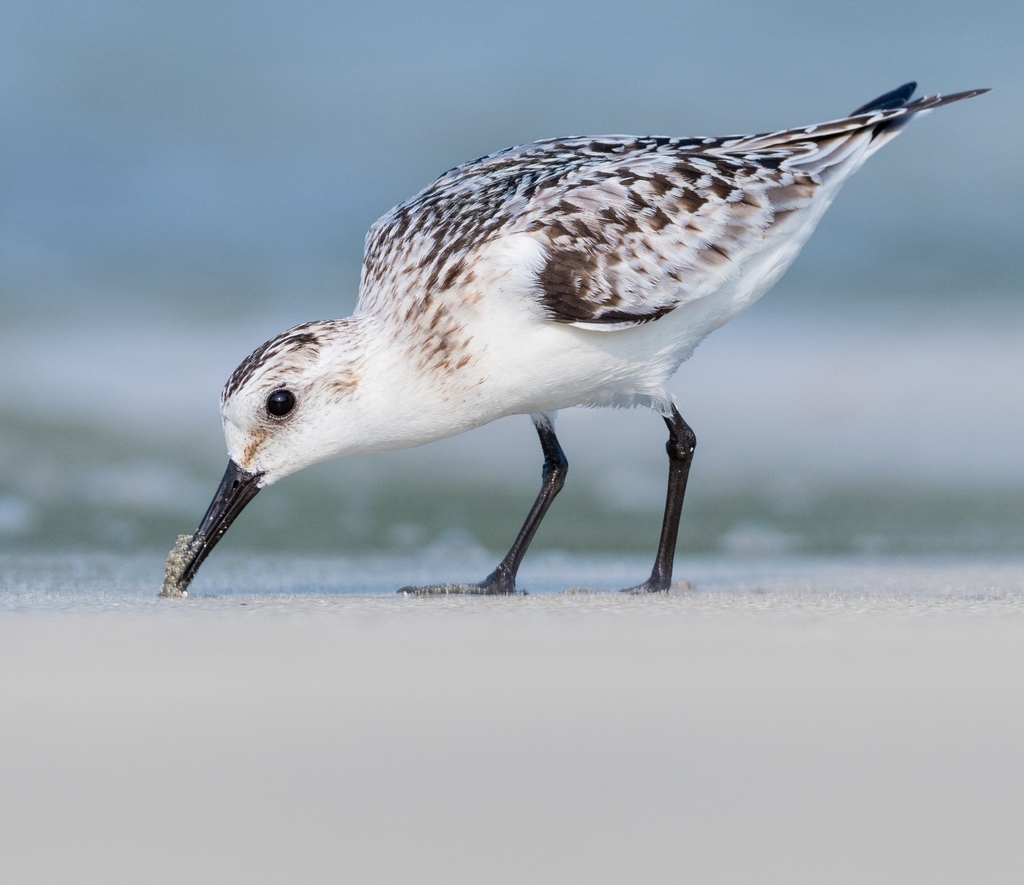
The sanderling (Calidris alba) is a small wading bird. It is a circumpolar Arctic breeder, being among the most extreme northern breeding birds in the world, nesting only on the coldest tundra, north of the 5°C July isotherm; in Europe, its southernmost breeding locality is Svalbard, where only a handful (5–15) pairs breed. It is a long-distance migrant, wintering south to South America, western and southern Europe, Africa, and Australia. It is highly gregarious in winter, sometimes forming large flocks on coastal mudflats or sandy beaches.
It is somewhat unlike other small sandpipers in appearance, in particular in lacking a hind toe, which has led to the suggestion that it should be placed into a monotypic genus Crocethia. More recent reviews indicate that the sanderling is a fairly typical "stint" or small sandpiper and should be retained along with the knots and other relatives in the genus Calidris.
From the article Sanderling on Wikipedia (CC BY-SA), quoted section by section
Description
The sanderling is a small plump sandpiper, 18–20 cm (7–8 in) in length. Its weight ranges from 40–100 g (1+1⁄2–3+1⁄2 oz). The winter bird is very pale, almost white apart from a dark shoulder patch. This is the source of the specific name, alba, which is the Latin for "white". Later in the summer, the face and throat become brick-red. The juvenile bird is spangled black and white, and shows much more contrast than the adult.
If its size is misjudged, a sanderling in breeding plumage can be mistaken for some varieties of stint, or a sanderling in winter plumage can be mistaken for a dunlin or red knot. It can be told from other small wading birds, given good views, by its lack of a hind toe. Its behaviour is also distinctive.
Range & habitat
The sanderling breeds in the High Arctic areas of North America, Europe and Asia. In North America, it breeds in the Canadian Arctic Archipelago, Nunavut, Greenland (and to a lesser extent Alaska). In Eurasia, it breeds in Spitsbergen and areas of northern Russia from the Taymyr Peninsula to the New Siberian Islands. In the northern winter, it has a nearly cosmopolitan distribution across the world's marine coasts. It is a complete migrant, travelling between 3,000 to 10,000 km (2,000 to 6,000 mi) from its breeding grounds to its wintering sites. Birds that travel further also arrive later and leave sooner. Most adults leave the breeding grounds in July and early August, whereas juvenile birds leave in late August and early September. The northward migration begins in March at the southern end of their winter distribution. The breeding habitat of the sanderling is coastal tundra north of 5 °C (41 °F) July isotherm. The species typically chooses nesting sites on dry stony areas near wet areas, from 60 to 800 m (200 to 2,600 ft) above sea level. During the winter and its migration, it is most commonly found on coastal sandy beaches, but also occurs on tidal sand flats, mud flats and the shores of lakes and rivers. More infrequently, it may occur on rocky shores.
Wikipedia: “Distribution, habitat and migration”
What it does
Sanderlings feed on invertebrate prey buried in the sand in the upper intertidal zone. In North America, this diet largely consists of the isopods Excirolana linguifrons, Excirolana kincaidii, and the mole crab, Emerita analoga. When the tide is out, these crustaceans live in burrows some way beneath the surface. When the tide comes in, they move into the upper layers of sand and feed on the plankton and detritus that washes over them with each wave. They then burrow rapidly down again as the water retreats. They leave no marks on the surface, so the sanderlings hunt for them by plunging their beaks into the sand at random, consuming whatever they find. Their bills can penetrate only 2 or 3 cm (0.79 or 1.18 in) and as the water swirls around and retreats, the sand is softer; this makes it easier for the birds' beaks to penetrate further. In the spring, when much breeding activity is taking place in the benthic community, there may be as many as 4000 invertebrates per square metre, but their average size is smaller than later in the year. The birds appear to rush madly around at the edge of the surf, but in reality they are maximising their chances of catching as many prey animals as possible when they are at their most vulnerable near the surface.
Wikipedia: “Feeding behaviour”
In human culture
The sanderling's name derives from the Old English sand-yrðling, "sand-ploughman". The genus name is from Ancient Greek: καλίδρις : kalídris or σκαλίδρις : skalídris, a term used by Aristotle for some grey-coloured waterside birds. The species name, alba, is Latin for "white". The sanderling consists of two subspecies:
C. a. alba, (Pallas, 1764), breeds on Ellesmere Island, north & east Greenland, Svalbard, Franz Josef Land and the Taymyr Peninsula C. a. rubida, (Gmelin, 1789), breeds in northeast Siberia, Alaska and northern Canada
Wikipedia: “Taxonomy and etymology”
Listen
Looking for field recordings…
Where it lives
Recorded sightings
—
geo-referenced records in GBIF, from museums, herbaria and field observers.
Drag the globe to turn it. Dots are where records exist, not a range map; darker means more records.
In the stacks
Searching the stacks…
Every page naming Calidris alba in the Biodiversity Heritage Library →
This page is assembled live from iNaturalist, GBIF, Wikipedia, the Source Library and the Internet Archive. It is not yet part of the hand-edited codex. iNaturalist taxon 3849.