 NL·0687
Herbarium of the Nature Library
- Name
- Limosa lapponica
- Family
- Scolopacidae
- Native to
- Breeds in Arctic Eurasia and Alaska; winters on coasts of Europe, Africa, Asia, Australia and New Zealand
- Habitat
- Tundra, Mudflats, Estuaries
On eBird ↗
Bar-tailed Godwit
Live sightings near you, the range map, bar charts of when it is seen, and Macaulay Library photos and recordings.
Bar-tailed godwit
Limosa lapponica
Also calledKuaka (Māori) · Aguja colipinta (Spanish) · Pfuhlschnepfe (German) · Bānwěi chéngyù (Chinese, 斑尾塍鹬)
A long-billed shorebird holding the record for the longest nonstop flight of any bird. Godwits fly from Alaska to New Zealand and Australia across the Pacific without feeding, drinking or resting.
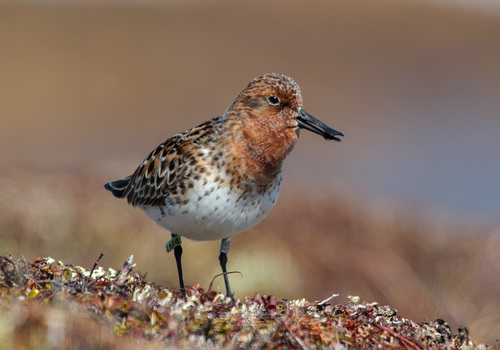
The bar-tailed godwit is a large and strongly migratory wader in the family Scolopacidae, which feeds on bristle-worms and shellfish on coastal mudflats and estuaries. It has distinctive red breeding plumage, long legs, and a long upturned bill. Bar-tailed godwits breed on Arctic coasts and tundra from Scandinavia to Alaska, and overwinter on coasts in temperate and tropical regions of Australia and New Zealand. The migration of the subspecies Limosa lapponica baueri across the Pacific Ocean from Alaska to New Zealand is the longest known non-stop flight of any bird, and also the longest journey without pausing to feed by any animal. The round-trip migration for this subspecies is over 29,000 km (18,020 mi). Wikipedia
What it can do
- iRecorded nonstop flight of 13,560 km in about 11 days (Alaska to Tasmania, 2022)
- iiShrinks digestive organs before migration to carry more fat
- iiiFat can make up over half its body weight at departure
- ivTimes departure to ride favourable winds from storm systems
- vProbes deep into mud for worms with a sensitive bill
In the field
Field marks
- aLarge wader with a long, slightly upturned bill
- bBreeding male brick-red below
- cWinter birds grey-brown, streaked
- dBarred tail and no wing bar in flight
- Voice
- A nasal 'kirruk' or 'kew-kew'
- Not to be confused with
- Black-tailed godwit has a straighter bill, longer legs, a bold white wing bar and a black tail band.
- Where to see it
- Miranda (Firth of Thames) and Farewell Spit, New Zealand; the Wash and Morecambe Bay, England
- When
- Breeds in the Arctic Jun–Jul; New Zealand Sep–Mar; Europe mainly in winter
Listen
Looking for field recordings…
Life & habits
- Diet
- Marine worms, molluscs and crustaceans; insects on breeding grounds
- Habitat
- Arctic tundra in summer; tidal mudflats in winter
- Size
- 37–41 cm; females with longer bills
- Lifespan
- Over 20 years
Flocks leave Alaska in autumn on north winds and fly over the open Pacific for over a week.
Where it lives
Recorded sightings
—
geo-referenced records in GBIF, from museums, herbaria and field observers.
Native range
Breeds in Arctic Eurasia and Alaska; winters on coasts of Europe, Africa, Asia, Australia and New Zealand
Drag the globe to turn it. Dots are where records exist, not a range map; darker means more records.
In the old herbals & bestiaries
No plate in the Source Library names this exact species, so these show its closest relatives as the old naturalists drew them: same genus, or the same kind of animal. Click a plate to read the page it came from, with translation.


In the stacks
Searching the stacks…
Every page naming Limosa lapponica in the Biodiversity Heritage Library →
Marginalia
Māori knew kuaka as birds that flew to Hawaiki and beyond, and their departure marked seasons. Their epic flights were proven by satellite tags in 2007, when a female called E7 flew 11,680 km nonstop.
Curiosity
The record bird, tagged '234684', was only five months old when it made its flight.
Kinship





Photographs: iNaturalist contributors under the licences shown. Records: GBIF.org. Historical plates: Source Library (CC BY-SA 4.0; originals public domain). Summary text: Nature Library editors and Wikipedia (CC BY-SA). Medicinal and edibility notes are historical and educational, not advice. iNaturalist taxon 3951.