 NL·0251
Herbarium of the Nature Library
- Name
- Fratercula arctica
- Family
- Alcidae
- Native to
- North Atlantic: breeds from Brittany, Britain and Ireland to Iceland, Norway, the Faroes and Svalbard, and from Maine to Greenland; winters at sea, south to the Canaries and western Mediterranean
- Habitat
- Open ocean, Coastal cliffs, Islands
On eBird ↗
Atlantic Puffin
Live sightings near you, the range map, bar charts of when it is seen, and Macaulay Library photos and recordings.
Atlantic puffin
Fratercula arctica
Also calledLundi (Icelandic) · Lunde (Norwegian) · Pâl (Welsh) · Buthaid (Scottish Gaelic) · Papageitaucher (German) · Macareux moine (French)
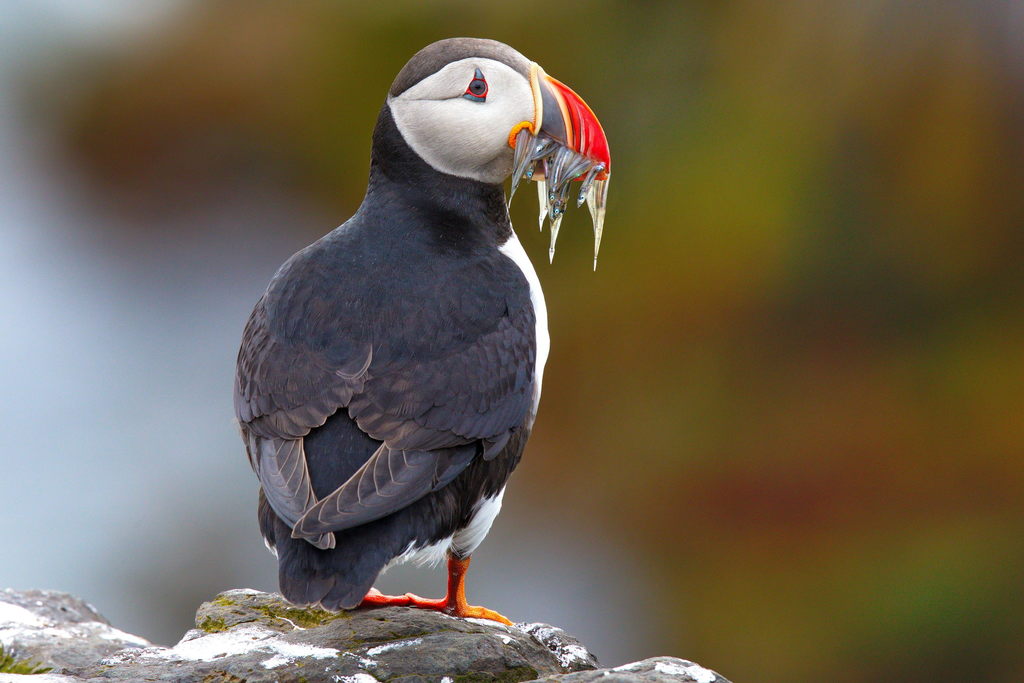
A small auk with a huge, colourful bill, nesting in burrows on grassy sea cliffs. It 'flies' underwater to catch small fish and brings them back crosswise in its bill.
The Atlantic puffin, also known as the common puffin, is a species of seabird in the auk family. It is the only puffin native to the Atlantic Ocean; two related species, the tufted puffin and the horned puffin, are found in the northeastern Pacific. The Atlantic puffin breeds in Russia, Iceland, Ireland, Britain, Norway, Greenland, Newfoundland and Labrador, Nova Scotia, and the Faroe Islands, and as far south as Maine in the west and France (Brittany). It is most commonly found in the Westman Islands, Iceland. Although it has a large population and a wide range, the species has declined rapidly, at least in parts of its range, resulting in it being rated as vulnerable by the IUCN. On land, it has the typical upright stance of an auk. At sea, it swims on the surface and feeds on zooplankton, small fish, and crabs, which it catches by diving underwater, using its wings for propulsion. Wikipedia
What it can do
- iCarries a dozen or more fish at once, held against spines on its tongue and palate
- iiDives to depths of several tens of metres, propelled by its wings
- iiiDigs burrows with bill and feet in cliff-top turf
- ivIts bill sheath fluoresces under ultraviolet light
In the field
Field marks
- aBlack upperparts and collar, white face and underparts
- bLarge, triangular bill striped red, yellow and blue-grey in summer
- cOrange legs and feet
- dFast, whirring flight low over the sea
- Voice
- A low, growling 'arr-arr' from inside burrows; silent at sea.
- Not to be confused with
- Razorbill and guillemots are larger with thinner bills and no coloured beak. Little auk is tiny with a stubby black bill. In winter the puffin's bill and face are duller.
- Where to see it
- Skomer (Wales), Farne Islands and Isle of May (Britain), Látrabjarg and Westman Islands (Iceland), Runde (Norway), Machias Seal Island (Canada/USA).
- When
- At colonies late Mar–early Aug; at sea in winter
Listen
Looking for field recordings…
Life & habits
- Diet
- Sandeels, sprats, capelin and other small fish
- Habitat
- Open sea; breeds on islands and cliffs with soft turf
- Size
- 26–29 cm; wingspan 47–63 cm; 320–550 g
- Lifespan
- Often 20+ years
Pairs reunite at the same burrow each year and greet each other by tapping bills ('billing').
Where it lives
Recorded sightings
—
geo-referenced records in GBIF, from museums, herbaria and field observers.
Native range
North Atlantic: breeds from Brittany, Britain and Ireland to Iceland, Norway, the Faroes and Svalbard, and from Maine to Greenland; winters at sea, south to the Canaries and western Mediterranean
Drag the globe to turn it. Dots are where records exist, not a range map; darker means more records.
In the old herbals & bestiaries
Woodcuts and engravings matched from the Source Library’s scanned books by name. Plates marked “relative” show a close kin rather than this exact species. Click a plate to read the page it came from, with translation.

In the stacks
Searching the stacks…
Every page naming Fratercula arctica in the Biodiversity Heritage Library →
Marginalia
Lundy Island in the Bristol Channel takes its name from the Norse word 'lundi', puffin, and in medieval England the bird's fishy flesh was sometimes accepted as Lenten food.
Curiosity
The colourful outer bill plates are shed after the breeding season, leaving a smaller, duller bill in winter.
Kinship



Photographs: iNaturalist contributors under the licences shown. Records: GBIF.org. Historical plates: Source Library (CC BY-SA 4.0; originals public domain). Summary text: Nature Library editors and Wikipedia (CC BY-SA). Medicinal and edibility notes are historical and educational, not advice. iNaturalist taxon 4504.