- Animals
- ›Chordates
- ›Vertebrates
- ›Birds
- ›Pelicans, Herons, Ibises, and Allies
- ›Ibises and Spoonbills
- ›Threskiornis
On eBird ↗
African Sacred Ibis
Live sightings near you, the range map, bar charts of when it is seen, and Macaulay Library photos and recordings.
African Sacred Ibis
Threskiornis aethiopicus
The African sacred ibis (Threskiornis aethiopicus) is a species of ibis, a wading bird of the family Threskiornithidae. It is native to much of Africa, as well as small parts of Iraq, Iran and Kuwait. It is especially known for its role in Ancient Egyptian religion, where it was linked to the god Thoth. The species is currently extirpated from Egypt.
From the article African sacred ibis on Wikipedia (CC BY-SA), quoted section by section
Description
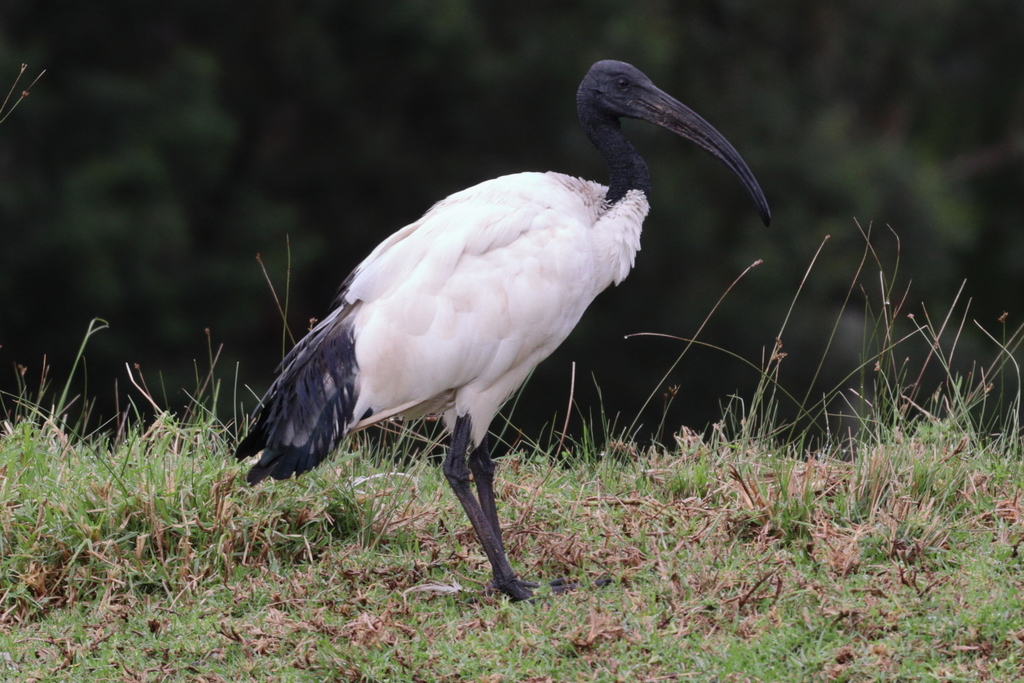
An adult individual is 68 cm (27 in) long with all-white body plumage apart from dark plumes on the rump. Wingspan is 112 to 124 cm (44 to 49 in) and body weight 1.35 to 1.5 kg (3.0 to 3.3 lb). Males are generally slightly larger than females. The bald head and neck, thick curved bill and legs are black. The white wings show a black rear border in flight. The eyes are brown with a dark red orbital ring. Sexes are similar, but juveniles have dirty white plumage, a smaller bill and some feathering on the neck, greenish-brown scapulars and more black on the primary coverts. This bird is usually silent, but occasionally makes puppy-like yelping noises, unlike its vocal relative, the hadada ibis.
Range & habitat
The African sacred ibis occurs in marshy wetlands and mud flats, both inland and on the coast. It preferably nests on trees in or near water. It feeds wading in very shallow wetlands or slowly stomping in wet pastures with soft soil. It will also visit cultivation and rubbish dumps.
Wikipedia: “Habitat”
What it does
The species are predators which feed primarily by day, generally in flocks. The diet consists of mainly insects, worms, crustaceans, molluscs and other invertebrates, as well as various fish, frogs, reptiles, small mammals and carrion. It may also probe into the soil with its long beak for invertebrates such as earthworms. It even sometimes feeds on seeds. Sacred ibises were observed to occasionally feed on the contents of pelican eggs broken by Egyptian vultures in the mixed colonies of the ibises, cormorants, pelicans and Abdim's storks at Lake Shala in Ethiopia. On Central Island in Lake Turkana sacred ibises were noted to incidentally eat Nile crocodile eggs excavated by Nile monitors. Most recently, in 2006, observations were reported from a large mixed colony on Bird Island (called Penguin Island in the article) in South Africa, where 10,000 pairs of gannets nested, together with 4800 pairs of Cape cormorant and other species such as gulls and jackass penguin. …
Wikipedia: “Diet”
Listen
Looking for field recordings…
Where it lives
Recorded sightings
—
geo-referenced records in GBIF, from museums, herbaria and field observers.
Drag the globe to turn it. Dots are where records exist, not a range map; darker means more records.
In the stacks
Searching the stacks…
Every page naming Threskiornis aethiopicus in the Biodiversity Heritage Library →
This page is assembled live from iNaturalist, GBIF, Wikipedia, the Source Library and the Internet Archive. It is not yet part of the hand-edited codex. iNaturalist taxon 3739.