- Animals
- ›Chordates
- ›Vertebrates
- ›Birds
- ›Rollers, Kingfishers, and Allies
- ›Kingfishers
- ›Tree Kingfishers
- ›Todiramphus
On eBird ↗
Sacred Kingfisher
Live sightings near you, the range map, bar charts of when it is seen, and Macaulay Library photos and recordings.
Sacred Kingfisher
Todiramphus sanctus
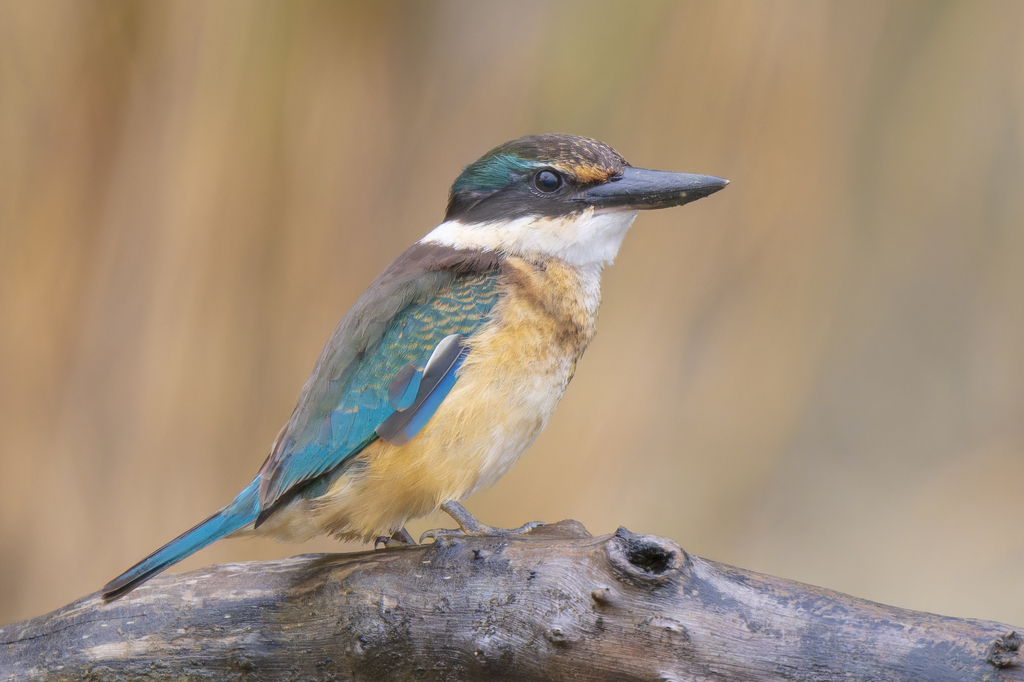
The sacred kingfisher (Todiramphus sanctus) is a medium-sized woodland kingfisher that occurs in mangroves, woodlands, forests, and river valleys in Australia, New Zealand, and other parts of the western Pacific. In New Zealand the species is also known by its Māori name kōtare.
From the article Sacred kingfisher on Wikipedia (CC BY-SA), quoted section by section
Description
The sacred kingfisher is mostly blue-green to turquoise above with white underparts and collar feathers, a black mask and buff lores. Both sexes are similar, but females are usually greener, duller and less buff beneath, and juveniles have buff or mottled brown edges on the collar, underparts and upper-wing coverts. Adults are 20–23 cm (7.9–9.1 in) long. Males weigh 28–61 g (1.0–2.2 oz) and females 28–56 g (1.0–2.0 oz).
Range & habitat
The sacred kingfisher is distributed in Australia, New Zealand, Lord Howe Island, Norfolk Island, New Guinea, eastern Indonesia, much of northern and western Melanesia, and the Kermadec Islands. This species breeds throughout much of Australia (except the dry interior), New Zealand, New Caledonia and locally, New Guinea. Populations in the southern two-thirds of Australia migrate northwards at the end of the breeding season to New Guinea, east to the eastern Solomon Islands and west to Indonesia becoming uncommon to very sparse westwards to Sumatra. Birds move south again to Australia in August and September. It has also occurred as a vagrant on Christmas Island in the Indian Ocean, Malaysia, the Marshall Islands, the Federated States of Micronesia, and Nauru. A pair were spotted in Pampanga, Philippines in April / May 2016. In Australia, it inhabits open eucalypt forests, melaleuca swamps, mangroves, mudflats, wetlands and river or lake margins, farmland, parks and gardens. In New Zealand, T. sanctus vagans shows altitudinal migration, with post-breeding movement from higher altitudes to the coast and also from forest to coast and open lands.
Wikipedia: “Distribution and habitat”
What it does
The sacred kingfisher feeds on a wide variety of invertebrates (particularly insects and spiders), small crustaceans, fish (infrequently), frogs, small rodents and reptiles, and there are a few reports of them eating finches and other small birds. Usually, the sacred kingfisher will sit on a low branch and wait for prey to pass by. It swoops down to grab the prey by briefly landing (sally-pounce) or hovering (sally-strike), and then returns to its perch to eat its catch by beating and swallowing.
Wikipedia: “Feeding”
In human culture
The name "sacred kingfisher" can be traced back to Latham's 1782 description of the species and what he called the "Respected Kingsfisher" of the Friendly Isles (now Tonga), and the "Venerated Kingsfisher" of the Society Islands (both collared kingfishers). Latham claims, citing Parkinson's journals, that all three kingfishers were held in "superstitious veneration" by the natives on account of frequently inhabiting marae and burial grounds, and were not allowed to be taken or killed. Later sources claim Polynesians venerated it for having the power of control over the waves.
Wikipedia: “Etymology”
Listen
Looking for field recordings…
Where it lives
Recorded sightings
—
geo-referenced records in GBIF, from museums, herbaria and field observers.
Drag the globe to turn it. Dots are where records exist, not a range map; darker means more records.
In the stacks
Searching the stacks…
Every page naming Todiramphus sanctus in the Biodiversity Heritage Library →
This page is assembled live from iNaturalist, GBIF, Wikipedia, the Source Library and the Internet Archive. It is not yet part of the hand-edited codex. iNaturalist taxon 2464.