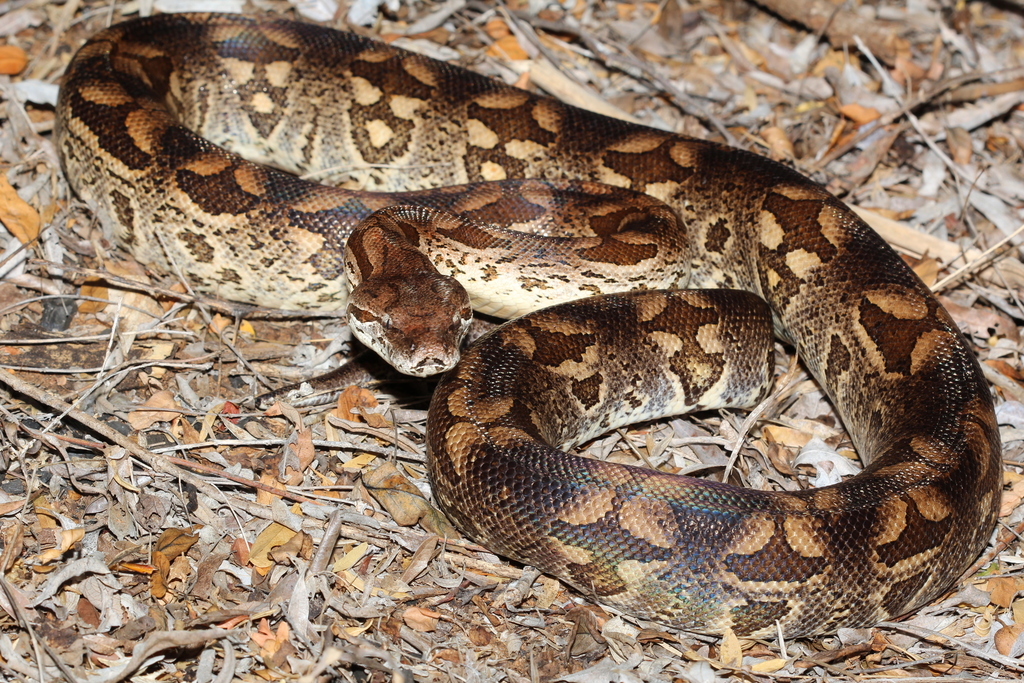
Dumeril's Boa
Acrantophis dumerili
Acrantophis dumerili, commonly known as Dumeril's boa, is a species of non-venomous snake in the family Boidae. The species is endemic to Madagascar. No subspecies are currently recognized.
From the article Acrantophis dumerili on Wikipedia (CC BY-SA), quoted section by section
Description
Adults of A. dumerili usually grow to 6.5 feet (2 m) in total length (including tail) with the maximum reported to be 8 feet, 6 inches (259 cm). Males usually have longer skinnier tails, while females tend to be larger overall. The color pattern consists of a gray-brown ground color with darker patches, forming an effective camouflage against the leaf litter of the forest floor of their native habitat.
Range & habitat
A. dumerili is found on Madagascar. The type locality given in the original description is "Amérique mérid. ?", which is later given as "?" by Jan (1863). Along the western coast and southwestern regions of Madagascar, it is found in a semi-arid habitat that gets fairly low amounts of precipitation. Durmeril Ground Boa's live in semi-arid forest along the western to southwestern parts of Madagascar. Their habitats consist of leaf litter, loose dirt, and rocky terrain for camouflage. When needed, these snakes will use burrows made by other animals as a shelter.
Wikipedia: “Distribution and habitat”
What it does
The diet of A. dumerili consists of small animals, such as birds, lizards, and small mammals, including juvenile lemurs. It is also known to prey on other snakes. These snakes are opportunistic feeders that may hunt during the day or at night. They can also be found on the ground floor or in trees when hunting (Raxworthy 2003; Vences and Glaw 2003; Gardner et al. 2017). They have been found to have toads, insects, and indigestible plants, as well as detritus in their stomach. These were all either eaten in the process of hunting another animal or were in the stomach of the animal that they consumed (Pendlebury 1974). They will use their muscular body type to constrict their prey prior to consumption. Although they can reach up to 6-8 feet in length, they typically are more docile creatures and will continue to eat smaller animals and amphibians.
Wikipedia: “Feeding”
In human culture
The specific name, dumerili, is in honor of French herpetologist André Marie Constant Duméril.
Wikipedia: “Etymology”
Where it lives
Recorded sightings
—
geo-referenced records in GBIF, from museums, herbaria and field observers.
Drag the globe to turn it. Dots are where records exist, not a range map; darker means more records.
In the stacks
Searching the stacks…
Every page naming Acrantophis dumerili in the Biodiversity Heritage Library →
This page is assembled live from iNaturalist, GBIF, Wikipedia, the Source Library and the Internet Archive. It is not yet part of the hand-edited codex. iNaturalist taxon 32121.