 NL·0385
Herbarium of the Nature Library
- Name
- Coryphaena hippurus
- Family
- Coryphaenidae
- Native to
- Tropical and subtropical seas worldwide, including the Mediterranean
- Habitat
- Open ocean (pelagic)
Mahi-mahi
Coryphaena hippurus
Also calledCommon dolphinfish · Dorado (Spanish) · Lampuka (Maltese) · Shiira (Japanese) · Ikan lemadang (Malay)
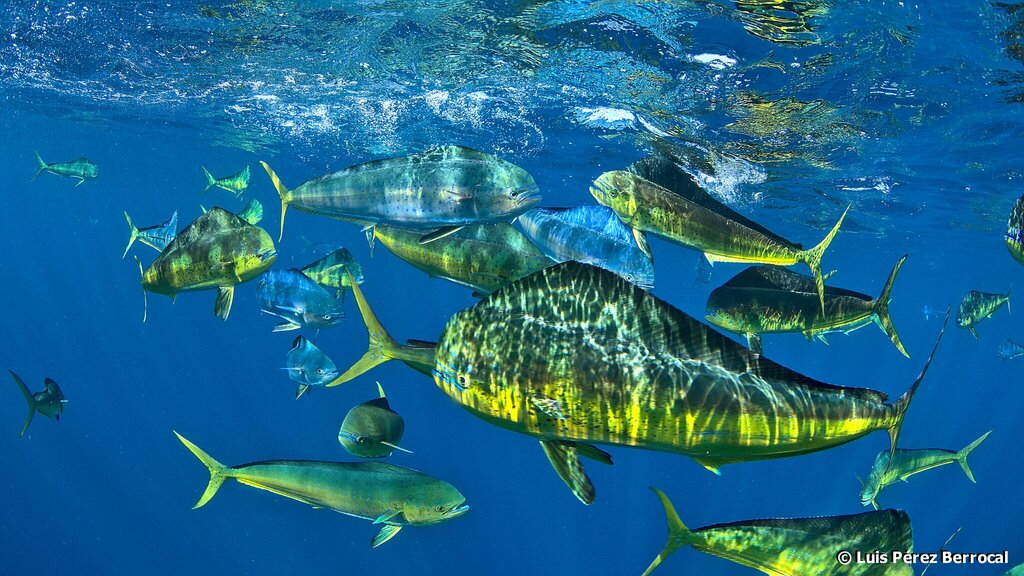
A blazing gold, green and blue surface hunter that grows astonishingly fast, reaching adulthood in months. Bulls develop a tall, square forehead; the colours fade to grey within minutes of death.
The mahi-mahi, common dolphinfish, dolphinfish, dolphin or dorado is a surface-dwelling ray-finned fish found in off-shore temperate, tropical, and subtropical waters worldwide. It is one of two members of the family Coryphaenidae, the other being the pompano dolphinfish. These fish are most commonly found in the waters around the Gulf of Mexico, Costa Rica, Hawaii, and the Indian Ocean. In Italy it is called corifena, lampuga or pesce capone, and has even given its name to the caponata though eggplant has now taken the place of the fish. Wikipedia
What it can do
- iOne of the fastest-growing fishes, maturing at 4–5 months
- iiChanges colour rapidly, flashing bars and spots while hunting
- iiiGathers under floating sargassum, logs and debris to hunt
- ivLeaps clear of the water chasing flying fish
In the field
Field marks
- aLong dorsal fin running from the head almost to the tail
- bBrilliant golden sides, blue-green back and scattered blue spots
- cMales with a steep, blunt forehead; females rounded
- dDeeply forked tail
- Not to be confused with
- Pompano dolphinfish (C. equiselis) is smaller with a squarer tooth patch on the tongue and fewer dorsal rays (48–55 vs 58–66). Not related to dolphins (mammals).
- Where to see it
- Sargassum lines off Florida and the Bahamas, Costa Rica, Hawaii, Malta (autumn lampuka fishery)
- When
- Year-round in tropics; Malta Aug–Dec
Life & habits
- Diet
- Flying fish, juvenile tunas, squid, crustaceans
- Habitat
- Warm surface waters, often near floating objects and sargassum
- Size
- Commonly 1 m; up to ~2 m and 40 kg
- Lifespan
- Usually under 4–5 years
Travels in small schools that follow drifting objects across the open ocean; pairs often stay together and a hooked fish is often followed by its mate.
Where it lives
Recorded sightings
—
geo-referenced records in GBIF, from museums, herbaria and field observers.
Native range
Tropical and subtropical seas worldwide, including the Mediterranean
Drag the globe to turn it. Dots are where records exist, not a range map; darker means more records.
In the old herbals & bestiaries
Woodcuts and engravings matched from the Source Library’s scanned books by name. Plates marked “relative” show a close kin rather than this exact species. Click a plate to read the page it came from, with translation.

History of Animals, Book II: On Oviparous Quadrupeds
Conrad Gessner · 1586 · p.443

De Indiae utriusque re naturali et medica
Willem Piso · 1658 · p.76

De Indiae utriusque re naturali et medica
Willem Piso · 1658 · p.474

Louis Renard — Poissons, ecrevisses et crabes (1754)
Louis Renard · 1754 · p.135

Louis Renard — Poissons, ecrevisses et crabes (1754)
Louis Renard · 1754 · p.136
In the stacks
Searching the stacks…
Every page naming Coryphaena hippurus in the Biodiversity Heritage Library →
Marginalia
Maltese fishers have caught lampuki under floating palm-frond rafts (kannizzati) for centuries, a technique that predates modern fish aggregating devices; 'mahi-mahi' is Hawaiian for 'very strong'.
Curiosity
Its brilliant colours are produced by chromatophores and iridophores that collapse at death, turning the fish dull grey within minutes.
Kinship


Fact-checked: 1 correction made to this sheet. Photographs: iNaturalist contributors under the licences shown. Records: GBIF.org. Historical plates: Source Library (CC BY-SA 4.0; originals public domain). Summary text: Nature Library editors and Wikipedia (CC BY-SA). Medicinal and edibility notes are historical and educational, not advice. iNaturalist taxon 98531.