- Animals
- ›Arthropods
- ›Hexapods
- ›Insects
- ›Winged and Once-winged Insects
- ›True Bugs, Hoppers, Aphids, and allies
- ›Plant-parasitic Hemipterans
- ›Whiteflies
- ›Whiteflies
- ›Aleyrodinae
- ›Bemisia
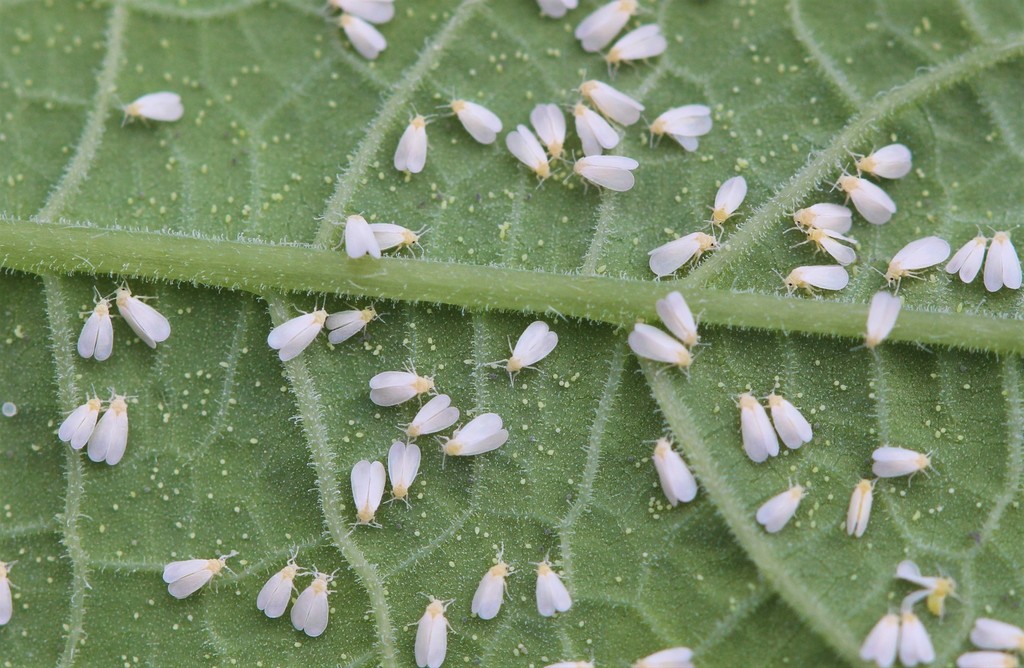
Silverleaf Whitefly
Bemisia tabaci
The silverleaf whitefly (Bemisia tabaci, also informally referred to as the sweet potato whitefly and cotton whitefly) is one of several species of whitefly that are currently important agricultural pests. A review in 2011 concluded that the silverleaf whitefly is actually a species complex containing at least 40 morphologically indistinguishable species.
The silverleaf whitefly thrives worldwide in tropical, subtropical, and less predominately in temperate habitats. Cold temperatures kill both the adults and the nymphs of the species. The silverleaf whitefly can be confused with other insects such as the common fruitfly, but with close inspection, the whitefly is slightly smaller and has a distinct wing color that helps to differentiate it from other insects.
From the article Silverleaf whitefly on Wikipedia (CC BY-SA), quoted section by section
Description
Female B. tabaci will lay 50 to 400 eggs ranging from 0.10 to 0.25 millimetres (1⁄128 to 1⁄128 in) on the under part of leaves. Female whiteflies are diploid and emerge from fertilized eggs whereas male whiteflies are haploid and emerge from unfertilized eggs. Eggs are laid in groups, being small in size with dimensions of 0.2 millimetres (1⁄128 in) wide and 0.1 millimetres (1⁄128 in) in height. Eggs are initially whitish in color and change to a brown color near hatching, within 5 to 7 days. After hatching, the whitefly nymph develops through four instar stages.
The first instar, commonly called a crawler, is the only mobile nymphal stage. The first instar nymph can grow to about 0.3 millimetres (1⁄64 in) and is greenish in color and flat in body structure. The mobile nymph walks to find a suitable area on the leaf with adequate nutrients and molts into an immobile stage. The next three instars remain in place for 40–50 days, until molting into an adult. Silver exuvia, or shed skins are left on the leaves. The immobile instars appear opaquely white. Nymphs feed by stabbing into the plant with their mouth-parts and sucking up plant juices. After the fourth instar, the nymph transforms into a pupal stage where the eyes become a deep red color, the body color becomes yellow, and the body structure thickens. …
Wikipedia: “Anatomy and life cycle”
Range & habitat
The silverleaf whitefly is an invasive agricultural pest in many locations around the world, including in Florida and in California.
Wikipedia: “Introduced range”
In human culture
Through a cultural control method, different planting areas can limit the amount of B. tabaci infected plants. Planting different host crops away from each other will decrease the number of plants the flies will be able to infect. Thus, the best control is to maximize the distance and time interval between host crops. Good sanitation in winter and spring crops is also required for the maintenance and control of the fly population. Weeds and host crop residues must be removed immediately to avoid infestation. Silver/aluminum cover mulches can repel the adult silverleaf whitefly. Thus, when planting seeds, placing a reflective polyethylene mulch on planting beds will significantly reduce the rate of colonization. Cultural controls are very important to crops such as vegetables and fruit. For example, in the family Cucurbitaceae, vegetables such as watermelon and squash contract squash vein yellowing virus (SqVYV) by the silverleaf whitefly. The SqVYV virus discovered by plant pathologist Benny Bruton and Shaker Kousik is essentially a crippling disease of the watermelon, which leads to the vine of the watermelon to collapse, causing the death of the watermelon before harvest. …
Wikipedia: “Cultural controls”
Listen
Looking for field recordings…
Where it lives
Recorded sightings
—
geo-referenced records in GBIF, from museums, herbaria and field observers.
Drag the globe to turn it. Dots are where records exist, not a range map; darker means more records.
In the stacks
Searching the stacks…
Every page naming Bemisia tabaci in the Biodiversity Heritage Library →
This page is assembled live from iNaturalist, GBIF, Wikipedia, the Source Library and the Internet Archive. It is not yet part of the hand-edited codex. iNaturalist taxon 199414.