- Animals
- ›Chordates
- ›Vertebrates
- ›Birds
- ›Swifts and Hummingbirds
- ›Hummingbirds
- ›Bee Hummingbirds, Emeralds, Mountain-gems, and Allies
- ›Emerald Hummingbirds and Allies
- ›Riccordia
On eBird ↗
Cuban Emerald
Live sightings near you, the range map, bar charts of when it is seen, and Macaulay Library photos and recordings.
Cuban Emerald
Riccordia ricordii
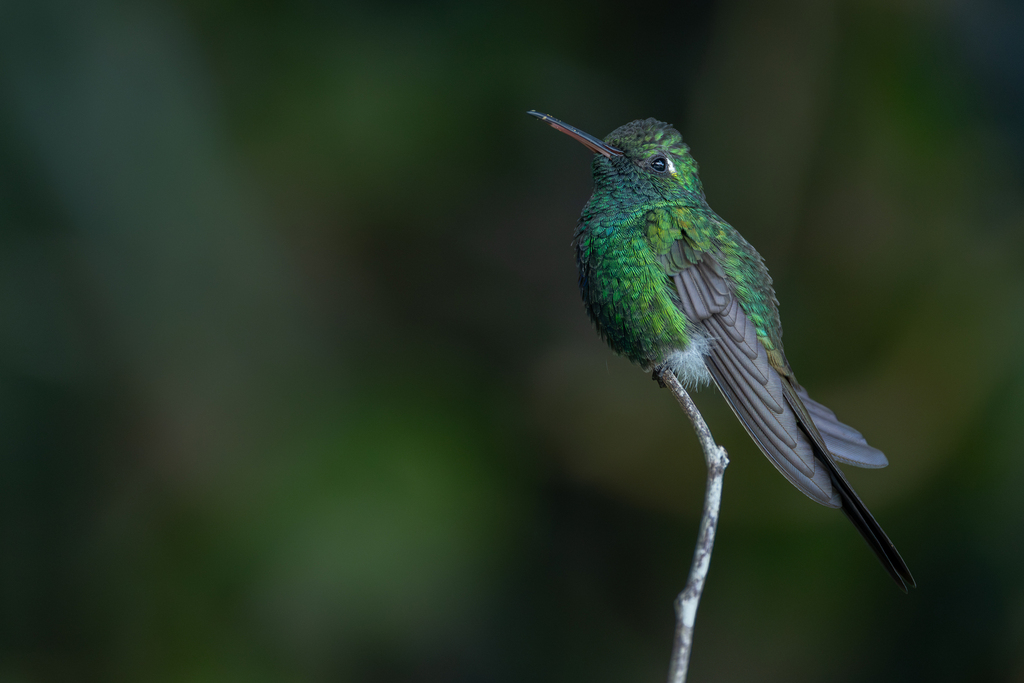
The Cuban emerald (Riccordia ricordii) is a species of hummingbird in the "emeralds", tribe Trochilini of subfamily Trochilinae. It is found in the Bahamas and Cuba.
From the article Cuban emerald on Wikipedia (CC BY-SA), quoted section by section
Description
Male Cuban emeralds are 10.5 to 11.5 cm (4.1 to 4.5 in) long and females 9.5 to 10.5 cm (3.7 to 4.1 in). The species weighs between 2.5 and 5 g (0.088 and 0.18 oz). Males have a short, slightly decurved, black-tipped bill whose mandible is dull black and the maxilla red. It has a small whitish spot behind the eye. Its upperparts are dark shining green with a bronze tinge; the crown is darker and duller. Its underparts are mostly iridescent metallic green with white undertail coverts. The tail is deeply forked. Its innermost four pairs of feathers are dark metallic bronze to greenish bronze and the outermost pair similar with dark brown inner webs. Female's upperparts are similar to the male's. It has a longer whitish spot behind the eye. The underparts are mostly brownish gray with metallic green flanks and white undertail coverts. The tail is less forked than the male's but colored similarly.
Range & habitat
The Cuban emerald is found on the main island of Cuba, the large Isla de la Juventud (Isle of Pines), and several smaller offshore cays. It is also found on Grand Bahama, Great Abaco, Andros, and Green Cay and occasionally as a stray on other islands in the Bahamas. It inhabits a variety of wooded habitats. On mainland Cuba it mostly occurs in both arid and humid open forest and on Grand Bahama in pine woods and coastal scrub forest. It also occurs in parks, gardens, and plantations. In elevation it ranges from sea level to at least 1,300 m (4,300 ft) but there are records at almost 2,000 m (6,600 ft) on Cuba.
Wikipedia: “Distribution and habitat”
What it does
The Cuban emerald forages for nectar at a variety of flowering trees and shrubs, generally staying below about 6 m (20 ft) of the ground. It also feeds on small insects captured by hawking from a perch and sometimes by gleaning from spider webs.
Wikipedia: “Feeding”
Listen
Looking for field recordings…
Where it lives
Recorded sightings
—
geo-referenced records in GBIF, from museums, herbaria and field observers.
Drag the globe to turn it. Dots are where records exist, not a range map; darker means more records.
In the stacks
Searching the stacks…
Every page naming Riccordia ricordii in the Biodiversity Heritage Library →
This page is assembled live from iNaturalist, GBIF, Wikipedia, the Source Library and the Internet Archive. It is not yet part of the hand-edited codex. iNaturalist taxon 1289681.