- Animals
- ›Chordates
- ›Vertebrates
- ›Birds
- ›Swifts and Hummingbirds
- ›Hummingbirds
- ›Bee Hummingbirds, Emeralds, Mountain-gems, and Allies
- ›Bee Hummingbirds and Allies
- ›Nesophlox
On eBird ↗
Bahama Woodstar
Live sightings near you, the range map, bar charts of when it is seen, and Macaulay Library photos and recordings.
Bahama Woodstar
Nesophlox evelynae
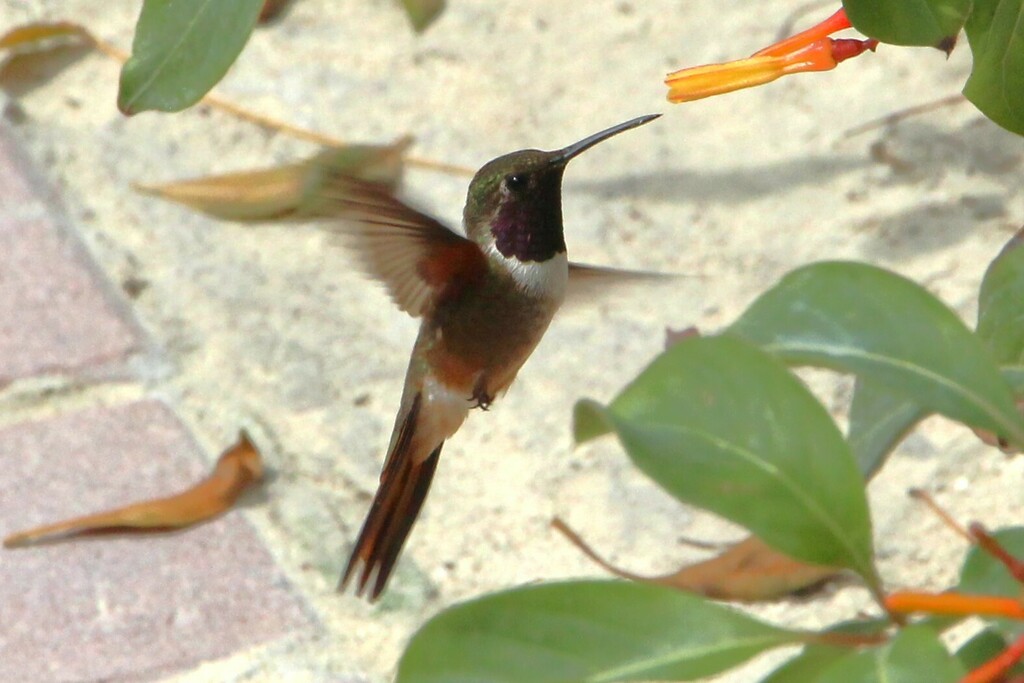
The Bahama woodstar or Bahama hummingbird (Nesophlox evelynae) is a species of hummingbird endemic to the Lucayan archipelago, including the Bahamian and Turks and Caicos islands. It is named the "hummer" by locals due to a distinct humming sound it makes while feeding.
From the article Bahama woodstar on Wikipedia (CC BY-SA), quoted section by section
Description
The Bahama woodstar is a small hummingbird, growing to be only about 8 to 9.5 cm (3.1 to 3.7 in) in length. These birds weigh around 2.4 to 3 g (0.085 to 0.106 oz). Their backs are green and gold, with olive-buff underparts, and flanks fading into white (males) or cinnamon (females). Wings are brown and their tails appear a blackish-purple. Males have a fork-shaped tail while females display a more rounded tail with wider feathers. Males have bright purple iridescent gorgets (when accurately exposed to sunlight) lined with a white stripe, which dull out as breeding season ends. Females do not have the purple throat or white stripe. Both males and females have black, slightly curved bills and black feet.
Vocalizations. The Bahama woodstar has three typical vocalizations: "chips", scolding and song. During flight and feeding, Bahama woodstars will make a one syllable "chip" sound. The length of this call may vary, from a simple "chip" to a longer, repeated sequence of "chips". Other simple calls such as "spurts" from courting or fighting males, and "cheep" sounds from younglings have rarely been recorded. Scolding was recorded during agonistic behaviour such as fighting and chasing. Scolding is a two syllable call, where the second syllable may be vocalized once or repeated multiple times after the first syllable. …
Range & habitat
The Bahama woodstar is distributed around the Lucayan Archipelago, including the Turks and Caicos Islands, and with exception to the Inaguan islands. It has also been recorded multiple times in Florida, United States. In April 2013, a bird was seen for three days at a feeder in Lancaster County, Pennsylvania. They are less plentiful on the Grand Bahama, Abaco and Andros Islands that house the Cuban emerald, an introduced hummingbird which shows competitive aggression towards the Bahama woodstar. Bahama woodstars are found in many different habitats such as gardens, scrubland, both secondary growth and dry lowland, the edges of tropical evergreen forests and pine forests. They tend not to migrate very far from these habitats being a year-round species. Although they may inhabit the same area as other woodstars, they are not very social and will often become aggressive towards other birds.
Wikipedia: “Distribution and habitat”
What it does
Bahama woodstars mainly suck up nectar from local plants . On the Abaco Islands, one of these plants include Ernodea serratifolia. They visit the flowers during the mornings and evenings. Lacerations can be seen in the tubular corollas of the flowers, where the beaks of these birds and other hummingbird species took the nectar. They may also feed on insects.
Wikipedia: “Food and feeding”
Listen
Looking for field recordings…
Where it lives
Recorded sightings
—
geo-referenced records in GBIF, from museums, herbaria and field observers.
Drag the globe to turn it. Dots are where records exist, not a range map; darker means more records.
In the stacks
Searching the stacks…
Every page naming Nesophlox evelynae in the Biodiversity Heritage Library →
This page is assembled live from iNaturalist, GBIF, Wikipedia, the Source Library and the Internet Archive. It is not yet part of the hand-edited codex. iNaturalist taxon 979880.