- Animals
- ›Arthropods
- ›Hexapods
- ›Insects
- ›Winged and Once-winged Insects
- ›Dragonflies and Damselflies
- ›Damselflies
- ›Coenagrionoid Damselflies
- ›Narrow-winged Damselflies
- ›Enallagma
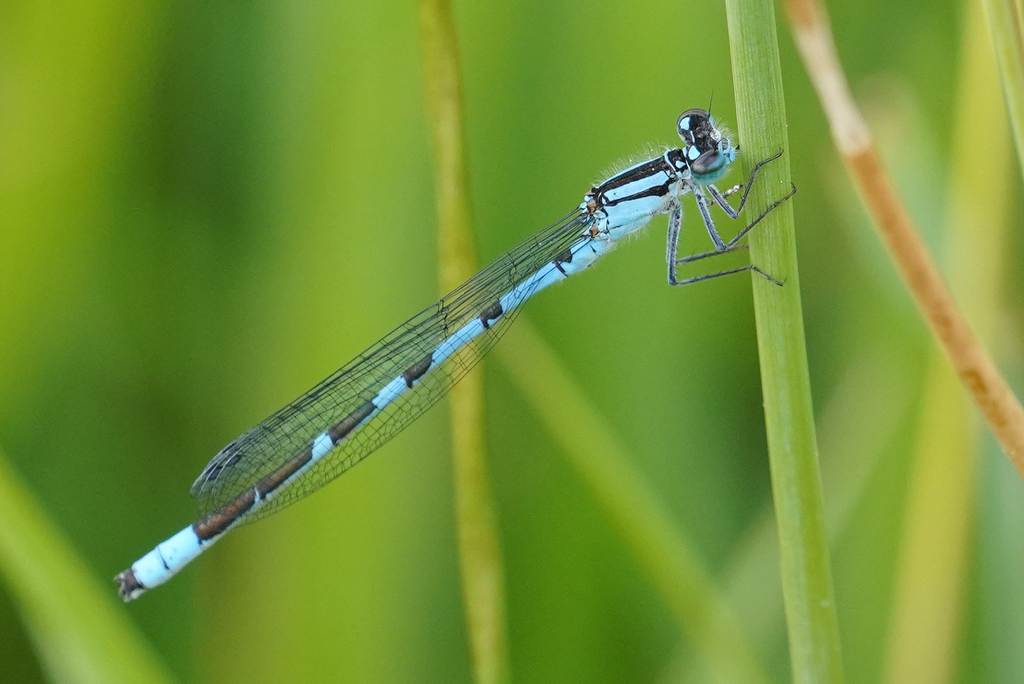
Marsh Bluet
Enallagma ebrium
The marsh bluet (Enallagma ebrium) is a damselfly species in the family Coenagrionidae.
From the article Marsh bluet on Wikipedia (CC BY-SA), quoted section by section
Description
Adult – Male marsh bluets have a blue thorax with a broad black stripe above and has two black shoulder stripes. Its slender abdomen is mostly blue with black marks along the top and with a black tip. The large eyes are dark blue-black with small, tear-shaped postocular spots. The thorax of the female is similar to the male only its tan or blue-green and black instead of blue and black. Its abdomen is mostly black above and tan or blue-green below. Its large eyes are brown and yellowish. Naiad – The naiad is small about 16 to 20 mm (0.63 to 0.79 in) in length. It has the typical slender shape of an immature damselfly. The naiad is light to dark brown in color.
Range & habitat
Marsh bluets are usually found near lowland lakes, ponds, and marshes, and has a definite preference for alkaline waters.
Wikipedia: “Habitat”
What it does
Naiad – They eat a wide variety of aquatic insects, including mosquito larvae, mayfly larvae, and other aquatic fly larvae. Adult – Adult bluets eat a wide variety of small soft-bodied flying insects, such as mosquitoes, mayflies, flies and small moths. They sometimes pick small insects such as aphids from plants.
Wikipedia: “Diet”
Listen
Looking for field recordings…
Where it lives
Recorded sightings
—
geo-referenced records in GBIF, from museums, herbaria and field observers.
Drag the globe to turn it. Dots are where records exist, not a range map; darker means more records.
In the stacks
Searching the stacks…
Every page naming Enallagma ebrium in the Biodiversity Heritage Library →
This page is assembled live from iNaturalist, GBIF, Wikipedia, the Source Library and the Internet Archive. It is not yet part of the hand-edited codex. iNaturalist taxon 99909.