- Animals
- ›Chordates
- ›Vertebrates
- ›Ray-finned Fishes
- ›Spiny-rayed fishes
- ›Freshwater Sunfishes, Grunters, and Allies
- ›Freshwater Sunfishes and relatives
- ›Pygmy Sunfishes
- ›Elassoma
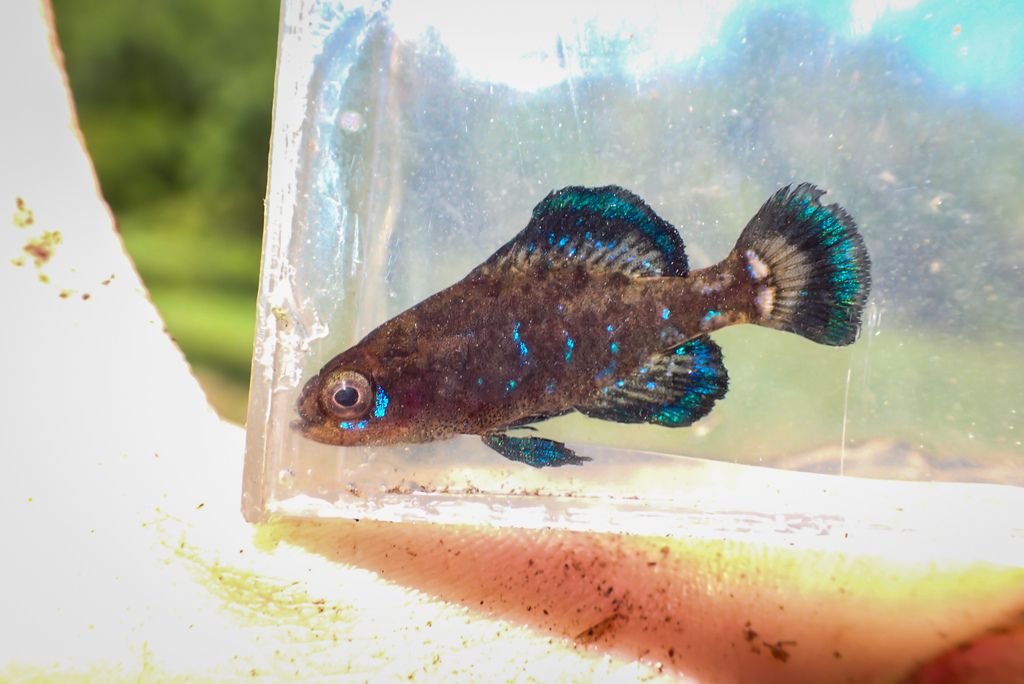
Okefenokee Pygmy Sunfish
Elassoma okefenokee
The Okefenokee pygmy sunfish, Elassoma okefenokee, is a species of pygmy sunfish found in southeastern United States, where it prefers waters with dense vegetation growth in the Altamaha drainage in southern Georgia south to Lake Okeechobee, Florida, interior lake basins in north-central Florida, and upper Suwannee, Withlacoochee, and Hillsborough river drainages on the Gulf Coast of Florida . This species can reach 3.4 cm (1.3 in) in total length.
From the article Okefenokee pygmy sunfish on Wikipedia (CC BY-SA), quoted section by section
Description
The Okefenokee pygmy sunfish is an olive green color fish with brownish-red mottling across the body, mixed with bright blue colors. Elassoma okefenokee differs from its close relative Elassoma gilberti by only having three preopercular canals (gilberti has, on average, four). The average number of anal fin rays is seven in E. gilberti whereas E. okefenokee has 8. The female E. gilberti often expresses a blue patch of color behind her eye and on her body, while the E. okefenokee does not.
Range & habitat
Elassoma okefenokee is a freshwater, demersal fish which spends its time in dense vegetation growth in waters with a pH range of 6.0-8.0 and a dH range of 5-unknown. Their preferred temperature range is 4–30 °C (39–86 °F).
Wikipedia: “Habitat”
What it does
Some good foods to try in the aquarium are California blackworms, daphnia, Grindal worms, microworms, and having a healthy population of snails. Some pygmy sunfish will learn to supplement their diet with crushed flake food, but this should not be relied upon as the only food source. The crushed fish flakes are a good idea, though, because they will feed the microfauna that will in turn feed the Elassoma.
Wikipedia: “Diet”
In human culture
Elassoma stems from the Greek, elasson (meaning smaller) plus the Greek, soma (meaning body) in reference to the fishes' diminutive size compared to the true sunfishes
Wikipedia: “Etymology”
Where it lives
Recorded sightings
—
geo-referenced records in GBIF, from museums, herbaria and field observers.
Drag the globe to turn it. Dots are where records exist, not a range map; darker means more records.
In the stacks
Searching the stacks…
Every page naming Elassoma okefenokee in the Biodiversity Heritage Library →
This page is assembled live from iNaturalist, GBIF, Wikipedia, the Source Library and the Internet Archive. It is not yet part of the hand-edited codex. iNaturalist taxon 99756.