- Animals
- ›Arthropods
- ›Hexapods
- ›Insects
- ›Winged and Once-winged Insects
- ›Stick Insects
- ›Verophasmatodea
- ›Anareolatae
- ›Phasmatidae
- ›Phasmatinae
- ›Phasmatini
- ›Dryococelus
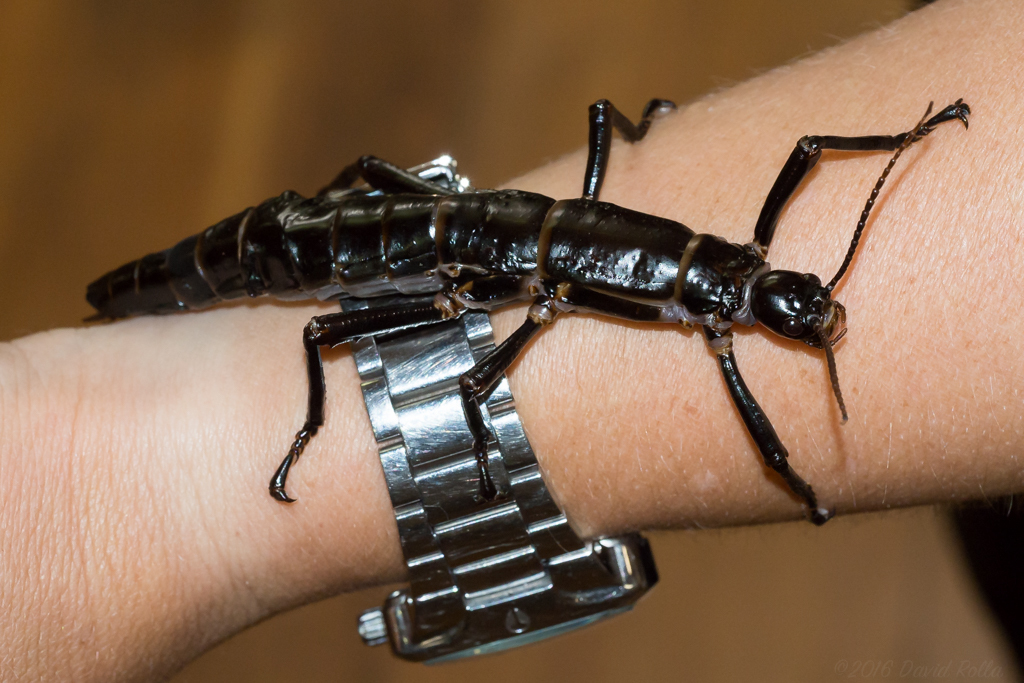
Lord Howe Island Stick Insect
Dryococelus australis
Dryococelus australis, also known as the Lord Howe Island stick insect, Lord Howe Island phasmid or, locally, as the tree lobster, is a species of stick insect that lives in the Lord Howe Island Group. It is the only member of the monotypic genus Dryococelus. Thought to be extinct by 1920, it was rediscovered in 2001. Although it had been extirpated from Lord Howe itself, a remnant population of 24 individuals was rediscovered on the sea stack of Ball's Pyramid. The species has been called "the rarest insect in the world".
From the article Dryococelus on Wikipedia (CC BY-SA), quoted section by section
Description
Adult Lord Howe Island stick insects can measure up to 20 centimetres (8 in) in length and weigh 25 grams (1 oz), with males 25% smaller than females. They are oblong in shape and have sturdy legs. Males have thicker thighs than females. Unlike most phasmida, the insects have no wings. The behaviour of this stick insect is highly unusual for an insect species, in that the males and females form a bond in some pairs. The females lay eggs while hanging from branches. Hatching can happen up to nine months later. The nymphs are first bright green and active during the day, but as they mature, they turn black and become nocturnal. Reproduction can happen without the presence of males (parthenogenesis) and this quality has allowed the species to survive when they are low in numbers.
Wikipedia: “Anatomy and behaviour”
Listen
Looking for field recordings…
Where it lives
Recorded sightings
—
geo-referenced records in GBIF, from museums, herbaria and field observers.
Drag the globe to turn it. Dots are where records exist, not a range map; darker means more records.
In the stacks
Searching the stacks…
Every page naming Dryococelus australis in the Biodiversity Heritage Library →
This page is assembled live from iNaturalist, GBIF, Wikipedia, the Source Library and the Internet Archive. It is not yet part of the hand-edited codex. iNaturalist taxon 99617.