- Animals
- ›Chordates
- ›Vertebrates
- ›Ray-finned Fishes
- ›Carps, Characins, Catfishes and Allies
- ›Minnows, Suckers, Carps, and Loaches
- ›Carps and Minnows
- ›Danios
- ›Danionins
- ›Devario
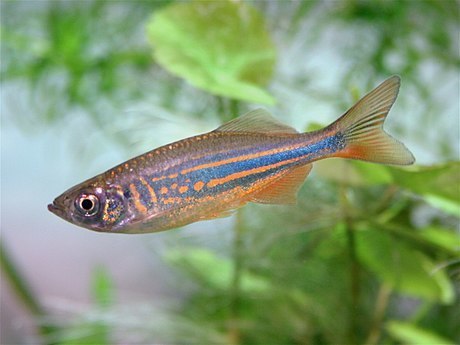
Giant Danio
Devario aequipinnatus
The giant danio (Devario aequipinnatus) is a tropical fish belonging to the minnow family Cyprinidae. Originating in Sri Lanka, Nepal, and the west coast of India, this species grows to a maximum length of 4 inches (10 cm), making it one of the largest of the danionins. It is characterized by a blue and yellow, torpedo-shaped body with gray and clear fins.
From the article Giant danio on Wikipedia (CC BY-SA), quoted section by section
Description
The giant danio can grow up to 10–15 cm (3.9–5.9 in), making it one of the largest danionins. It is characterized by a blue and yellow, torpedo-shaped body with gray and clear fins. Females are larger than males and possess a more rounded abdomen.
Range & habitat
The giant danio is native to the Indian subcontinent (including Sri Lanka) and most of Indochina, with a range running from Pakistan to Cambodia. Within these areas, this species is found in fast-flowing streams, usually in hilly areas, at elevations up to 300 m (980 ft). It prefers shaded and clear water with the following characteristics:
with gravel or sand bottom; pH between 6.0 and 8.0; hardness between 5 and 19 dGH; temperature between 22–27 °C (72–81 °F).
Wikipedia: “Distribution and habitat”
What it does
As surface dwellers, the diet of the giant danio consists predominantly of exogenous insects; this is supplemented by aquatic invertebrates such as worms and crustaceans. In captivity, the giant danio accepts most foods, including mosquito larvae, chironomous larvae, white worms, chopped earth worms, and commercially available pet food.
Wikipedia: “Diet”
In human culture
The giant danio belongs to the large danionin genus Devario. Its specific epithet is a combination of the Latin adjectives aequalis and pinnatus, meaning "equal" and "finned" respectively. This is a reference to the fact that the dorsal and anal fins of this species are symmetric. Several other species in the genus, including D. affinis, D. browni, D. malabaricus (the Malabar danio), and D. strigillifer, were once deemed as synonyms of the giant danio, but are now valid species. One may find fish labelled as "golden giant danio" in the aquarium trade; this is not a separate species, but merely a partial albino giant danio.
Wikipedia: “Taxonomy and etymology”
Where it lives
Recorded sightings
—
geo-referenced records in GBIF, from museums, herbaria and field observers.
Drag the globe to turn it. Dots are where records exist, not a range map; darker means more records.
In the stacks
Searching the stacks…
Every page naming Devario aequipinnatus in the Biodiversity Heritage Library →
This page is assembled live from iNaturalist, GBIF, Wikipedia, the Source Library and the Internet Archive. It is not yet part of the hand-edited codex. iNaturalist taxon 99221.