On eBird ↗
Blue Seedeater
Live sightings near you, the range map, bar charts of when it is seen, and Macaulay Library photos and recordings.
Blue Seedeater
Amaurospiza concolor
The blue seedeater (Amaurospiza concolor) is a species of bird in the family Cardinalidae. It was formerly placed with the American sparrows in the Emberizidae. It is found in highland forest and woodland, mainly near bamboo, in southern Mexico and Central America with a disjunct population in south-western Colombia, through Ecuador, to northern Peru. The population in south-western Mexico has a paler plumage than the other populations and has sometimes been considered a separate species, the...
From the article Blue seedeater on Wikipedia (CC BY-SA), quoted section by section
Description
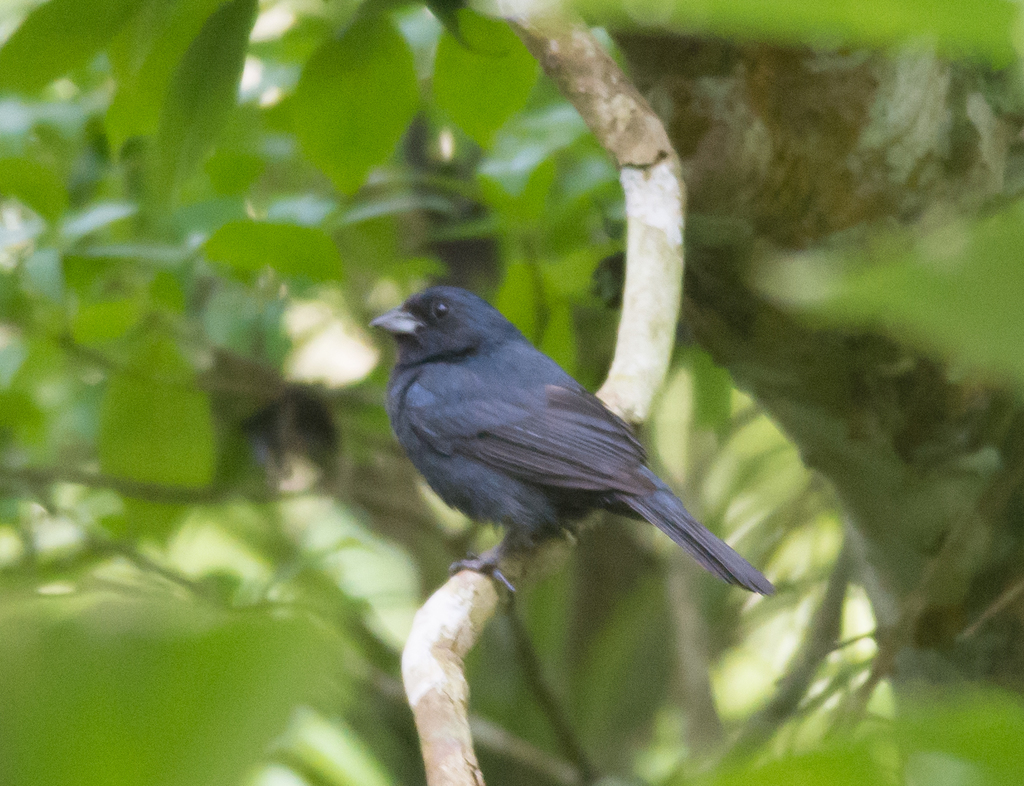
The blue seedeater is 11.5 to 14 cm (4.5 to 5.5 in) long and weighs 12 to 15 g (0.42 to 0.53 oz). The nominate male is entirely slate blue. The female's upperparts are cinnamon and the underparts tawny. The male A. c. relicta is more slaty (less blue) than the nominate and has black lores; the female is a paler cinnamon. The songs and calls have been transcribed in several ways. A song from Chiapas, Mexico, is [1]. One from Panama is [2]. A call from Puebla, Mexico, is [3] and one from Panama is [4].
Range & habitat
The nominate blue seedeater is found from Chiapas in southern Mexico through Central America to western and central Panama. A. c. relicta is found in six southwestern Mexico states, Jalisco, Colima, Morelos, Puebla, Guerrero and Oaxaca. The species inhabits openings in and edges of humid montane and secondary forest. It most often is found at sites with bamboo. In northern Central America it ranges in elevation from 600 to 2,500 m (2,000 to 8,200 ft) but in Costa Rica inhabits the narrower range of 1,700 to 2,200 m (5,600 to 7,200 ft).
Wikipedia: “Distribution and habitat”
Listen
Looking for field recordings…
Where it lives
Recorded sightings
—
geo-referenced records in GBIF, from museums, herbaria and field observers.
Drag the globe to turn it. Dots are where records exist, not a range map; darker means more records.
In the stacks
Searching the stacks…
Every page naming Amaurospiza concolor in the Biodiversity Heritage Library →
This page is assembled live from iNaturalist, GBIF, Wikipedia, the Source Library and the Internet Archive. It is not yet part of the hand-edited codex. iNaturalist taxon 9890.