On eBird ↗
Rust-and-yellow Tanager
Live sightings near you, the range map, bar charts of when it is seen, and Macaulay Library photos and recordings.
Rust-and-yellow Tanager
Thlypopsis ruficeps
The rust-and-yellow tanager (Thlypopsis ruficeps) is a species of bird in the family Thraupidae. It is found in Argentina, Bolivia, and Peru. Its natural habitats are subtropical or tropical moist montane forests and heavily degraded former forest.
From the article Rust-and-yellow tanager on Wikipedia (CC BY-SA), quoted section by section
Description
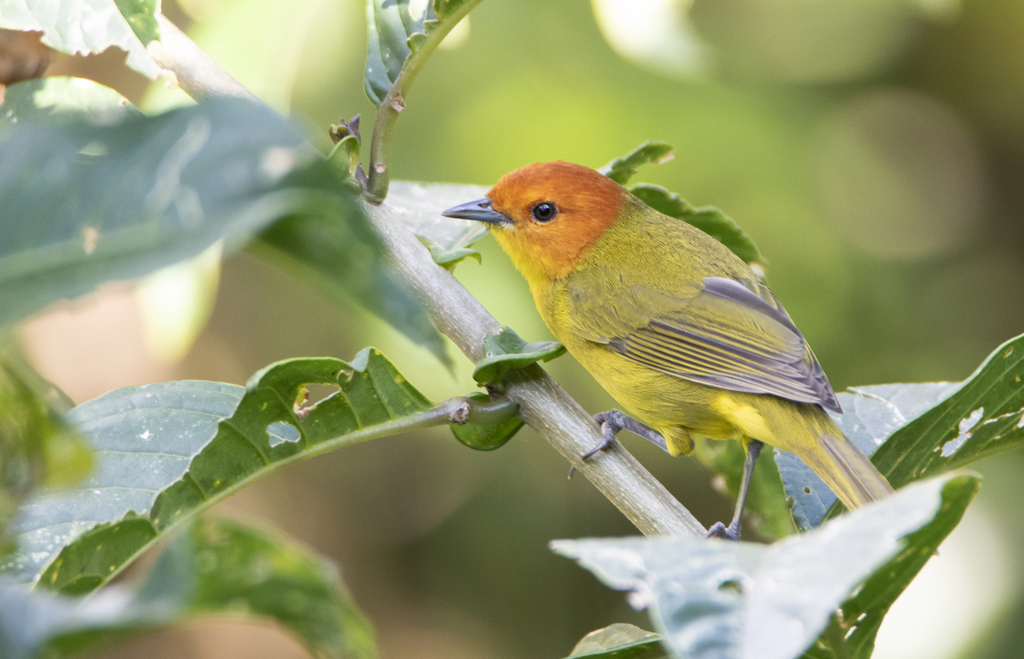
The rust-and-yellow tanager is 12.5 to 14 cm (4.9 to 5.5 in) long. It weighs 9.6 to 13 g (0.34 to 0.46 oz). It is a small tanager with a slim bill. The species is sexually dimorphic though not dramatically so. Adult males have a mostly bright rufous head. Their nape, upperparts, and upperwing coverts are bright olive-green. Their flight feathers are dusky with bright olive-green edges and their tertials dusky with olive-green outer webs. Their tail is a slightly duller olive-green than the upperparts. Their throat and underparts are bright yellow with an olive tinge on the sides and flanks. Adult females are overall duller than males. They have an olive crown and nape and a rufous-tinged buffy yellow face. Their back is olive and their wings, tail, and underparts are like the male's. Both sexes have a dark brown iris, a dark gray to blackish bill with often a paler and bluer mandible, and horn-gray legs. Immature birds have very little rufous on the face, olive-green upperparts, and yellow underparts.
Range & habitat
The rust-and-yellow tanager is found on the eastern slope of the Andes from Junín and Cuzco departments in central Peru south through Puno Department. There are also records of vagrancy further north to Huánuco Department. Its range continues through Bolivia into northwestern Argentina to Tucumán Province. The species inhabits shrubby humid secondary forest, the edges of older forest and cloudforest, and patches of Chusquea bamboo. It sometimes also is found in Polylepis woodlands. In Peru it ranges in elevation between 1,300 and 3,700 m (4,300 and 12,100 ft). It is mostly somewhat below that maximum in Argentina.
Wikipedia: “Distribution and habitat”
What it does
The rust-and-yellow tanager's diet has not been studied but it is known to include insects. It forages singly, in pairs, and in family groups and often joins mixed-species feeding flocks. It forages restlessly in low, dense, vegetation. It takes prey from foliage, flowers, and bamboo stalks.
Wikipedia: “Feeding”
Listen
Looking for field recordings…
Where it lives
Recorded sightings
—
geo-referenced records in GBIF, from museums, herbaria and field observers.
Drag the globe to turn it. Dots are where records exist, not a range map; darker means more records.
In the stacks
Searching the stacks…
Every page naming Thlypopsis ruficeps in the Biodiversity Heritage Library →
This page is assembled live from iNaturalist, GBIF, Wikipedia, the Source Library and the Internet Archive. It is not yet part of the hand-edited codex. iNaturalist taxon 9886.