On eBird ↗
Fulvous-headed Tanager
Live sightings near you, the range map, bar charts of when it is seen, and Macaulay Library photos and recordings.
Fulvous-headed Tanager
Thlypopsis fulviceps
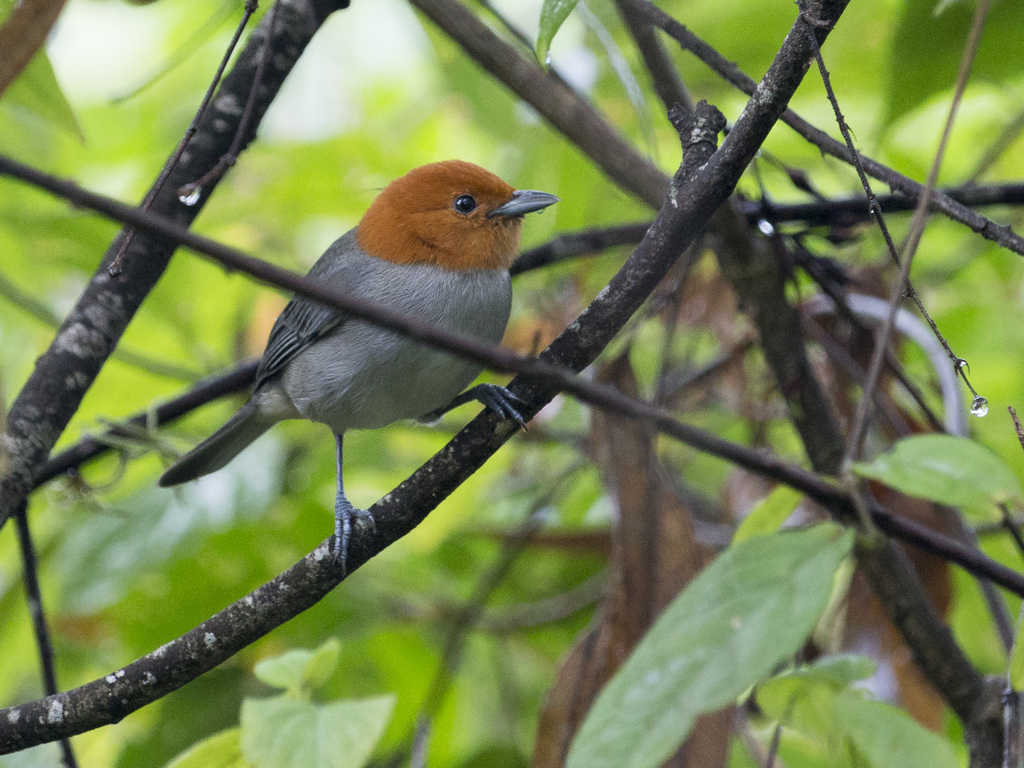
The fulvous-headed tanager (Thlypopsis fulviceps) is a species of bird in the family Thraupidae. It is found in the Venezuelan Coastal Range and far northern Colombia. Its natural habitats are subtropical or tropical moist montane forests and heavily degraded former forest.
From the article Fulvous-headed tanager on Wikipedia (CC BY-SA), quoted section by section
Description
The fulvous-headed tanager is about 12 cm (4.7 in) long and weighs 11 to 13 g (0.39 to 0.46 oz). It is a small tanager with a thin bill. The species is slightly sexually dimorphic. Adult males of the nominate subspecies T. f. fulviceps have a rufous-chestnut head, nape, and throat, though the throat is slightly paler than the rest. Their upperparts, upperwing coverts, and tail are gray. Their primary coverts are dusky and their flight feathers dusky with gray edges. Their underparts are mostly light gray with a whitish center to the belly and whitish undertail coverts. Females have a paler, more rufous-buff throat than males, but are otherwise the same. Subspecies T. f. obscuriceps has slightly darker gray upperparts than the nominate. T. f. meridensis has paler underparts than the nominate with a gray tinge on the undertail coverts. T. f. intensa has a darker chestnut head than the other three subspecies and also cinnamon undertail coverts. All subspecies have a dark brown iris, a grayish bill with a paler base to the mandible, and horn-gray legs.
Range & habitat
The fulvous-headed tanager has a disjunct distribution. Each subspecies is separate from the others and the nominate also has a gap in its range. The subspecies are found thus:
T. f. fulviceps: Venezuelan Coastal Ranges from Carabobo and northern Guárico states east to the Capital District and Miranda state and further east in Anzoátegui, western Sucre, and northern Monagas states T. f. obscuriceps: Serranía del Perijá straddling the Colombia-Venezuela border (and see below) T. f. meridensis: eastern slope of the Venezuelan Andes from northeastern Táchira state north to Lara state T. f. intensa: eastern slope of Colombia's Eastern Andes in Norte de Santander Department An isolated population on the western slope of the Sierra Nevada de Santa Marta in northern Colombia is believed to belong to T. f. obscuriceps. The fulvous-headed tanager primarily inhabits semi-humid forest including secondary woodlands; it occurs in lesser numbers in more humid forest and also is known from shrubby gardens in Caracas and other urban areas. In forest it favors areas of the canopy and forest edges that are heavy with vines. In Colombia it ranges in elevation from 1,600 to 2,300 m (5,200 to 7,500 ft) and in Venezuela from 800 to 1,900 m (2,600 to 6,200 ft).
Wikipedia: “Distribution and habitat”
What it does
The fulvous-headed tanager feeds primarily on larval and adult insects and includes small amounts of berries in its diet. It typically forages singly, in pairs, or in small groups that might be families, and regularly joins mixed-species feeding flocks. It forages in the forest canopy and at all levels at the forest edge. It takes most prey from leaves, both dead clusters and live ones, by gleaning and reaching while perched. It often is acrobatic, hanging sideways or upside down to reach prey. It sometimes makes a short flight to reach the underside of leaves.
Wikipedia: “Feeding”
Listen
Looking for field recordings…
Where it lives
Recorded sightings
—
geo-referenced records in GBIF, from museums, herbaria and field observers.
Drag the globe to turn it. Dots are where records exist, not a range map; darker means more records.
In the stacks
Searching the stacks…
Every page naming Thlypopsis fulviceps in the Biodiversity Heritage Library →
This page is assembled live from iNaturalist, GBIF, Wikipedia, the Source Library and the Internet Archive. It is not yet part of the hand-edited codex. iNaturalist taxon 9883.