- Animals
- ›Chordates
- ›Vertebrates
- ›Ray-finned Fishes
- ›Spiny-rayed fishes
- ›Wrasses and allies
- ›False scorpionfishes, wrasses, and parrotfishes
- ›Wrasses and Parrotfishes
- ›North Atlantic wrasses
- ›Ctenolabrus
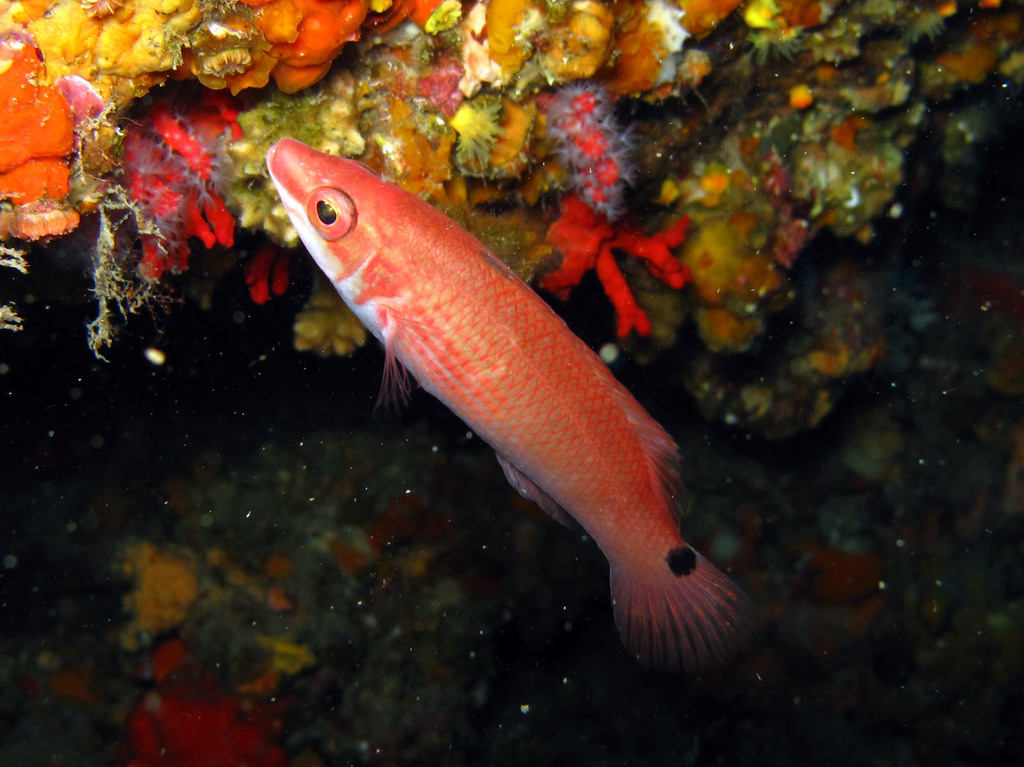
Goldsinny Wrasse
Ctenolabrus rupestris
The goldsinny wrasse (Ctenolabrus rupestris) is a species of wrasse native to the eastern Atlantic Ocean, the Mediterranean Sea, and the Black Sea where they inhabit weedy, rocky reefs at depths from 1 to 50 m (3.3 to 164.0 ft), though rarely below 20 m (66 ft). This species is the only known member of its genus.
From the article Goldsinny wrasse on Wikipedia (CC BY-SA), quoted section by section
Description
The goldsinny wrasse can reach a total length of 18 cm (7.1 in), though most do not exceed 12 cm (4.7 in). Its coloration is brown, greenish or orange-red and there are two noticeable dark spots which readily identify it from other eastern Atlantic wrasses, one on the dorsal fin and one situated on the caudal peduncle immediately in front of the caudal fin. It has a slender body with a small, pointed head and large eyes. The large, fleshy lipped mouth is equipped with two rows of small teeth in each jaw.
Range & habitat
The goldsinny wrasse is found in the eastern Atlantic Ocean from Norway south as far as Morocco. It is also found throughout the western and central Mediterranean Sea as far as Antalya in Turkey, but it is absent from the far eastern Mediterranean. It extends through the Sea of Marmara into the Black Sea.
Wikipedia: “Distribution”
At the table
The goldsinny wrasse is fond of sea lice and has been used to clean salmon in commercial farms together with the Ballan wrasse. Both these wrasses are not easy to retain in the salmon farms, as they escape through the nets, being significantly smaller than the salmon. This species is caught as a food fish by local indigenous peoples and is popular as a game fish. It is also a popular fish for display in public aquaria.
Wikipedia: “Human uses”
Where it lives
Recorded sightings
—
geo-referenced records in GBIF, from museums, herbaria and field observers.
Drag the globe to turn it. Dots are where records exist, not a range map; darker means more records.
In the stacks
Searching the stacks…
Every page naming Ctenolabrus rupestris in the Biodiversity Heritage Library →
This page is assembled live from iNaturalist, GBIF, Wikipedia, the Source Library and the Internet Archive. It is not yet part of the hand-edited codex. iNaturalist taxon 98753.