- Animals
- ›Chordates
- ›Vertebrates
- ›Ray-finned Fishes
- ›Spiny-rayed fishes
- ›Perches, Scorpionfishes, Sticklebacks, and Allies
- ›Perches, groupers and allies
- ›Perches, Darters, and allies
- ›Darters
- ›Crystallaria
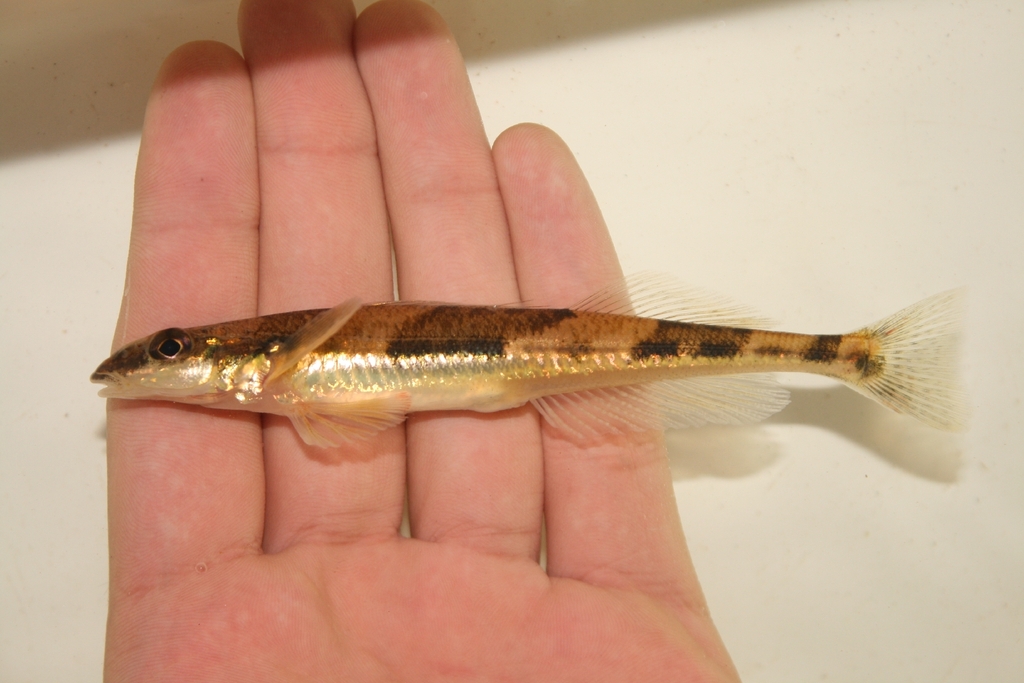
Crystal Darter
Crystallaria asprella
The crystal darter (Crystallaria asprella) is a species of freshwater ray-finned fish, a darter from the subfamily Etheostomatinae, part of the family Percidae, which also contains the perches, ruffes and pikeperches. This small North American fish is found in small, moderate, and swift rivers in the drainage basins of the Mississippi and Ohio Rivers. It is now extirpated from a majority of its range along the Ohio River.
From the article Crystal darter on Wikipedia (CC BY-SA), quoted section by section
Description
The crystal darter can grow to 12 cm (5 in) in length. It is olive-colored to tan with four dark saddles extending downward to its lateral line, a brownish stripe, and a whitish belly. Its maximum reported age is three years.
Wikipedia: “Appearance”
Range & habitat
The historical range of the crystal darter included the Mississippi River basin, from Wisconsin and Indiana, southwards to southeastern Oklahoma, northern Louisiana, southern Mississippi, the Mobile Basin, Pascagoula, Pearl River, Florida, Alabama, and Mississippi. It is now absent from much of this range and is rare in Wisconsin, Minnesota, Iowa, and Missouri. It is found in swift-flowing streams with clear or slightly turbid water and moderately swift riffles, on small or medium-sized rivers with beds of sand or gravel. It is not found on silty bottoms or areas with vegetation. Individual fish often hide under stones or bury themselves in sand with just their eyes showing.
Wikipedia: “Distribution and habitat”
What it does
The crystal darter burrows in sandy substrates with only its eyes protruding. This behavior may have evolved to capture prey, avoid predators, or conserve energy. In 1989, Robert Daniels conducted a study on a closely related species, the eastern sand darter, Ammocrypta pellucida, to explain burying behavior, but rejected both the predator avoidance and prey capturing hypotheses. He suggested that darters burrow in order to save energy while maintaining their position in the sandy substrate where they live. This behavior may be very important during periods of high or low flow, but can be exhibited at any time. Results from Daniels' study may also explain burying behavior in the crystal darter.
Wikipedia: “Burrowing behavior”
Where it lives
Recorded sightings
—
geo-referenced records in GBIF, from museums, herbaria and field observers.
Drag the globe to turn it. Dots are where records exist, not a range map; darker means more records.
In the stacks
Searching the stacks…
Every page naming Crystallaria asprella in the Biodiversity Heritage Library →
This page is assembled live from iNaturalist, GBIF, Wikipedia, the Source Library and the Internet Archive. It is not yet part of the hand-edited codex. iNaturalist taxon 98733.