On eBird ↗
Slate-colored Grosbeak
Live sightings near you, the range map, bar charts of when it is seen, and Macaulay Library photos and recordings.
Slate-colored Grosbeak
Saltator grossus
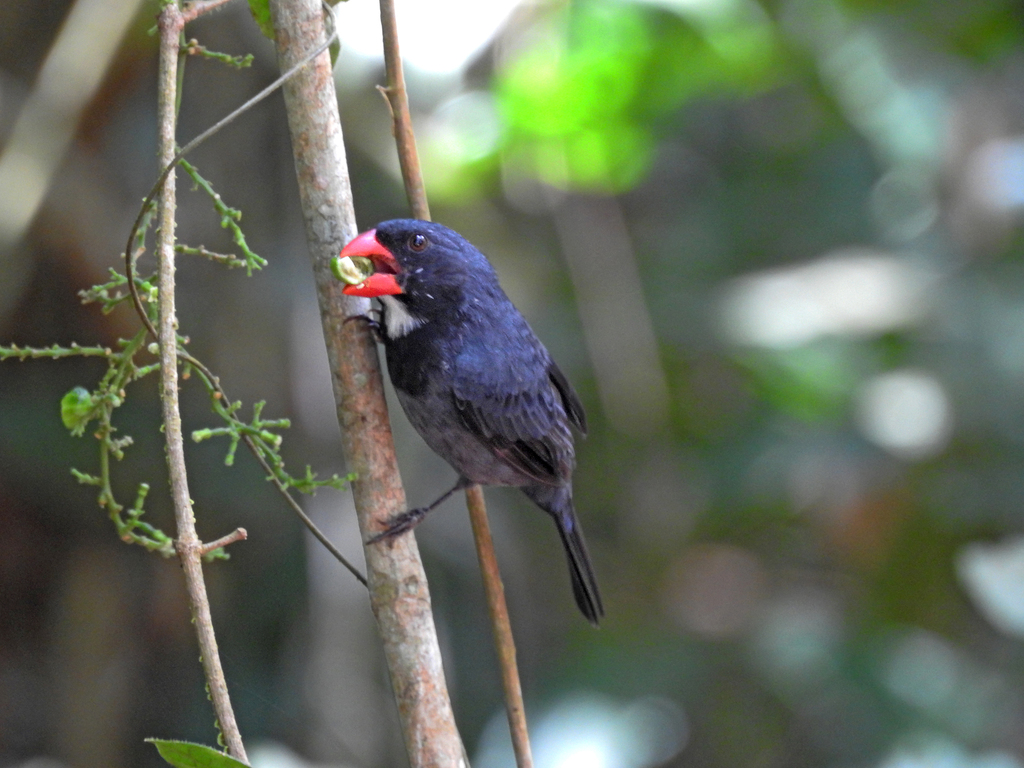
The slate-coloured grosbeak (Saltator grossus) is a species of grosbeak in the Thraupidae family. Most of its range is the Amazon in South America, but it is also found in forests of the Chocó in Ecuador and Colombia, and southern Central America from Panama to Honduras.
From the article Slate-coloured grosbeak on Wikipedia (CC BY-SA), quoted section by section
Description
The slate-colored grosbeak is 19 to 20.5 cm (7.5 to 8.1 in) long and weighs 41 to 53 g (1.4 to 1.9 oz). The species is sexually dimorphic. Adult males of the nominate subspecies are mostly slaty blue. Their lores, face, ear coverts, sides of the throat, and upper breast are black. Their wings are blackish with wide slaty blue edges on the coverts and on the outer webs of the secondaries. Their tail is blackish. Their throat and underwing coverts are white. Adult females are overall duller than males with no black on the face or throat, greenish slate underparts, and a gray-white throat. Subspecies S. g. saturatus is slightly darker overall than the nominate. Both sexes of both subspecies have a deep brown iris, a bright orange-red or red bill, and dark horn to black legs and feet. The species closely resembles its sister black-throated grosbeak, which however is darker with more black on the face and a black throat.
Range & habitat
The slate-colored grosbeak has a disjunct distribution. Subspecies S. g. saturatus is the more northerly of the two and has a much smaller range. It is found on the Caribbean slope from eastern Honduras south through Nicaragua and Costa Rica, continuing through Panama on the Caribbean and Pacific slopes, and south on the western slope of the Andes through Colombia and into Ecuador to far northern El Oro Province. The nominate is found in the Amazon Basin and Guiana Shield from the southeastern third of Colombia south on the eastern Andean slope through Ecuador and Peru into Bolivia and from Colombia and Peru east through the southern Venezuelan states of Amazonas and Bolívar, the Guianas, and Brazil north of a line roughly from western Mato Grosso do Sul northeast to the Atlantic in Maranhão. The slate-colored grosbeak inhabits the interior and edges of humid forest and mature secondary forest. In the Amazon Basin it occurs in both terra firme and várzea forest. In Central America it ranges in elevation from sea level to 1,250 m (4,100 ft) though only to 750 m (2,500 ft) in Honduras and 1,200 m (3,900 ft) in Costa Rica. In Colombia and Ecuador it reaches 1,200 m (3,900 ft) and in Peru it is mostly below 1,100 m (3,600 ft) but locally occurs up to 1,800 m (5,900 ft). It reaches 1,300 m (4,300 ft) in Venezuela and 1,200 m (3,900 ft) in Brazil.
Wikipedia: “Distribution and habitat”
What it does
The slate-colored grosbeak's diet has not been studied but is known to include seeds and insects. It forages from the forest's mid-level to its canopy, usually in pairs, and sometimes joins mixed-species feeding flocks.
Wikipedia: “Feeding”
Listen
Looking for field recordings…
Where it lives
Recorded sightings
—
geo-referenced records in GBIF, from museums, herbaria and field observers.
Drag the globe to turn it. Dots are where records exist, not a range map; darker means more records.
In the stacks
Searching the stacks…
Every page naming Saltator grossus in the Biodiversity Heritage Library →
This page is assembled live from iNaturalist, GBIF, Wikipedia, the Source Library and the Internet Archive. It is not yet part of the hand-edited codex. iNaturalist taxon 9853.