On eBird ↗
Black-throated Grosbeak
Live sightings near you, the range map, bar charts of when it is seen, and Macaulay Library photos and recordings.
Black-throated Grosbeak
Saltator fuliginosus
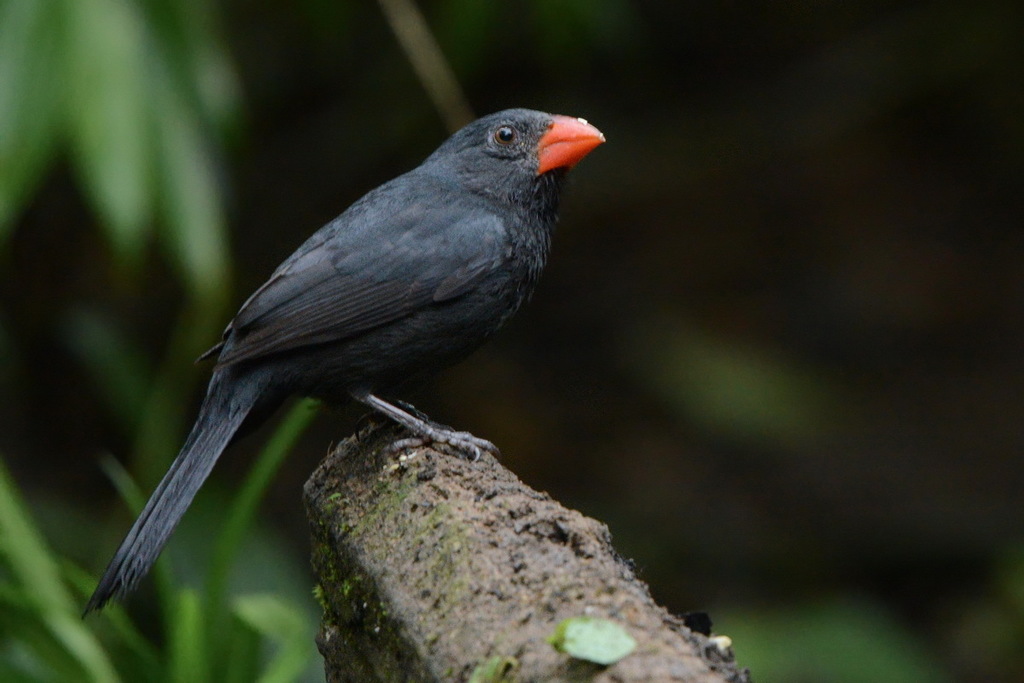
The black-throated grosbeak (Saltator fuliginosus) is a species of songbird. Traditionally placed in the cardinal family (Cardinalidae), it actually seems to be closer to the tanagers (Thraupidae) – see the genus article for details.
From the article Black-throated grosbeak on Wikipedia (CC BY-SA), quoted section by section
Description
The black-throated grosbeak is 20 cm (7.9 in) to 22 cm (8.7 in) long. The species is sexually dimorphic though the sexes are similar. Adult males are mostly deep slate-blue. Their lores, face, ear coverts, throat, and upper breast are black. Their wings are black with deep slate blue feather edges and their tail is uniformly black. Their underwing coverts are white. Adult females are overall duller than males with less blue in their upperparts and less of a contrast between the upper and lower breast. Both sexes have a dark brown iris, a bright coral-red bill, and dark gray legs and feet. Juveniles are duller and less blue than adults with sometimes a dark culmen. The species closely resembles it sister slate-colored grosbeak, which however is grayer and has less black on the face and a white throat.
Range & habitat
The black-throated grosbeak has a disjunct distribution with one large range and two small ones. Its main range is primarily in southeastern Brazil from southern Bahia and eastern Minas Gerais south to northern Rio Grande do Sul and continuing west to northeastern Argentina's Misiones Province and at least historically also into southeastern Paraguay. A small range is in eastern Pernambuco and Alagoas in northeastern Brazil and another in Goiás in south-central Brazil. There are also a few scattered records in northern Brazil. The black-throated grosbeak is a bird of the humid Atlantic Forest.
Wikipedia: “Distribution and habitat”
What it does
The black-throated grosbeak's diet has not been studied. It usually forages from the forest's mid-story to its canopy.
Wikipedia: “Feeding”
Listen
Looking for field recordings…
Where it lives
Recorded sightings
—
geo-referenced records in GBIF, from museums, herbaria and field observers.
Drag the globe to turn it. Dots are where records exist, not a range map; darker means more records.
In the stacks
Searching the stacks…
Every page naming Saltator fuliginosus in the Biodiversity Heritage Library →
This page is assembled live from iNaturalist, GBIF, Wikipedia, the Source Library and the Internet Archive. It is not yet part of the hand-edited codex. iNaturalist taxon 9851.