On eBird ↗
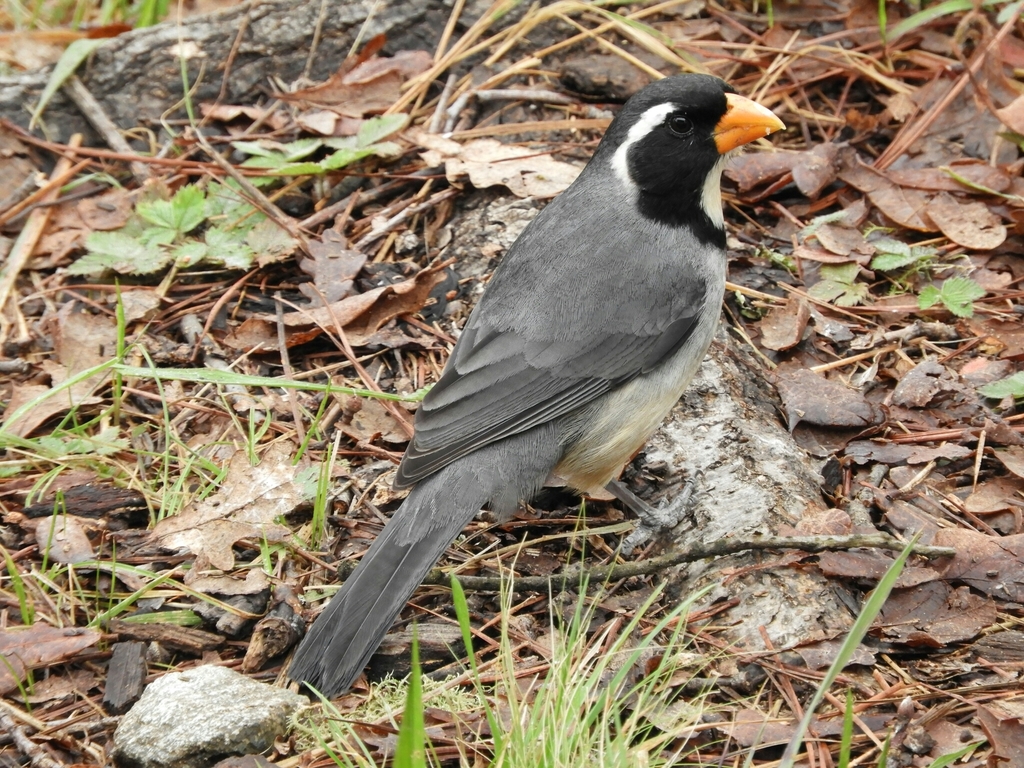
Golden-billed Saltator
Live sightings near you, the range map, bar charts of when it is seen, and Macaulay Library photos and recordings.
Golden-billed Saltator
Saltator aurantiirostris
The golden-billed saltator (Saltator aurantiirostris) is a species of saltator in the family Thraupidae. It is found in Argentina, Bolivia, Brazil, Chile, Paraguay, Peru, and Uruguay; also the regions of the southern pantanal, along the Paraguay River. Its natural habitats are subtropical or tropical dry forests, subtropical or tropical dry shrubland, subtropical or tropical high-altitude shrubland, and heavily degraded former forest.
From the article Golden-billed saltator on Wikipedia (CC BY-SA), quoted section by section
Description
The golden-billed saltator is 19 to 20.5 cm (7.5 to 8.1 in) long and weighs 33 to 55 g (1.2 to 1.9 oz). The species is sexually dimorphic. Adults of the nominate subspecies S. a. aurantiirostris have a blackish forehead, a gray crown and nape, black lores, face, and ear coverts, and a white supercilium that extends around the rear of the ear coverts. Their upperparts and wings are gray and their tail is gray with thin white edges on the outermost pair. Their throat is white with a thin black band under it that connects with the black of the face. Their breast is gray that becomes buffy on the belly and a warmer buff on the vent area. Adult females have a dusky wash on the bill. They are a dull brownish black on the head where males are pure black. Their supercilium and chin are whitish yellow-buff and they have minimal to no black under the throat. Juveniles resemble females with more of a male-like head pattern, no chest band, and a dusky bill with a yellowish tip. The other subspecies of the golden-billed saltator differ from the nominate and each other thus:
S. a. iteratus: smaller bill than nominate with a buffy white throat, a thicker black chest band, and thin white tips on the outer two pairs of tail feathers S. a. albociliaris: like iteratus but with very narrow white chin and throat patch S. a. …
Range & habitat
The subspecies of the golden-billed saltator are found thus:
S. a. iteratus: western slope of the Andes in northern Peru's Cajamarca, Amazonas, La Libertad, and Ancash departments S. a. albociliaris: Andes from Ancash and Huánuco departments in Peru south into extreme northern Chile's Arica y Parinacota Region S. a. hellmayri: Bolivia from La Paz and Cochabamba departments south to southeastern Potosí and northern Tarija departments S. a. aurantiirostris: southern Tarija in Bolivia, northern Argentina south to Buenos Aires Province, eastern Paraguay, and western Mato Grosso do Sul in Brazil S. a. parkesi: eastern Argentina's Entre Ríos Province, most of Uruguay, and southern Rio Grande do Sul in southernmost Brazil S. a. nasica: west-central Argentina from La Rioja Province south to western La Pampa Province The golden-billed saltator inhabits a variety of dryish somewhat open landscapes including montane scrublands, Gran Chaco woodlands, the edges of forest, hedges around fields, and gardens. It is found down to near sea level in eastern Argentina, Uruguay, and far southern Brazil and mostly between 1,500 and 3,800 m (4,900 and 12,500 ft) in the Andes. It reaches 4,000 m (13,000 ft) in Peru.
Wikipedia: “Distribution and habitat”
What it does
The golden-billed saltator's diet has been studied only in Argentina, where it fed primarily on seeds with smaller numbers of several types of insects. As far as is known, it usually forages in pairs.
Wikipedia: “Feeding”
Listen
Looking for field recordings…
Where it lives
Recorded sightings
—
geo-referenced records in GBIF, from museums, herbaria and field observers.
Drag the globe to turn it. Dots are where records exist, not a range map; darker means more records.
In the stacks
Searching the stacks…
Every page naming Saltator aurantiirostris in the Biodiversity Heritage Library →
This page is assembled live from iNaturalist, GBIF, Wikipedia, the Source Library and the Internet Archive. It is not yet part of the hand-edited codex. iNaturalist taxon 9847.