On eBird ↗
Greater Koa-Finch
Live sightings near you, the range map, bar charts of when it is seen, and Macaulay Library photos and recordings.
Greater Koa Finch
Rhodacanthis palmeri
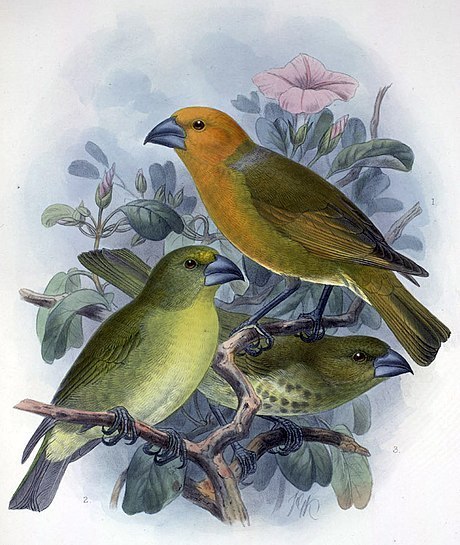
The greater koa finch (Rhodacanthis palmeri) is an extinct species of Hawaiian honeycreeper in the subfamily Carduelinae of the family Fringillidae. It was endemic to the island of Hawaiʻi.
From the article Greater koa finch on Wikipedia (CC BY-SA), quoted section by section
Description
The bird was about 7–8 in (18–20 cm) long when fully grown. It was the largest known honey-creeper, although its typical weight is unknown. The bird was sexually dimorphic; the male was brilliant scarlet-orange on head, neck, and breast, with lighter orange on its bottom, and olive brown with orange touches on back, wings, and tail; however, the female was brownish olive, and somewhat lighter below. It had a thick black bill which allowed it to break open seed pods that were found in the trees. In historical times, its range was largely confined to the Kona District of the island of Hawaiʻi, although it was observed in the Kīlauea area in 1895. It was much more widespread prior to the arrival of humans in Hawaiʻi, and related species lived on other islands. In Kona, it co-occurred with the closely related lesser koa finch (Rhodocanthis flaviceps), and the Kona grosbeak. The lesser and greater koa finches were once thought by scientists to be the minimum and maximum growth of a single species of koa finch.
What it does
The greater koa finch was a granivore, preferring the pods and seeds of koa (Acacia koa). It was also observed eating caterpillars and ʻaʻaliʻi (Dodonaea viscosa) seeds.
Wikipedia: “Diet”
Listen
Looking for field recordings…
Where it lives
Recorded sightings
—
geo-referenced records in GBIF, from museums, herbaria and field observers.
Drag the globe to turn it. Dots are where records exist, not a range map; darker means more records.
In the stacks
Searching the stacks…
Every page naming Rhodacanthis palmeri in the Biodiversity Heritage Library →
This page is assembled live from iNaturalist, GBIF, Wikipedia, the Source Library and the Internet Archive. It is not yet part of the hand-edited codex. iNaturalist taxon 9822.