- Animals
- ›Chordates
- ›Vertebrates
- ›Birds
- ›Perching Birds
- ›Old World Flycatchers, Robins, and Chats
- ›Emarginata
On eBird ↗
Karoo Chat
Live sightings near you, the range map, bar charts of when it is seen, and Macaulay Library photos and recordings.
Karoo Chat
Emarginata schlegelii
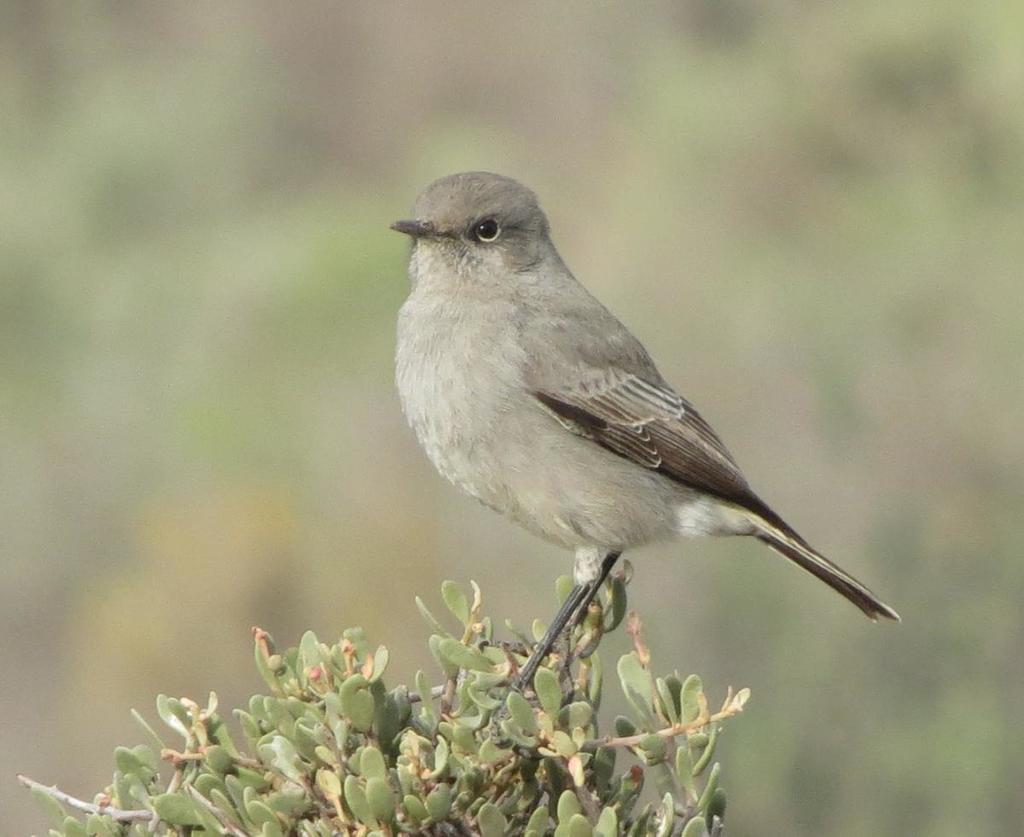
The Karoo chat (Emarginata schlegelii) is a small passerine bird of the Old World flycatcher family Muscicapidae. It is a common resident breeder in southwesternmost Angola, western Namibia and western South Africa. Its habitat is Karoo and desert scrub in the south, extending to the escarpment zone in the north.
From the article Karoo chat on Wikipedia (CC BY-SA), quoted section by section
Description
The Karoo chat is 16–18 cm long and weighs around 32 gm. Its upperparts are grey, but it has a rufous patch behind the eye, and the tail is black with white outer feathers. Its underparts are white, the short straight bill, legs and feet are black and the eye is dark. The sexes are similar, but the juvenile is spotted with buff and has scaly underparts. This species is paler than the similar grey form of the female mountain wheatear, from which it also differs in having a grey (not white) rump and completely white outer tail feathers. Its larger size and all-white outer tail feathers prevent confusion with the tractrac or sickle-winged chats. The Karoo chat has chak-chak and trrat-trrat calls.
What it does
The Karoo chat builds a cup-shaped nest of straw and leaves on the ground, usually under a bush or shrub. It lays two to four green eggs. This species is monogamous, mating for life. The Karoo chat is usually seen singly or in pairs. It forages from the ground for insects including butterflies, bees, wasps, locusts and ants. Prey is typically taking in a short flight.
Wikipedia: “Behaviour”
Listen
Looking for field recordings…
Where it lives
Recorded sightings
—
geo-referenced records in GBIF, from museums, herbaria and field observers.
Drag the globe to turn it. Dots are where records exist, not a range map; darker means more records.
In the stacks
Searching the stacks…
Every page naming Emarginata schlegelii in the Biodiversity Heritage Library →
This page is assembled live from iNaturalist, GBIF, Wikipedia, the Source Library and the Internet Archive. It is not yet part of the hand-edited codex. iNaturalist taxon 980210.