On eBird ↗
Amami Thrush
Live sightings near you, the range map, bar charts of when it is seen, and Macaulay Library photos and recordings.
Amami Thrush
Zoothera major
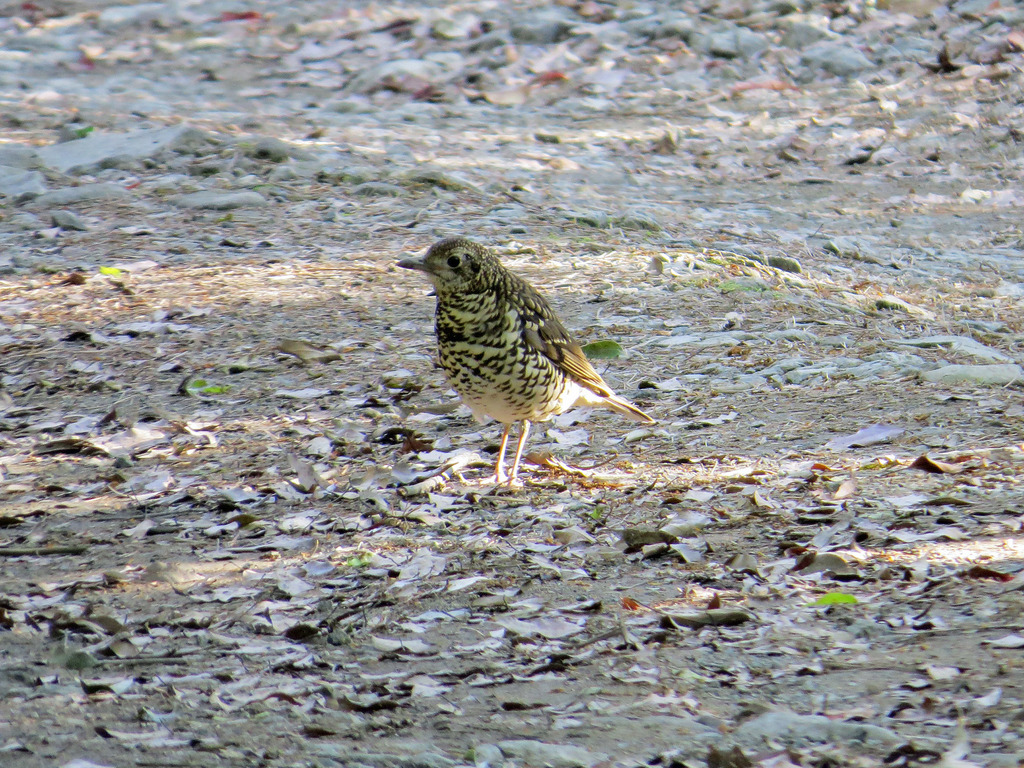
The Amami thrush (Zoothera major) is a member of the thrush family Turdidae. It is endemic to the islands of Amami Ōshima and Kakeroma island in the northern Nansei Islands of Japan.
From the article Amami thrush on Wikipedia (CC BY-SA), quoted section by section
Description
This large, heavily patterned thrush is similar in appearance to the scaly thrush, to which was considered a subspecies. It has warm olive-brown to buff upperparts and whitish underparts with heavy black scaling. It has twelve tail feathers. The scaly thrush is smaller and has fourteen tail feathers. It has a cheerful song similar to the Siberian thrush. The Amami thrush ranges in length from 29 to 31 cm (11 to 12 in) and weighs approximately 172 g (6.1 oz). Among standard measurements, the wing chord is 16.4 to 17.3 cm (6.5 to 6.8 in), the bill is 3.1 to 3.3 cm (1.2 to 1.3 in) and the tarsus is 4.1 to 4.5 cm (1.6 to 1.8 in).
What it does
Its breeding habitat is mature subtropical broadleaved evergreen forest around humid valleys. Its diet includes invertebrates and fruit. It breeds in May and June, laying 3-4 eggs.
Wikipedia: “Behaviour and ecology”
Listen
Looking for field recordings…
Where it lives
Recorded sightings
—
geo-referenced records in GBIF, from museums, herbaria and field observers.
Drag the globe to turn it. Dots are where records exist, not a range map; darker means more records.
In the stacks
Searching the stacks…
Every page naming Zoothera major in the Biodiversity Heritage Library →
This page is assembled live from iNaturalist, GBIF, Wikipedia, the Source Library and the Internet Archive. It is not yet part of the hand-edited codex. iNaturalist taxon 980041.