On eBird ↗
Pantepui Thrush
Live sightings near you, the range map, bar charts of when it is seen, and Macaulay Library photos and recordings.
Pantepui Thrush
Turdus murinus
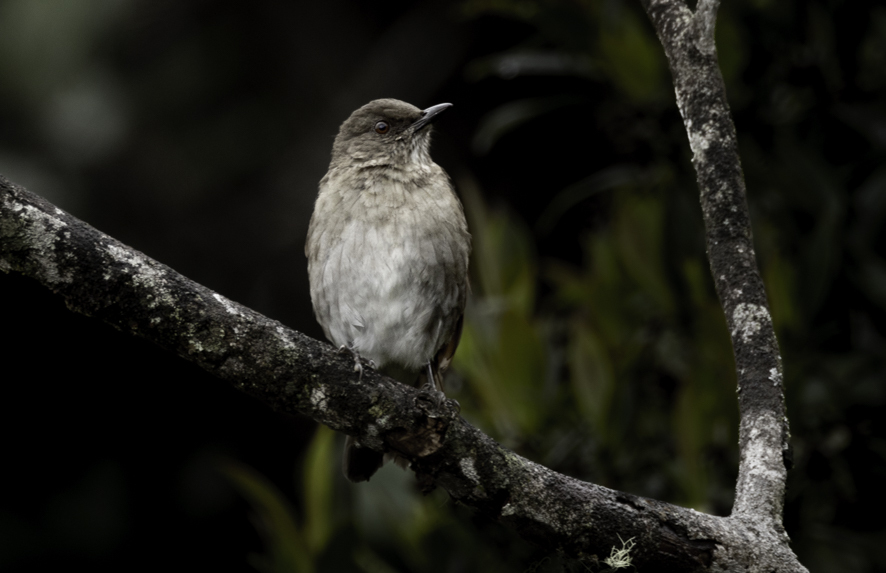
The Pantepui thrush (Turdus murinus) is a bird in the genus Turdus native to the Amazon biome. It was previously considered conspecific with the black-billed thrush.
From the article Pantepui thrush on Wikipedia (CC BY-SA), quoted section by section
Description
The pantepui thrush is about 20 cm (7.9 in) long and weighs 52 to 81 g (1.8 to 2.9 oz). The sexes have the same plumage. Adults have a mostly dusky-brown head with a white-streaked throat. Their upperparts, wings, and tail are dusky-brown. Their breast and upper flanks are a much paler dusky-brown than their upperparts. Their belly is dark ash-gray and their lower flanks and undertail coverts white. They have a dark brown iris, a black bill, and dark gray to blackish legs and feet.
Range & habitat
The pantepui thrush is found on the lower slopes of tepuis in the southeastern Venezuelan states of Bolívar and Amazonas, in far western Guyana, and in extreme northern Brazil. The tepuis include Cerro Duida, Cerro Roraima, the Merumé Mountains, Auyán-tepui, Ptari-tepui, Sororopán-tepui, Cerro Urutani, Cerro de la Neblina, Cerro Yavi, Cerro Guanay, Cerro Camani, and Cerro Guaiquinima. The species' habitat has not been extensively studied. However, it appears to favor the edges of humid forest and early successional areas.
Wikipedia: “Distribution and habitat”
What it does
The pantepui thrush's diet and foraging behavior have not been studied. They are assumed to be similar to those of the black-billed thrush, which see here.
Wikipedia: “Feeding”
In human culture
The generic name Turdus is derived from Latin, meaning "thrush", and the specific epithet murinus comes from the Latin term for "mouse-gray".
Wikipedia: “Etymology”
Listen
Looking for field recordings…
Where it lives
Recorded sightings
—
geo-referenced records in GBIF, from museums, herbaria and field observers.
Drag the globe to turn it. Dots are where records exist, not a range map; darker means more records.
In the stacks
Searching the stacks…
Every page naming Turdus murinus in the Biodiversity Heritage Library →
This page is assembled live from iNaturalist, GBIF, Wikipedia, the Source Library and the Internet Archive. It is not yet part of the hand-edited codex. iNaturalist taxon 980028.