On eBird ↗
Chestnut-breasted Mountain Finch
Live sightings near you, the range map, bar charts of when it is seen, and Macaulay Library photos and recordings.
Chestnut-breasted Mountain-Finch
Poospizopsis caesar
The chestnut-breasted mountain finch (Poospizopsis caesar) is a species of bird in the family Thraupidae. It is endemic to Peru. Its natural habitat is subtropical or tropical high-altitude shrubland.
From the article Chestnut-breasted mountain finch on Wikipedia (CC BY-SA), quoted section by section
Description
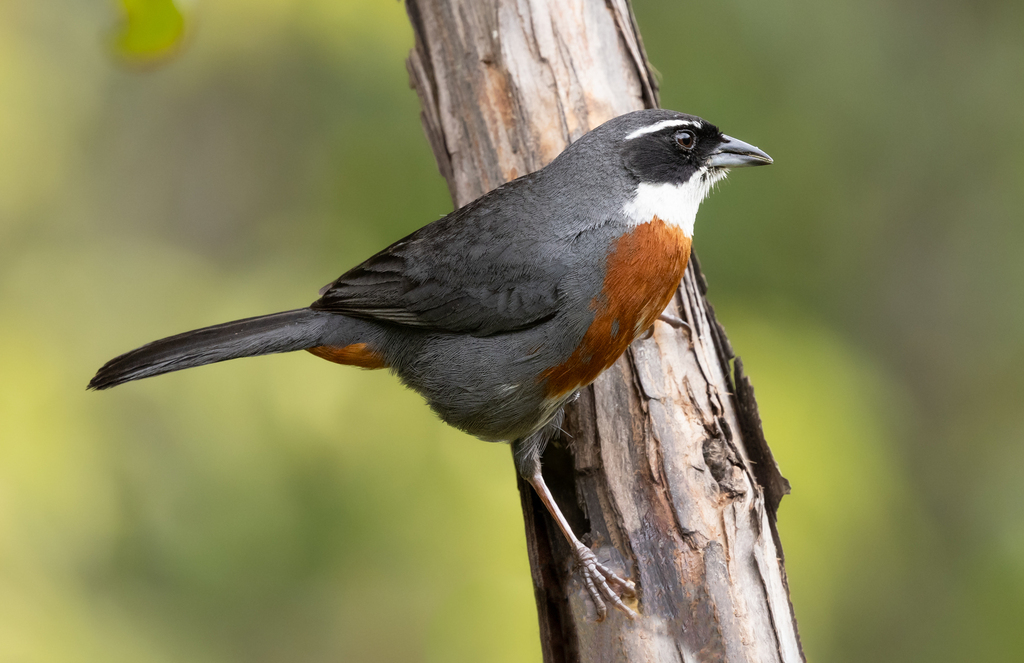
The chestnut-breasted mountain finch ranges from 17 to 18.5 centimetres (6.7 to 7.3 in) long, with its wings around 8 centimetres (3.1 in) long. Both sexes look similar, consisting of a gray upperpart with the lore and auricular feathers colored black. They are separated from the crown by a distinctly white supercilium. Its throat is colored white and the breast is colored rufous with the feathers with pale buff tips following a fresh plummage. The flanks are colored a gray-brown. The middle underside is colored white while the rear underside is colored rufous. Juveniles look fairly similar to adults, excluding predominantly gray or black areas where those are tinged with a brown, along with a buff tinge on the throat. The irises of the chestnut-breasted mountain finch are a brown to dark brown. The bills are black at the maxilla, gray or black at the mandible, and a small gray area at the base of the beak. Its tarsi and toes are a dark gray. The song of the chestnut-breasted mountain finches is described as "a chirping warble lasting two-to-three seconds and repeated some 10 seconds intervals", similar to the song of the golden-billed saltator found in the same area but featuring more complex and buzzy notes. No nonvocal sounds have been recorded. It has a generation length of 3.69 years.
Range & habitat
The chestnut-breasted mountain finch is endemic to Peru, where it has been confirmed to be in the departments of Apurímac and Cusco. It is present in intermontane valleys ranging from 2,900 to 3,900 metres (9,500 to 13,000 ft) above sea level, mostly found in shrubland in said valleys.
Wikipedia: “Distribution”
What it does
The chestnut-breasted mountain finch, in contrast to other members of Poospiza which are arboreal, forages on the ground, remaining close to the cover of shrubs. They typically sing on low to the ground, but may ascend higher into trees during territorial disputes. They are either found solitary or in pairs, but occasionally associates with mixed species flocks which contain other species of finches. Regarding breeding, not much is known about the species on seasonality or their nest and eggs, with only a male being collected in breeding condition in April 2011. With no data being collected on the diet of the chestnut-breasted mountain finch, it is presumed that the diet contains a mixture of seeds and arthropods.
== References ==
Wikipedia: “Behavior and diet”
Listen
Looking for field recordings…
Where it lives
Recorded sightings
—
geo-referenced records in GBIF, from museums, herbaria and field observers.
Drag the globe to turn it. Dots are where records exist, not a range map; darker means more records.
In the stacks
Searching the stacks…
Every page naming Poospizopsis caesar in the Biodiversity Heritage Library →
This page is assembled live from iNaturalist, GBIF, Wikipedia, the Source Library and the Internet Archive. It is not yet part of the hand-edited codex. iNaturalist taxon 979915.